'MBA sent me to Sweden headquarters'
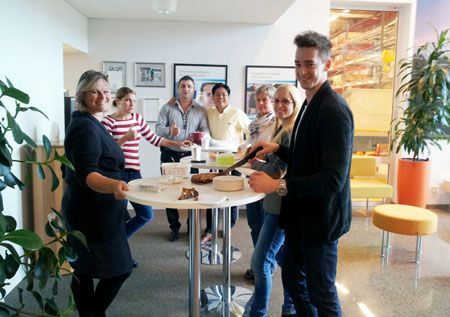
Bae Jong-hun, center, the Asia-Pacific regional manager of Atlas Copco, poses with his colleagues at the firm’s headquarters in Stockholm, Sweden, in this December 2012 photo. / Courtesy of Bae Jong-hun
By Kim Da-ye
For Koreans who aspire to work at the headquarters of global companies, completing an MBA at leading business schools in the U.S. or Europe has been considered a fast track to achieving their ambition.
When Bae Jong-hun, the Asia-Pacific regional manager of Swedish heavy equipment maker Atlas Copco, wanted to get transferred to headquarters, he also chose to study an MBA. Instead of going abroad, however, he opted for a part-time evening course taught in English at the KDI School of Public Policy and Management.
After finishing the two-year course at the education branch of the state-run Korea Development Institute (KDI), Bae did move to Atlas Copco’s headquarters in Sweden. He is now back in Korea as business manager for the whole Asia Pacific region, which includes Korea, China, Japan and Southeast Asian countries. He oversees the region’s sales, inventory and production, and reports to the vice president of the company’s headquarters in Sweden.
Bae said his career jump might have been impossible without his master’s degree in business administration.
“We hold a meeting on mergers and acquisitions every week. Meetings tend to be full of abbreviated business terms such as EBITDA or ROI. We also discuss the right value of the companies we want to acquire. An engineering school graduate like myself wouldn’t understand such words. After doing an MBA, I can actually understand them all,” Bae said.
“Doing an MBA wasn’t just helpful. It was a decisive factor in my career move. And it was important that the program was taught in English as the terminology in Korean would be completely different.”
Bae, who majored in energy resource engineering at Inha University, started working for Atlas Copco in 1989. In 1999, he quit the firm in order to study in the U.S., but his studies did not last long as he was instead persuaded to join a mine development project in Central America. After spending three years on the other side of the world, he came back to the Korean office of Atlas Copco as a business line manager. He wished to move to headquarters, and doing so required an MBA, Bae said.
Atlas Copco is a major industrial equipment manufacturer with 2012 sales of 90.53 million Swedish kroner (15.4 trillion won) and operating profit of 19.23 million kroner. The firm was chosen earlier this year as one of the most sustainable companies by research firm Corporate Knights in its Global 100 list presented at the World Economic Forum in Davos, Switzerland.
Bae chose to study at KDI because the state-run institution, a training ground for government officials, was at that time the only school with an evening MBA program taught in English. He learned about the school through officials at the Ministry of Knowledge Economy he worked closely with.
The MBA program was abolished in 2009 when “moral hazard” among the faculty was publicly criticized. It is claimed that complaints from private universities against the school played a bigger role in ending the program. The KDI’s MBA program had been ranked one of the best in the country, and was highly popular for its low tuition fees. Private universities are claimed to have protested that taxpayers’ money shouldn’t be wasted on providing a business education to only a few. Although the MBA program disappeared, its curriculum survived under a new course named the Master’s of Public Policy.
At KDI, lectures started at 7 p.m. and ended at 10:30 p.m. Monday to Saturday at the Korea Advanced Institute of Science and Technology (KAIST) campus in northern Seoul. Students could design their own schedule according to the subjects they chose. When there was a lot of homework to be done, students would stay until 1 or 2 a.m. Even on weekends, classmates gathered to study together or do group homework, Bae said.
“I feel like I lived in the library for two years. Because of so much homework, some classmates lived in the dormitory located on the KAIST campus. They went to work directly from there,” Bae recalled.
Finishing his degree while working was possible because of Bae’s employer’s support. Atlas Copco paid 70 percent of his tuition fees and allowed him to leave work at 4 p.m. As a manager, he could also manage his own time. Furthermore, the then head of the Korean office was a foreign executive who understood such circumstances.
Bae said he was very satisfied with the MBA program at the KDI. One advantage was the low fees of 14 million won (around $13,000) a year. Considering that price, the KDI’s faculty, many of whom had taught in the U.S., was outstanding, Bae said. The faculty member he best remembers is Chang Yu-sang, professor of operation management. Chang taught at Boston University for some 40 years, and returned to Korea in 2001, teaching at Korea University and serving as a non-executive board member at the Doosan Group.
Bae also boasted of KDI’s alumni network, which consists of many civil servants. He said a large portion of the student body were elite government officials who had passed the higher civil service exam. In addition, he met government officials from developing countries who came to study at the KDI on scholarships provided by the Korea International Cooperation Agency (KOICA).
“The KDI has a great network of Korea and foreign government officials. When I needed some documents about the Philippines, I requested them from an official at the Philippine government whom I met at the KDI,” Bae said.
In his office, Bae keeps all the study materials he received during the MBA course in green folders. He reviews them whenever he needs to revisit what he learned at the KDI.
Since he became a regional business manager, Bae said he is responsible for merger and acquisitions (M&As) and investments in the region. Atlas Copco, Bae said, carries out around 10 M&A deals each year. He couldn’t comment on specific deals under a non-disclosure agreement.
Bae said he received an M&A manual from headquarters, and the content was exactly the same as what he learned at the school.
“After working in the field, I come back and review the materials. Many parts are the same. I actually use at work a lot of things I learned at the school. The courses were very practical,” Bae said.