To be global leader in infant products
Agabang CEO Gu Bon-chul to aggressively expand overseas
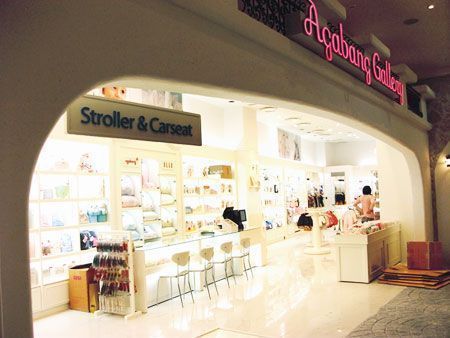
Shown above is an Agabang Gallery store where all brands of Agabang & Company are offered in Hwaseong, Gyeonggi Province. / Courtesy of Agabang & Company
By Kim Tae-gyu
Agabang & Company has been leading the infant clothing and accessories industry in Korea during the past decades. Now, the company aims to duplicate its success overseas.
In a recent interview with Business Focus, Agabang CEO Gu Bon-chul, who has been with the Seoul-based company since 1985, said that it expects double-digit growth in the international market this year with its flagship brands, including Agabang, Ettoi and Dear Baby.
“We racked up $32 million in the offshore markets last year and aims to crank up the figure to $36 million this year and $45 million in 2015,” Gu said.
“It is just a small fraction of our annual sales amounting to some $200 million. In the long run, however, the proportion would reach around a third based on our brisk global activities.”
International sales of Agabang peaked in 2007 at $54 million. Since 2008, this amount has been shrinking because of the global financial crisis. Agabang’s global revenues fell below $30 million in 2011, but increased to $35 million last year.
“We have operations in the United States, China, Vietnam and Mongolia. Last year, we made an inroad to the Middle East through cooperation with a United Arab Emirate retailer Landmark,” the CEO described.
“In particular, the Chinese business expanded by about 30 percent in 2012 and the growth rate would be also in the vicinity of 30 percent this year. Plus, we vie to wade into the European markets.”
Original design manufacturer (ODM) is one of the major overseas business formats of Agabang under which the firm designs and makes products retailed under the brand names of other companies.
It promises better profitability than original equipment manufacturer (OEM) that rolls out products or components for others but does not design them.
“Eventually, we will make a foray into world markets with our own brands,” he said.
Eight pockets, one mouth
Korea is one of the fastest-aging societies in the world, with the lowest birthrate among the Organisation for Economic Cooperation and Development (OECD) countries. Its fertility rate, which is the average number of children a woman is expected to have in her lifetime, is around 1.2, and for its capital, Seoul, below 1.
These statistics should signal a disaster to infant clothing and accessories companies such as Agabang, but Gu disagrees: “In the 1980s, more than 800,000 babies were born a year but the figure has halved to just above 400,000 of late. But the market for children’s clothing continued to get bigger over the span.”
“The tendency is projected to continue down the road as parents spend more for their children. Although the birthrate does not double overnight, the market size will keep expanding.”
Gu noted that the “eight pockets, one mouth” trend will help Agabang improve its bottom line in the domestic market.
“It was six pockets and one mouth in the past because two parents and four grandparents shelled out big bucks for a single kid at one-child households,” Gu said.
“Currently, maternal and paternal aunts join so as to make it eight pockets and one mouth, which demonstrates how Koreans are ready to spend big money for their children to benefit corporations like us,” he added.
Challenges ahead
Agabang currently has the largest market share in infant clothing and accessories in Korea and has been vigorously expanding overseas.
However, the increasing globalization presents additional challenges. For one, foreign brands such as Chocolat, Gap, Polo, Stokke and Quinny, as well as discount chains’ private brands, pose a big threat to Agabang.
“In the case of the market for children gear like baby carriages, foreign brands are more competitive. The baby clothing markets would also see an increasing number of foreign brands,” Gu acknowledged.
Upcoming star products
In 2008, Agabang signed a contract with a state-backed research institute, in order to secure permission to use a natural herb extract blend called NHEB-05. The substance is a blend of natural botanical extracts, which have been found to be effective in retaining moisture in the skin.
With NHEB-05, Agabang developed a line of skin products, including creams, lotions, shampoos and soaps, which the company claims protect the skin better from free radicals.
“The premium skin care is our next-generation growth engine not only in Korea but also in foreign countries. We plan to market them across the world starting this year.”
Under the brand name Putto, the company has been selling its NHEB-05 products in the world markets where it has been getting positive feedback for its ability to alleviate skin conditions such as atopic dermatitis and allergic rhinitis.
According to the company, the entire Putto line does not contain ingredients like colorants, alcohols or preservatives, which have been shown to irritate skin.
“It brings back the health to baby’s delicate and sensitive skin. Its scare relief ingredients and other substances change the dry and itchy baby’s skin to soft and moist one,” Gu said.
“As the number of babies and even adults suffering atopic dermatitis rises, the product would continue to gain grounds. It already substantially underpins our financial performances.”
Putto generated 3 billion won in domestic sales in 2010. This figure increased to 7 billion won in 2011 and 10 billion won last year.
“This year, the domestic sales of Putto are expected to reach 20 billion won, a feat that we will achieve without any big marketing campaigns or advertisements. Word of mouth will boost the sales,” Gu explained.
Putto is presently available in 10 countries, namely Russia, the United States, Australia, Hong Kong, Taiwan, Thailand, Singapore, Vietnam, Malaysia and Turkmenistan. Agabang plans to expand the line to European and Middle Eastern countries this year.
“In Europe, such global behemoths as Nivea and Johnson & Johnson rule the markets. It would be hard to take the giants head on from the very beginning,” he said.
“We will carve out the niche in the early stage. As consumers show affections to Putto, we think we will be able to do so.”
In addition to market expansion, Agabang also plans to diversify Putto’s product portfolio.
“Putto, which is quite expensive, targets children aged less than three and we will come up with affordable Putto Therapy, which will attract children aged three and above,” Gu said. “They are star products in the making.”
Agabang maintains around 700 stores in Korea and some 150 in overseas markets, mostly in China. The firm, which soared to market supremacy instantly after its debut in 1979, has introduced unique forms of outlets dubbed Agabang Gallery and Next Mom.
In Agabang Gallery, all the products of Agabang & Company are available including Agabang, Dear Baby and Ettoi. In Next Mom, imported products are added to the lineup on top of the three brands.
As of the end of last month, the company had 11 Agabang Gallery stores and six Next Mom outlets in Korea.