Getting to know what's ahead in 2013
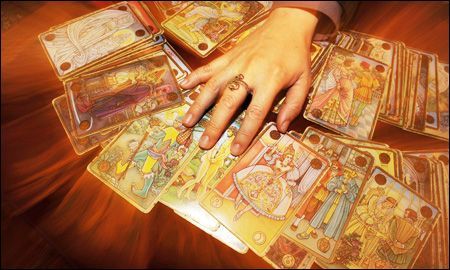
Tarot cards which are used for fortune telling are spread on the table. / Korea Times photo by Shim Hyun-chul
What to expect from different types of fortune tellers
By Chung Hyun-chae
Shaman Yong-goong
Saju scholar Kim Jae-geun
Tarot card reader Yoon Hye-rim
The New Year Bell rang 33 times and the sun rose on the first day of 2013. During this time people made plans for the year ahead. As the beginning of a year has the power to make people keep promises to themselves for at least three days, heavy smokers set the goal of kicking the habit and regular drinkers abstain from alcohol. Some people do one other thing ― they head to fortune tellers.
While people tend to be curious about their future all the time, now is the time that people strongly want to know what the year is going to be like and how they will fare.
In Korea, there are several types of fortune tellers including oriental ones such as shaman and those specialized in “saju”, which means the four pillars that support one’s life, and western-style practitioners such as tarot card readers.
Fortune tellers in the same category are different from each other. Regarding shamans who are said to be possessed with spirits, there are 12 different primary spirits including that of a grandmother, a general and a child, according to Yong-goong, a shaman at “Funny Sculptor,” a coffeehouse of fortunetellers, often called a “saju cafe,” in the Apgujeong area in southern Seoul.
People often regard shamans as strange and eerie. Contrary to popular belief, the shaman at “Funny Sculptor” was not that scary. They were rather friendly and sociable compared to those in their own sanctuaries, probably because the venue is well known among the young and was covered many times by the media.
Shaman Yong-goong is one of the most sought-after fortune tellers there. “I went through a tough time after being possessed by a grandmother spirit, and after that experience, I received the gift of seeing part of one’s future,” said the shaman.
“What I’m saying is that I can only see limited scenes just like movie. I admit I can’t make perfect predictions while it is hard to explain the probability in numbers. I just provide a rough outline and direction to those who visit me.”
Yong-goong added that she is specialized in foretelling love relationships and each shaman has his or her own special talent.
Yoon Hye-rim is a tarot card reader, another type of a fortune teller at Funny Sculptor. Tarot cards are totally different because it is a western way of telling the future. It derives from the theory of synchronicity by psychologist Carl Jung. Jung firstly explained the link between a message coming from the subconscious and the symbols on the tarot cards. Simply put, tarot card readers literally read people’s minds with psychological tools.
“We provide a kind of translation service and counseling at the same time. By looking into people’s minds, I can present the direction or path of their lives. I can say this work is by and large comparable to a healing process,” Yoon said.
For example, this reporter picked a card featuring a tender flower blooming on a rock and Yoon asked how the reporter felt about the picture. She gains insight into people’s minds this way. In the tarot-card case, readers’ ability of interpreting and counseling matters. One tarot card reader may interpret the card negatively, saying that the client’s future is unfortunate like a lonely flower blooming on the rock, while the other may say that the client is set to face a bright future like a beautiful rose in a splendid garden.
Another feature of fortune telling with tarot card reading is their active participation. “People choose the cards themselves. It is different to just listening to what fortune tellers say,” Yoon said.
The last kind of fortune telling, the Four Pillars of Destiny or saju, is claimed by some to be an academic discipline even though this is yet to be scientifically proven.
“The Four Pillars of Destiny was once a subject in the state examination a long time ago in Eastern countries. It is based on the premise that humans are a small universe inside a giant universe and that they receive the energy of nature when they are born,” Kim Jae-geun, a fortune teller ― and a scholar ― at the Woon Gwan fortune teller house, said.
Kim said fortune tellers need one’s date of birth and the exact time to predict the remainder of one’s life. Kim publishes “Today’s Fortune” in The Chosun Ilbo, a Korean-language daily newspaper.
“I write Today’s Fortune which is only decided by the date of birth. There are so many people who were born on the same day, even at the same time, of course. It is just a work of probability and therefore it is desirable to consider Four Pillars of Destiny as a point of reference,” Kim said.
“Without any information, life seems so uncertain and scary, but people can prepare to deal with something or seek and develop something good by asking fortune tellers what their futures hold.”
Interestingly, three fortune tellers interviewed shared a common belief: One should not have blind faith in destiny.
We are all anxious to know our future and sometimes desire to be lucky but we all know deep in our minds that the future is what we make it, not something given. Stuart Vyse, the author of the book “Psychology of Superstition,” also said that believing in certain behavior brings luck and making efforts to do so leads to positive results. Fortune tellers can be our helpers or counselors who provide some direction throughout the journey of our lives.