Currency war in waiting
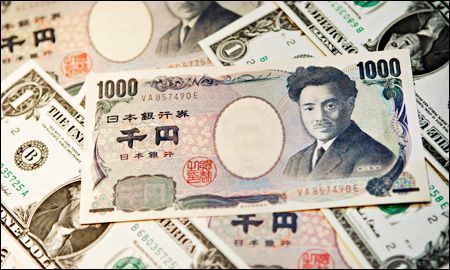
Will Korea fight back to protect exporters?
By Kim Da-ye
QE1 + QE2 + QE3 = So far nearly $2.5 trillion injected
The landslide election victory of Japan’s conservatives has been interpreted by many Korean media outlets as signaling an escalation of the global currency war.
Shinzo Abe of the ultra conservative Liberal Democratic Party pledged to have the Bank of Japan print an unlimited amount of money in order to end deflation and buoy the stagnating economy.
Even before Abe proves if he can persuade the central bank to do this, the value of the yen has been dropping. Between Nov. 21 and Dec. 21, the yen lost its value 2.1 percent against the dollar, with the exchange rate rising to 84.11 from 82.36. During the same period, the Japanese currency also lost its value 3.1 percent against the won.
As further depreciation of the yen is expected to hurt Korea’s exports, Korea knows that the country cannot let the value of the won rise freely. The clash between developed economies’ struggle to recover and developing countries’ efforts to keep their exports competitive is an archetypal battle in the second round of the global currency wars.
Competitive devaluation?
Brazilian finance minister Guido Mantega who coined the term, currency wars in 2010, is the first person to publicly describe another round of quantitative easing by the U.S. and Japan in 2012 as a further currency war.
Bank of England Governor Mervyn King confirmed the fears in a speech to the Economic Club in New York on Dec. 11, saying, “In 2013, we will see the growth of actively managed exchange rates as an alternative to the use of domestic monetary policy.”
This year’s — or next year’s — version of a currency war differs from the previous one for which the 2010 G-20 Seoul Summit attempted to find a solution.
The 2010 version was a fight between the U.S. vs. China — the U.S. pressed China to stop controlling its currency, arguing that the undervalued Chinese yuan was behind China’s trade surplus with the U.S.
Now in 2012, China is no longer a major player. Those to benefit from the devalued currencies are the developed countries that struggle to recover from the crises and the victims are the emerging markets that see unwanted excessive liquidity flowing in.
Critiques of quantitative easing by the U.S. Federal Reserve argue that the excessive liquidity did little to the U.S. domestic economy but caused the values of other countries’ currencies to rise, hurting their exports and distorting financial markets.
The existing definition of a currency war as a “competitive devaluation” may not fully suit the current one. The major players’ reason for increasing money supply is to prop up their domestic consumption and investment rather than promoting exports. Those countries appear to be irresponsible rather than intentional.
The U.S., for instance, had supplied $2.35 trillion into the market through the first two phases of monetary easing, and is buying assets worth tens of billions of dollars a month until the unemployment rate improves.
European Central Bank Governor Mario Draghi has also promised that the institution would buy an unlimited amount of bonds issued by European countries in crises including Spain and Italy.
The U.K. is no exception having carried out a quantitative easing of 376 billion British pounds.
However, when the impacts of monetary easing gradually diminish, countries may more actively seek exports for growth.
Korea under pressure
The devaluation of the yen alone cannot undermine Korea’s exports because the gap between the qualities of Japanese and Korean products has shrunken, said a report released by Institute for International Trade a day after the election of the Liberal Democrat Party.
The report said that the problem is the devaluation of the yen and the appreciation of the won taking place at the same time. “If the phenomenon continues for a considerable time, Korea’s competitiveness in exports in the global market will greatly weaken,” the report said. A survey found that 41 percent of 789 domestic firms had similar concerns.
Korean exporters have, in fact, benefited for a while from the appreciation of the yen and the massive earthquake that hit Japan’s major industries. Automobile, steel, machinery and shipbuilding sectors are expected to face steep competition from Japanese manufacturers.
In the case of the automobile sector, concern over the weakening yen has caused drops in the stock prices of Kia Motors and Hyundai Motor. Korea Investment & Securities analyst Suh Sung-moon said in his latest report that such worries are exaggerated.
Suh said that exchange rates’ impact on the sales of Korean automobiles would be limited because the manufacturers increasingly produce locally in overseas markets. The portions of exports in Hyundai and Kia’s total sold vehicles have been going down fast since 2005. That of Hyundai dropped to 28 percent this year from 45 percent in 2007 while that of Kia fell to 40 percent from 63 percent.
The same has happened to Japanese automotive makers. According to Suh’s report, the exports accounted for 18.2 percent of Japanese automotive companies’ total sales in the first half of 2012, compared to 28.7 percent in 2008.
What can Korea do?
The value of the Korean won is rising fast. After hitting a peak for the year at 1,184 won against the dollar on May 24, the exchange rate has descended to as low as 1,072 won last Monday.
As the won is a floating currency, the government is believed to be carrying out so-called “smoothing operations,” the action of interfering in the market to prevent dramatic fluctuation of the won.
Last month, the finance ministry began regulating the portion of forward exchange against a bank’s own capital in order to reduce the supply of dollars in the market and boost the exchange rate. However, the measure did little to prevent the value of the won from dropping further.
Park Geun-hye of the ruling Saenuri Party was elected the president last Wednesday, and the media and economists now speculate what her policy on the exchange rate would be like.
It is generally known that the Korean government has promoted devaluation of the won to help domestic exporters. Such policies are argued to have helped large conglomerates to expand globally but made the public suffer from inflation.
Because Park pledged to move away from pro-conglomerate policies as part of her “democratization of economy” plan, market observers say that the next government isn’t likely to actively keep the value of won low.
At the same time, the new administration cannot afford to ignore exports that accounted for half of the country’s gross domestic product (GDP) in 2011.
Huh In, research fellow at Korea Institute for International Economic Policy, said that Korea, like other developed countries, has the monetary policy as an option. Manipulating exchange rates or regulating the financial market would appall other countries as well as foreign investors.
The environment isn’t too negative about more expansionary monetary policies. The central bank has kept the key interest rate at 2.75 percent for the last two months while the rate is nearly zero in the developed economies. The consumer price index — controlling inflation is the central bank’s key responsibility — rose 1.6 percent in November from the same month in 2011, compared to 2.1 percent increase in October, although there are various media reports that steep price hikes are planned at the end of the presidential election campaign.
“Limiting the inflow of liquidity is a difficult job. Tough measures would make foreign capital leave but a cautious approach has proved to have little impact on the influx of foreign money,” Huh said.
“What Korea can ultimately do to prevent a too-strong won will be an easing of monetary policy. But changing the policy just for the value of the won may be too dramatic. We should look at the domestic situation to see if it can accommodate such a measure. It seems the government is still concerned with price hikes in both public and private sectors planned after the election.”