'Working with diverse team wasn't easy at the beginning'
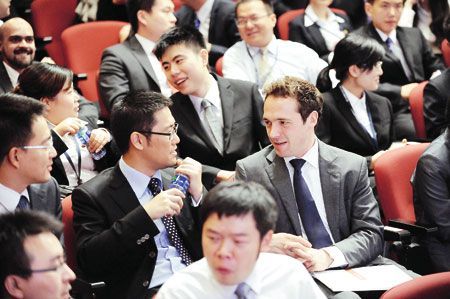
Sebastian Thomas Schmitz, right on the second row, a first-year MBA student at CEIBS, talks to his classmates at the school’s opening ceremony in the Shanghai campus in this photo taken in July this year. / Courtesy of Sebastian Thomas Schmitz
During the last six months, Sebastian Thomas Schmitz from Germany has been studying at the China Europe International Business School (CEIBS). He worked at a corporate finance boutique in Frankfurt for five years before moving to Shanghai, China to study for an MBA. He has a degree in business administration from the University of Munster.
Why did you choose CEIBS?
For five years, I was working at a corporate finance boutique that advises on mergers and acquisitions in the energy sector. We had several projects with private equities and I found this work even more challenging and interesting. In investment banking, you normally advise your customers when they want to buy and sell. I was always interested in what happens after the transaction, so I wanted to switch the career from investment banking to private equity. What I was missing were general management skills, so I thought it might be a good idea to take a break and do an MBA for a year or two.
I had to think what I can get from doing an MBA. One was improving my general management skills — how to motivate others and how to work in a team. The next point was access to the network, and the other was the chance to get to know a new culture and a new language. Most of my former colleagues went to the United States to do their MBAs, but I chose Asia, after considering the three factors, especially the third one. The package that CEIBS offers is better than any other business school.
Has the school met your expectations in the last six months?
There is much more work than expected because the first two terms are very intense.
What I found difficult at the beginning was that the school is very international with students from all over the world and most of our assignments have to be done in teams. When you have team members from different nationalities, cultures and backgrounds, it’s difficult to reach the common understanding of how you approach a task and come up with solutions. In the beginning, we needed some time to get used to working in cross-cultural teams. It is one of the best things you can learn here because it really gives you the chance to work with Indians, Chinese, Americans, Koreans, Japanese and more. Each person approaches the task differently, and once you are open to it, you can benefit from different viewpoints.
Are you learning Mandarin?
The school wants us to learn Mandarin, and we have to pass an exam. While the classes are taught in English, the language is very important if you want to stay and have a career here in China.
How is it for a German and other Europeans to live in Shanghai?
I lived in Frankfurt, a German city with half a million inhabitants, for five years, and Shanghai, in comparison, is a huge city with so many possibilities. I am surprised how international the city is. There are many expats living here, and depending on where you go, you might think you are actually in a European city. Of course, I want to get to know the Chinese parts of the city, and the best way to find them out is through being with Chinese students.
What have you liked the most about the program so far?
My classmates; we have interesting classmates from different industries, countries and background.
In terms of courses, economics we learn here is different from what I learned in Germany during undergraduate years. The professor focuses on the Chinese view point, and things look different from the Chinese point of view.
For example, in case of the the currency issues, the U.S. side says that China has to appreciate the currency so that the U.S. becomes more competitive in trading with China. I’ve always learned the Western point of view, and when you learn China’s perspectives, you will have other types of argument.
The course also teaches how China solved problems during the economic crisis in 2009 — how the government adjusted fiscal and monetary policies to meet the upcoming challenges. You don’t learn it in Western universities.
What are your future plans?
I would like to work for a Chinese private equity firm. I don’t know if I will stay here forever, but I would like to stay longer after finishing the MBA. If I do not find a job here — because I am not fluent in Mandarin, but this will be absolutely no problem because Germany and Europe have a huge demand for people that know the Asian markets well, especially China.
What can the applicants to CEIBS and those already accepted to the school prepare?
The application process was straightforward, and it isn’t very different from those for schools in the U.S. All international students are required to submit a GMAT score. I think the essay was very important. You have to write about why you chose the school, why you want to come to China and what challenges you faced in your work life and how you solved them. They want to see who you are as a person. You should spend some time and be very open about yourself.
For those who have already been accepted by the school, for students who never worked in the financial industry before, accounting is very challenging to learn in a short period of time.
Anything you’d like to add?
The school really gives you the chance to work with different people. It’s an experience, which you cannot experience when you later work. I would recommend this to everybody, especially Europeans. You can go to the U.S., but you cannot get the same experience you get here.