'First learn who you are'
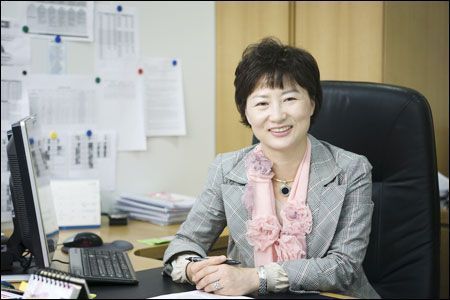
Janice Lee, the head of human resources and change program at Standard Chartered Bank Korea, poses for photos in her office in this undated photo. / Courtesy of Standard Chartered Bank Korea
SC Bank VP Janice Lee says leaders need strong career anchors
By Kim Da-ye
For Janice Lee, the “glass ceiling” was like a bullet proof window that she couldn’t break on her own but could be shattered only by the very people shielded by it.
Lee, the head of human resources and change program at Standard Chartered Bank Korea, moved to Korea in 1998 as the finance manager of Volvo Construction Equipment’s Korean operation after the Swedish company acquired part of Samsung Heavy Industries.
Having studied and worked in the United States for 15 years, Lee had concerns over Korea’s male-dominated working environment — particularly managing men as a woman. She thought the job may be easier for a purely foreign female manager. Although she was a naturalized American citizen, she would still be recognized as a Korean who finished college here. Male colleagues were going to judge her by her age, educational background and on the basis of her hometown. Such a concern was part of the reason why she kept her English name, Janice.
But her breakthrough was made possible by a male boss. Anthony Helsham, the then president of Volvo Construction Equipment Korea and now the CEO of Doosan Infracore’s construction equipment arm. He said firmly in a meeting upon Lee’s arrival that people now had to adapt to working with female bosses and those who couldn’t accept them should leave the company.
“The glass ceiling must be broken from above, not the other way around. It’s a leaders’ role to break the ceiling. Now it’s female leaders’ turn to do so for their junior colleagues,” Lee said.
Career anchor
When asked what makes a great female leader, Lee looked slightly frustrated by the frequent questions she has to answer. She said that not every woman is up for doing a leader’s job.
“The problem is that people try to be a certain kind of a leader rather than being themselves. You can’t change who you are,” Lee said.
She said that each person has a different set of strengths and values that guide his or her career choices. She calls this a “career anchor,” a term created by Edgar Schein, a former professor at the MIT Sloan School of Management.
Schein divided career anchors into eight types — technical-functional competence, general managerial competence, autonomy/independence, security/stability, entrepreneurial creativity service/dedication to a cause, pure challenge and lifestyle.
While people who prefer a strictly 9-a.m.-to-5-p.m. job and prioritizes the balance between work and life may have career anchor in lifestyle, Lee found hers in general managerial competence.
Lee names “self-motivation” as an important element of her career anchor. “Many people want their companies to provide a ‘vision’ instead of trying to find one of their own,” Lee said. Another is analytical skills, and the other, which she said is the most important, is having the guts to make a decision even when there is little information provided.
Once people have a strong career anchor — in other words, they know what they are good at and what they want, people should try to tailor their career paths to it.
“On the path to becoming a leader, I wondered what kind of experiences I would need. When proper positions were available to me, I think I made correct decisions by grabbing them,” Lee said.
She spent the earlier stage of her career in the manufacturing industry — at Daewoo Heavy Industries’ U.S. operation and at Volvo, so she wanted to move onto the service sector at a listed company. Hanaro Telecom, now absorbed into SK Telecom, seemed to be an ideal choice because it was listed on both the KOSDAQ and NASDAQ markets. Her actual employer was a private equity partnership of AIG and Newbridge Capital that gave her a CFO job with the aim of restructuring, improving and eventually selling the telecommunication service provider.
The term “career anchor” recurred throughout the interview. And behind the term is Lee’s strong belief in the importance of psychological analysis.
The most important education she said she had so far was the Leadership at the Peak program at the Center for Creative Leadership, a week-long program for C-level and senior executives on a mountain peak in Colorado in the U.S.
Her education on the resume is as extensive as her work experience. After graduating from Ewha Womans University with a major in English, she earned a master’s in accounting from Cleveland State University and another in financial planning at Ohio State University. She also studied an Executive MBA at the Booth School of Business, the University of Chicago.
In Colorado, Lee said she joined a 15-member team with her being the only woman and the only Asian there. She paid $10,000 in tuition, exclusive of the cost of flights and accommodation.
The team was accompanied by an industrial psychologist who analyzed Lee throughout the week. She said they had advanced tools that helped her see through herself as though she was looking straight at a mirror.
“The key message of the program was that in order to become an effective leader, one should be an effective human being.”
“Becoming a completely different person to become a leader doesn’t lead to success. The really successful leaders understand their strengths and weaknesses, and they supplement their weaknesses by embracing others who have the strengths that they lack.”
Transparency — women’s strength
Lee remembers the macho atmosphere of meetings of C-level and senior executives at Hanaro when she joined. The men were connected to each other through the schools they went and the hometowns they came from, and the way they treated each other was highly hierarchical.
She thought she didn’t need to be influenced by the culture or should try to adapt to it. She chose to stick to the principles of her profession. While business deals tended to be swayed by decision makers’ personal relationships, she said she closely looked into the financial sides of investments. That sometimes involved opposing the majority.
Because there were few women in management, networking involving regionalism and school relations mattered little to her, she said. Remaining independent and objective was a key to her position as a CFO. She also believed it was an asset to her when she came to a newly merged company and had to work with both sides.
Lee once participated in a conference on female leadership as a panel. Another panel was Ahn Tae-sik, a former dean of Seoul National University Business School.
She recalled that Ahn said that companies are unwilling to give an equal opportunity to men and women because they believe women tend to show less responsibility for their careers than men do. He added that women are considered as emotional.
Lee said Ahn’s first argument made the participants reflect on what men think of women. Although she understood his viewpoint, she couldn’t agree. She corrected it, saying that while women are as responsible as men, women, who often have to juggle between their job and a family, tend to not have strong career anchors.
Lee wouldn’t agree with Ahn’s second argument at all. She said such prejudice comes from women being a minority.
“Men immediately form a sense of kinship because there are many of them. Because there had been few women at work, men were unfamiliar with them. From my perspective, men are more emotional. And men tend to get involved in factious quarrels more than women do,” she said.
Lee brought up another business studies theory called the Johari window, invented by two psychologists Joseph Luft and Harrington Ingham. Four panes of the Johari window indicate areas of a person.
The “open” area is part of a person that both the person and others know while the “blind spot” is known to others but the person isn’t aware of it. The “hidden” area is known to the person, but not to others, while both the person and others aren’t aware of the “unknown” area.
“When the open area that both myself and others know is the largest, one can be successful. Transparency now matters, and leaders must be transparent. Leadership is developed through training your true self, not who you want to be,” Lee said.