Classmates ― most valuable asset from MBA
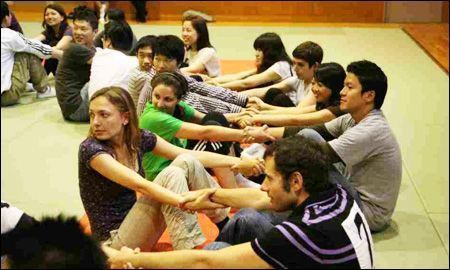
Reema Siyam, left in the second row wearing a green T-shirt, an MBA student at Hitotsubashi ICS, holds hands with other MBA students at a team building exercise in Takao, during an orientation program for new students, in this undated photo. / Courtesy of Reema Siyam
Reema Siyam, from Saudi Arabia, is a second-year MBA student at Hitotsubashi University Graduate School of International Corporate Strategy (ICS). She earned a bachelor’s degree in computer science from Wellesley College in the United States. After graduation, she worked for three years in the info-tech field before switching to a career in human resource policy development and planning.
Not many Saudi Arabian women are known to be studying abroad, especially in Japan. Is there any special reason why you chose Japan?
While it is true that there are very few others studying in Japan, a considerable number of Saudi women are studying abroad, at both undergraduate and graduate levels, in countries all over the world and that number is rising each year.
Many of them are supported by Saudi government-sponsorship programs. I came to Japan, however, as a self-sponsored student. Japan was simply the most attractive in terms of the MBA program I had chosen, as well as the high standard of living in Tokyo and the chance to learn Japanese.
Why Hitotsubashi ICS?
My educational background is computer science and I had already made a career change away from that field and into human resources policies. I now want to acquire the tools that will help me become “literate” in the corporate world and that I can continually use to learn through my future experiences. At the same time I also wanted to be able to create an impact beyond the corporate level.
ICS includes the phrase “Best of Two Worlds” in its stated mission and this concept resonated strongly with me. In addition to the traditional elements that make up an MBA, ICS supplemented its program with courses such as Global Citizenship and Knowledge Week. An MBA program that made societal impact and self-reflection just as important as corporate finance, accounting and marketing was exactly what I had been looking for.
Another appealing aspect of the program is that it is part of Hitotsubashi University, a national ivory tower. It means tuition is affordable and one can have access to resources such as the extensive alumni network. This diverse and tightly-knit network is a unique asset that will stay with me long after I’ve graduated from the program and will help me stay connected to Japan.
How different is Japan from Saudi Arabia? How’s life in Japan as a Saudi Arabian woman?
Japan and Saudi Arabia are, of course, very different, but they have surprising similarities on many levels, mostly in the conservative nature of the two nation’s cultures. I have found life in Tokyo to be very rewarding and Japanese people to be very welcoming, considerate and generous. Even though I initially struggled with the language barrier, I’ve managed to learn the basics through daily activities and conversations.
When do you miss your country the most?
I miss many things in Saudi Arabia, especially my family and friends. I feel homesick the most during holidays, such as Eid festivities and other important Muslim festivals.
How helpful is your previous work experience while studying an MBA?
In class, I felt that I was able to contribute a different perspective during discussions, given my professional background. I think one of the most valuable assets you can get out of an MBA is your classmates and what you can learn from their experiences.
Which class is your favorite?
While it’s very difficult to choose one class or professor to single out as a favorite, Strategy Simulation Week was one of my favorite experiences at ICS. It was a week-long event, where students were split into groups and we competed against each other, running simulated companies within a chosen industry. It wasn’t just about financial models and marketing frameworks, but also about how to play your role within the team.
What are the challenges in pursuing an MBA?
It’s a huge time commitment, a lot of studying and a great deal of competition. It takes detailed time management and careful organization to avoid being overwhelmed by the workload.
What is
your future plan? In what country do you want to have a career?
I feel that getting my MBA in Japan at ICS has opened up a lot of doors for me. The economies of the Middle East are growing rapidly, so I would like to go back and contribute my skills toward my country’s development. Yet, there are a lot of interesting career opportunities in Japan that I would like to grab as well. I want to find a place where I have an organizational and cultural fit and where I can make a significant contribution.
If you can go back to the past, what do you want to prepare the most for an MBA?
I would have studied more for my GMAT, spent more time working on my analytical skills. More than that, I would have worked on improving my listening skills. Most MBA programs are about making a contribution to discussions or presenting ideas, but significant parts are listening and learning from others.
Do you have any advice to those eager to enter Hitotsubashi ICS?
ICS is a small school, so each student can make a huge impact. When applying, think about what impact you can make and how you can contribute your own skills. Then be sure to make it clear in the application process.
Interview by Chung Hyun-chae