Siemens to partner with Korea in smart grid
By Lee Min-hyung
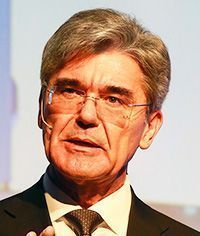
Siemens CEO Joe Kaeser
Siemens AG, the world’s leading electrical components maker, said Wednesday it will make significant investments in building the next-generation electrical grid here in Korea after receiving sizable demand from local customers.
“First and foremost, in contrast to the high voltage direct current (HVDC) transmission system that already is big in China, our plan to do more investment in Korea will depend on customers,” Siemens AG CEO Joe Kaeser said during a press conference at the Shilla Hotel in Seoul.
HVDC is gaining the spotlight as the next-generation electricity transmission system, as it is more efficient in terms of electrical power loss than the currently-dominant alternating current (AC) transmission system.
In particular, HVDC can send more than twice the transmission voltage by reducing electrical wire use and thereby guaranteeing more area for transmission lines.
The German-based engineering giant said the nation’s localization policy has prevented the company from making enough investments in building the HVDC ecosystem here, but it is willing to make the investments if there’s enough demand from Korean customers.
This is the second time one of the industry leaders has hinted at increasing investment in HVDC here. In 2013, the Korean Electric Power Corporation (KEPCO) signed a deal with Alstom, a French-based key player in HVDC technology, for joint investment to spread HVDC in Korea.
Right now, the global HVDC market is dominated by a few major players ― including Siemens, ABB and Alstom. They are active in expanding their presence as the HVDC market leaders, but they have made little investment in Korea and other Asian countries. There still remains a significant gap in the HVDC power grid level between the United States, European countries and Asian countries.
In the Asian market, LSIS, Korea’s leading electrical components manufacturer, is pushing for the next-generation grid system by partnering with Alstom.
During the press conference, the Siemens chief stressed the shift in manufacturing converging with digitalization, citing the government’s Manufacturing Industry 3.0 Strategy for Creative Economy.
“We at Siemens are ready to support Korea on its way to 10,000 smart factories by 2020,” he said.
The policy was initiated by the government to intellectualize the nation’s manufacturing process by investing 1 trillion won ($866 million).
“I commend the approach of the German government,” he said. “Germany has a strong SME base, and their inclusion is a declared goal of Industrie 4.0.”
He said Germany adopted the drive to remodel the entire value creation chain in a digital way. “Digitalization has pervaded into business-to-customer and even business-to-business transactions.”
In October last year, the company expanded its business portfolio into building smart factories. It said the digital factory division helps all the manufacturing processes streamline and track in real-time.