Regulator may revise telecom act
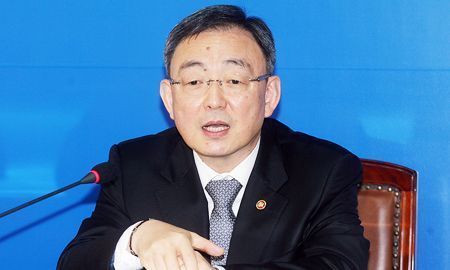
KCC chairman Choi Sung-joon answers questions during a Tuesday press briefing at the government complex in Gwacheon about the Mobile Device Distribution Improvement Act that took effect on Oct. 1, Tuesday. / Yonhap
By Kim Yoo-chul
Korea Communications Commission (KCC) Chairman Choi Sung-joon attempted Tuesday to appease public criticism about the recently implemented telecom law that puts a ceiling on handset subsidies.
The nation's top telecom regulator also indicated that the government may modify the Mobile Device Distribution Improvement (MDDI) Act that went into effect on Oct. 1.
Consumers have remained reluctant to buy new handsets since the introduction of the new rule. The regulation is blamed for denting consumer demand for the latest tablets and smartphones, freezing the market.
"I've acknowledged controversies about the law. Because the law has just been launched, please give us some more time," the KCC chairman said in a hurriedly arranged press briefing on Tuesday.
He implied there would be some rewriting of the law. Still, he urged carriers and manufacturers to follow the regulation.
Subsidies include two elements ― the manufacturers' portion to carriers, and the carriers' portion to consumers. With the introduction of the new rule, the government sought to root out illegal subsidies by mobile carriers and producers.
Subsidies have been a longstanding issue in Korea as carriers want to stay afloat by stealing away consumers from rivals by providing huge subsidies beyond the legal cap set by the KCC and the Ministry of Science, ICT and Future Planning (MSIP).
Under the new regulations, the maximum subsidy amount now stands at 345,000 won, up from a previous ceiling of 270,000 won. If a carrier breaches the law, both carriers and its sales agencies will be penalized up to 3 percent of their annual revenue.
For example, consumers are reluctant to buy Samsung’s newest handset Note 4 tablet as it is expensive with the lowered subsidies. They can buy the Note 4 for 850,000 won, with 150,000 won subsidies from SK Telecom, KT and LG Uplus.
The carriers agreed that the law will cut the total market size, as heavy promotional campaigns are now impossible under the new law.
Manufacturers like Samsung and LG are not happy about this.
Under the regulation, Samsung's flagship models will no doubt suffer due to lukewarm response from consumers for high-end models.
Dealerships are also facing huge difficulties as the ceiling is not enough to attract new customers for devices.
"This is really nonsense. I have no option but to close my shop if the subsidy rate isn’t changed. Are you ready for the Note 4 and paying more than 800,000 won? Subsidies are one of the debatable issues. But the new regulation is far from reality," said Kim Jin-hong, a 39-year-old mobile shop owner in Gangnam, southern Seoul.
Consumer Watch, a local civic group, said it has started its own signing campaign with an aim to scrapping the new regulation and protect consumer rights.
"The best way to protect consumers is to lay grounds for fair competition between companies to help consumers purchase high-quality products at better prices," said the group.