Samsung to invest W15.6 tril. in chip plant
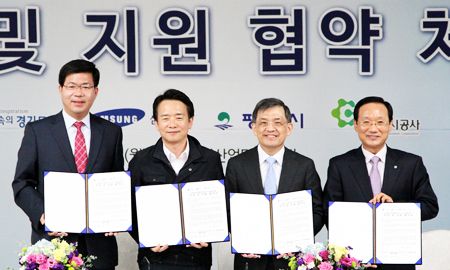
Samsung Electronics Vice Chairman Kwon Oh-hyun, third from left, poses with Gyeonggi Province Governor Nam Kyung-phil, second from left, Pyeongtaek City Mayor Kong Jae-kwang, left, and Gyeonggi Urban Innovation Corporation CEO Choi Geum-shik after signing an agreement to build a chip plant in Pyeongtaek, south of Seoul, Monday. / Courtesy of Samsung Electronics
By Kim Yoo-chul
Samsung Electronics will invest 15.6 trillion won to build a chip plant in Pyeongtaek, Gyeonggi Province, the company said Monday.
The investment is the largest by the chipmaker in a single chip plant.
“Samsung signed a memorandum of understanding with Gyeonggi Province to build a chip plant in Pyeongtaek,” the company said Monday in a statement.
The massive investment comes as the electronics giant is facing growing competition with Apple and Chinese handset makers, which are cutting into its smartphone margins.
It will begin construction of the plant in the first half of 2015, and expects it to begin operating in 2017.
“We’ve decided to move the operation of the plant forward by one year, from the original plan, to help boost the local economy and respond actively to the growing demand for chips used for various consumer electronics gadgets,” the statement said.
The new facility will occupy 790,000 square meters within the 2.83-million-square-meter Pyeongtaek Industrial Complex. Pyeongtaek is 73 kilometers south of Seoul.
Samsung invested 12.6 trillion won in chip factories last year. It supplies memory and logic-based chips _ critical components that power digital devices by reading and storing data _ to all global technology leaders including IBM, Cisco, Apple, Microsoft and Google.
Samsung runs eight chip factories as of September, both at home and abroad.
The company currently produces memory chips at its plant in Hwaseong, Korea, and Xian, China. It runs assembly lines in Suzhou, China, as well as in the local district of Onyang within Asan, South Chungcheong Province; while it produces logic and LED chips in Tianjin, China, and at its U.S. plant in Austin, Texas.
Kim Ki-nam, head of the company’s memory chip division, said the investment plan would not cause any glut in the industry given the growth of data centers and the increasing demand for chips used in memory-intensive devices such as wearable gadgets and automotive solutions.
“Samsung doesn't think the market will see an oversupply after 2016,” Kim said in a press briefing. “If that becomes an issue, then we will control the pace of output capacity. Given the current market situation, we remain quite positive about the outlook.”
He said Samsung planned to invest more in chips next year “on a gradual basis, with the amount depending on market conditions.”
Samsung could manufacture as many as 100,000 wafers in a single chip line, Kim said.
“However, we have no plans to operate at full capacity, initially,” he added. “We don't want to send the wrong signal. Our production facility in this town will help us maintain an edge over our rivals.”
On Oct. 7, Samsung will announce its preliminary earnings guidelines for the third quarter of this year.
Local brokerages expect the company to report below 4.3 trillion won in operating profits, considering its narrowing handset margin amid fiercer competition with Apple and Chinese rivals.