LG Chem enhances energy storage biz
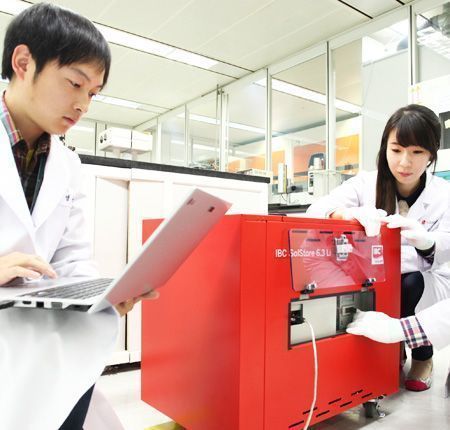
LG Chem technicians check the quality of an energy storage system at its technology center in Daejeon in this file photo. / Courtesy of LG Chem
By Kim Yoo-chul
LG Chem, the world’s top supplier of rechargeable batteries for electric vehicles (EVs), is beefing up its energy storage system (ESS) business to attract corporate and government clients in the global market.
The chemical affiliate of LG Group is diversifying its portfolio to non-petrochemical businesses, capitalizing on ESS as the demand for energy continues to grow at a rapid pace.
The electricity market is being deregulated further as grid systems remain unstable, LG Chem said in a statement to The Korea Times.
“Governments around the world are focusing more on how to effectively manage electricity, and that means energy-related policies are seeing a new paradigm,” Owen Sung, head of the firm’s public relations office, said Tuesday.
“LG Chem is riding the industry’s new wave, and we are ideally positioned to increase our stakes in the promising renewable energy market.”
ESS, based on lithium-ion battery technology, is a device that stores electricity in preparation for peak seasons when household and corporate demands for electricity increase significantly. LG Chem supplies high-end lithium-ion car batteries to 20 global carmakers.
Sung said the firm’s ESS solutions are cost-effective and can fundamentally change how and when energy is consumed, to enable more efficient use of energy system resources.
LG Chem’s confidence in this industry lies in the references it acquired and the patents it has filed. Sung said the firm aims to create a new ecosystem in ESS solutions, starting with laying the groundwork.
Data from the Korean Intellectual Property Office showed that LG Chem leads in terms of patent filings for lithium-ion batteries for ESS solutions and battery management systems, accounting for 41 percent and 34 percent, respectively, of total filings between 2001 and 2010.
Meanwhile, the company’s two ESS plants in Korea, which have an annual production capacity of 23 and 7 megawatts, respectively, will go online in July. LG claims the two plants have the biggest in capacities.
It has been collaborating with LG Electronics, GS Caltex, POSCO and Korea Electric Power Corp. for ESS-embedded smart grid projects in the country’s southern resort island of Jeju, according to the statement.
On a global level, LG is teaming up with Southern California Edison, one of the largest electric utilities in California in the United States, to supply LG-manufactured ESS batteries for households, and it has reached an agreement with ABB, a leading global electricity engineering firm, to offer megawatt-scale ESS solutions.
It has also formed partnerships with IBC and SMA of Germany, said the statement.
“LG Chem is considered one of the most trusted ESS and rechargeable battery suppliers. By partnering with the world’s leading electricity companies, we will expand our renewable energy business.”
Navigant Research, a market research firm, forecasts in its report that the global annual installed capacity of ESS solutions will earn 47 trillion won in revenue by 2020, from only 2 trillion won in 2010.
“Key industry players are profiled in depth and worldwide revenue and capacity forecasts, segmented by technology and region, extend through 2023,” said the research firm regarding the content of its report.