SK hynix swings into black in Q4
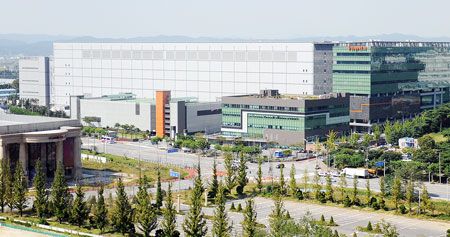
SK hynix’s NAND flash memory chip-producing plant in Cheongju, North Chungcheong Province
Chipmaker sees turnaround on solid chip demand
By Kim Yoo-chul
SK hynix said Wednesday that it shifted to profit in the fourth quarter of last year on the back of growing demand for smartphones and tablets, raising hopes that the world’s No. 2 supplier of computer memory chips will see a turnaround this year.
In a regulatory filing to the Korea Exchange, the company posted operating profit of 55 billion won between October and December from a deficit the previous year of 106.5 billion won.
Its net profit reached 163.7 billion won compared with a 239.9 billion won loss a year earlier.
Sales rose 6.5 percent year-on-year to 2.72 trillion won during the same period.
The firm remains upbeat about its performance in coming quarters, saying that demand for its chips will be solid thanks to the rise of Chinese smartphone makers.
``Mobile chips, which are one of the essentials to power smartphones and tablets, took up as much as 40 percent of our production in the fourth quarter compared with around 10 percent a year earlier,’’ the statement read.
"The overall outlook for memory chips is still negative as it’s highly unlikely PC demand will soar despite more budget models. But SK hynix is benefiting from rising Chinese smartphone makers as they are buying more chips from the SK hynix at affordable prices," said Samsung Securities in a note to clients.
However, the Icheon, Gyeonggi Province-based company plans to cut investment in key facilities this year from the last year’s 3.8 trillion won in order to avoid the cutthroat competition on the supply side.
It said that one of major threats this year will be revival of its main Japanese rivals due to the weakening yen.
"We have no plans to build new chip-making lines. We will cut investment this year from last year," said SK hynix Chief Financial Officer Kim Joon-ho, during a conference call to investors, Wednesday.
The executive admitted that a stronger won and weaker yen is posing threats to the SK Group-affiliated chipmaker as Toshiba and Elpida Memory of Japan ― SK hynix’s two main Japanese rivals ― are becoming price competitive in chip sales to leading customers such as Dell, Hewlett-Packard, Apple, Lenovo and China’s Huawei.
"But we’re not worrying too much. Demand for conventional PCs looks solid as manufacturers are rolling out budget computers and the rising demand for smartphones and tablets will help us ship more mobile DRAM chips, though competition for the growing market will be fiercer,’’ Kim said.
As the company is getting more calls to supply embedded chip solutions with multiple functions, the firm is betting heavily on premium products such as embedded multimedia cards and solid state drives as they become increasingly important amid demand from customers for higher density and faster interface speed.
Kim said that SK hynix plans to mass-produce mobile DRAMs and PC chips using a 2Y-nanometer processing technology, regarded as next-generation technology, to maintain its competitive edge.
"That’s why we are positive on our business this year, in general," the executive said.
The chip-making industry is volatile and cyclical and the market is already crowded, pushing major players to migrate to thinner and better technology to save costs, increase efficiency and secure their bottom line.