Samsung, Hynix strengthening leadership in chips
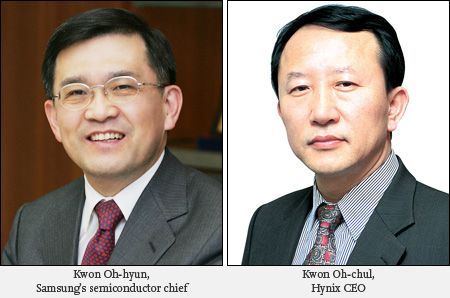
Combined market share exceeds 60 percent for first time
By Kim Yoo-chul
The heyday for the South Korean chip duo ― Samsung Electronics and Hynix Semiconductor is at its height.
Despite the business struggles of their fellow rivals, the Korean companies are cementing their leadership in the crowded memory chip market.
Combined market shares captured by Samsung and Hynix exceeded 60 percent by the end of the third quarter ― the first time in history since South Korea's appearance in the memory chip market, according to market research firms.
It is widely expected the combined shares will undergo some corrections in the current quarter due to aggressive moves by competitors to lower inventories as the year-end approaches.
But analysts have no looming doubt over the continued joint leadership by Samsung Electronics and Hynix Semiconductor in the sector, citing advanced technologies, better cost cuts and more shipments of value-added computer chips.
Memory chips are commonly divided into two categories ― dynamic random access memory (DRAM) and flash-type ones or NAND. DRAMs read the data widely used in traditional PCs, while NAND flashes can store data even when switched off, used in high-end portable gadgets such as smartphones and tablet PCs.
The appetites for smartphones and tablet-style PCs are seeing explosive demand as consumer electronics majors are churning out such digital devices, satisfying the shift for ``all-in-one’’ gadgets, meanwhile making Samsung and Hynix skip to the bank as they receive more component orders.
Samsung Electronics sells DRAM chips to all major PC makers such as Hewlett-Packard, Dell, and leading Taiwanese players, while the iPhone and iPad maker Apple is buying massive amounts of NAND flash chips from Samsung for its two representative consumer gadgets, Samsung officials say.
Hynix also sells its mobile DRAMs to Apple, in addition to selling its traditional DRAM and NAND chips to other top-tier manufacturers.
``We can say that’s a `client effect.’ Considering other chipmakers, Samsung and Hynix are shipping components to relatively stable and big buyers, making it possible to increase shares, even as the overall memory market plunges into trouble,’’ said Seo Ju-il, an analyst at KB Investment.
Seo added an upcoming series of digital devices that include tablet PCs, ``smart’’ televisions and smartphones ― all of them using memory chips as key parts ― will further help the South Korean firms raise their shares in the ``winner takes all’’ chip sector.
Elpida's output cuts production
iSuppli, a U.S.-based market research firm, has recently shown that the combined market share by Samsung and Hynix by the end of third quarter reached 61.6 percent ― 40.7 percent by Samsung and 20.9 percent by Hynix.
The data comes just days after the world’s third-biggest DRAM chipmaker Elpida decided to cut its production of DRAM chips by a quarter to secure its deteriorating cash-flow hit by tumbling chip prices.
The global DRAM market is blaming PC makers over their sluggish sales performances as insufficient sales have resulted in an oversupply and lower prices by over 40 percent in the past six months, immediately deflating the sector’s one-year boom.
Although the timing and magnitude of the production cut will depend on the market situation, slashing the output has been regarded as the ``last card’’ for survival in the memory chip industry.
``The announcement by Elpida was a `declaration of surrender,’ amid the decreasing demand for chips,’’ said Lee Seung-woo, an analyst at Shinyoung Securities in Seoul.
But, it’s a different story at least for Samsung Electronics and Hynix Semiconductor as they have no plans to cut their output amid continued bearish moves in the industry.
On Monday, Samsung said it doesn’t have ``any plans’’ to reduce its output, though the outlook in the current quarter is dim.
``Samsung is maintaining full rates in output. We will keep with that throughout this year,’’ said Kim Choon-gon, a senior Samsung Electronics spokesman.
Hynix spokesman Park Hyun also said it hasn’t reviewed any possibilities of reducing production at its chip facilities.
``Ironically, the decision is positive as the rare confirmation of the output cuts by Elpida has raised the possibility in the industry of more players following that move,’’ said an unnamed Samsung executive.
Elpida lost its global DRAM share by 1.6 percentage points to 16.1 percent in the third quarter from the previous quarter, while that of the U.S.-based Micron Technology, the No. 4 DRAM maker, also fell by 2.8 percentage points to 10.5 percent, iSuppli said.
click
Advanced tech, market recovery
In addition to the ``external help,’’ Samsung and Hynix are the industry’s only two manufacturers to fully manage the highly-advanced 40-nanometer technology.
Chipmakers have been heavily investing in the migration of thinner technologies to make smaller chips, implementing narrower circuitry that gives them a larger storage capacity on silicon wafers and lowers per-chip production costs.
Japanese and U.S. chipmakers are still using 50-nanometer technology in their productions, while Taiwanese makers are adopting 60-nanometer level technology as their main one.
``Considering these factors, Samsung and Hynix are having better product mix-ups, which is enough to overcome any big ups and downs in the highly-cyclical memory sector,’’ said Kim Jang-yeol, an analyst at Mirae Asset Securities.
Samsung and Hynix have increased the shipments of value-added premium DRAM chips that go into mobile products, servers and graphics to distinguish their positions from their rivals in a strategy for sustainable corporate growth.
``Hynix has boosted their portion of non-PC DRAM chips to 60 percent from an earlier 30 percent,’’ said a Hynix official.
Expectations are high that the global chip industry will be back on track earlier than expected as Elpida’s announcement may help the industry see an ease in oversupply.
``We are seeing an earlier turnaround as more second-tier players will coincide with Elpida to secure their bottom line,’’ said Mirae’s Kim.
``DRAM price falls will see a moderate pace. Considering the demand growth in consumer electronics at the year-end, we will see a price turnaround from early next year,’’ added Suh at KB.
In the third quarter, Samsung reported 10.66 trillion won in sales, while the quarterly operating profit at its semiconductor division reached 3.43 trillion won ― quarterly records both in sales and profit.
Profit margins at the division were increasing to 32 percent during the July-September period, Samsung said in the filing.
Hynix also reported 3.25 trillion won for its quarterly sales. Operating profit for the latest quarter was 1.011 trillion won, which is the second-biggest in its corporate history.
``Samsung and Hynix are earning more because the South Korean companies have no big problems in the adaptation of thinner technology, and if rivals including Elpida start to cut their production, they will ship more,’’ another unnamed Samsung executive said.