Ahead of US election, settlement urged between SK, LG
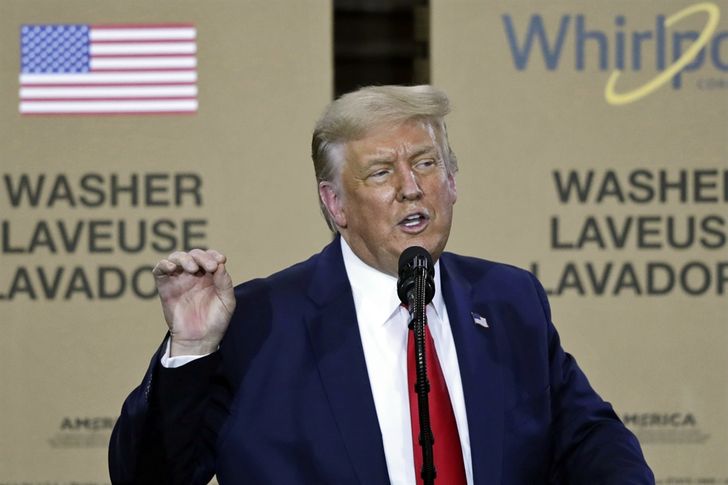
US President Donald Trump speaks during an event at the Whirlpool Corporation Manufacturing Plant, Aug. 6 in Clyde, Ohio. AP-Yonhap
By Kim Yoo-chul
Ahead of the upcoming U.S. presidential election, the issue of the alleged theft of trade secrets relating to electric vehicle (EV) lithium-ion battery technology between LG Chem and SK Innovation is becoming a political matter with the Korean companies being asked to agree on what has become a “multi-billion” dollar fight.
Such a scenario is gaining clear momentum after U.S. Rep. Doug Collins, Gainesville, asked U.S. Immigration and Customs Enforcement and the U.S. Customs and Border Protection to probe what he referred to as “an ongoing effort to illegally employ foreign nationals” at the SK Innovation battery plant in the state of Georgia. SK Innovation is expected to employ more than 2,000 people at the plant in line with the expansion of its production facilities.
The U.S. politician reported the matter to top federal officials citing a May 29 incident at Hartsfield-Jackson International Airport in Atlanta, when border officials say they “intercepted 33 Korean nationals … who were attempting to enter the United States with fraudulent work authorizations.”
SK Innovation officials declined to comment. However, the requests by Collins came as settlement talks are currently under way between LG and SK legal representatives. The USITC recently ruled in favor of LG Chem in a preliminary ruling. Specifically, it said SK Innovation stole LG's battery trade secrets. The body plans to issue a determination in October this year, which if adverse, could block SK from importing equipment to outfit its Georgia plant which in turn could seriously jeopardize contracts with EV manufacturers such as Volkswagen.
LG Chem officials said the company “doesn't want to see a worst-case scenario” reiterating its stance that an agreement could be reached following an apology by SK and a commitment not to repeat “wrongdoings.” Of note is that the USTR is in a position to veto a final ruling by the USITC.
SK Innovation is expecting the possible reelection of U.S. President Donald Trump would provide a “fresh impetus” from its standpoint in terms of reversing the USITC ruling.
But industry officials contacted by The Korea Times said Sunday the request by the U.S. politician was demonstrating the de-facto hope by the Trump camp of a settlement in the case as the spread of the pandemic is taking a toll on the recovery trajectory in the U.S. economy.
A recent report issued by the Council on Foreign Relations (CFR) said a lot of U.S. economists are worried about slowing growth, rising debt and uncertainty over Trump's trade war with China. The CFR said more competitive foreign economies and the rise of automation are reshaping the U.S. labor market, and noted the ongoing criticism by U.S. politicians who said global trade deals were resulting in the losses of manufacturing jobs.
“Clearly, the legal tussle between LG Chem and SK Innovation isn't a matter only between them. The issue is being complicated as a lot of interested parties are involved. The impact of the final USITC ruling will depends on the U.S. presidential election which is approaching. LG and SK will initiate relevant processes for an eventual settlement anytime now,” a senior industry executive familiar with the issue said.
SK Innovation is building a new battery plant in Georgia with an investment of 1.1 trillion won. The plant is scheduled to begin operations in 2022. In April, it decided to make an additional 894 billion won investment to build a second plant, there.
As the settlement efforts are reaching a climax, legal representatives for the two Korean companies are discussing details related to the finalization of terms. Sources familiar with the matter said SK Innovation hopes to make a one-off payment of between 1.5 trillion won and 1.8 trillion won to LG Chem, while LG Chem is seeking a comprehensive cross-licensing contract in return for a settlement before the final USITC ruling.
LG officials said its 2017 agreement with China's ATL, for which the latter agreed to pay 3 percent of its sales of safety-reinforced separators is far from the possible settlement with SK in terms of the gravity of the issue. ATL infringed on three of LG's battery separator patents.
“Just like U.S.-based mobile chipset giant Qualcomm is doing to LG Electronics, LG Chem was hoping to receive royalties in sync with the amount of battery sales from SK's battery plants for a certain period. That scenario, if it happens, will clearly help LG Chem continuously invest in its battery business but will be a burden for SK. The point will be how they find a middle ground,” the executive added.