Kim Rahn is the managing editor of The Korea Times. Since joining the company in 2003, she has covered various beats including the presidential office, Seoul city government, the Bank of Korea and the tourism industry. In 2014, she won the Society of Publishers in Asia (SOPA) award for her coverage of the ordeals of migrant women in Korea.
2 more nuclear reactors pulled out of service
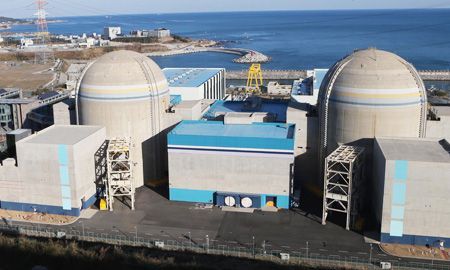
Shin Kori Reactors 1 and 2 in Busan
By Kim Rahn
By Kim Rahn
The nuclear safety authorities have halted the operation of two nuclear reactors and suspended the scheduled operation of another two after they found substandard parts were used in them.
As 10 reactors out of the nation’s total of 23 are now offline, there is concern the country may experience electricity shortages and possible blackouts in the summer.
The Nuclear Safety and Security Commission (NSSC) and the Korea Institute of Nuclear Safety said Tuesday they confirmed substandard control cables with fake quality warranties were used in building six reactors — the Shin Kori Reactors 1 to 4 and the Shin Wolsong Reactors 1 and 2.
The cable is a safety device that sends signals in the case of incidents, such as radiation leaks. About 5 kilometers of the cables were used for each of the reactors.
“We found fabrication in some graphs and test results of the cable parts used in the Shin Kori Reactors 1 and 2 and Shin Wolsong Reactors 1 and 2. We also confirmed that these parts have been also used for the Shin Kori Reactors 3 and 4, which are near completion,” NSSC Chairman Lee Un-chul said in a media briefing in Seoul.
Lee said a staff member of a domestic testing institute produced a forged test result claiming it was from an overseas institute. “The Korean institute asked a Canadian institute to conduct a part of the test. The foreign institute said some of the cable parts didn’t pass its test, but the staff member altered the result,” he said.
The authorities began investigating in late April after being tipped off about the fabrication. They obtained the original copy of the Canadian institute’s test result last week and confirmed the forgery.
They have not yet found why the staffer did so.
Following the finding, the authorities suspended operations of the Shin Kori Reactor 2 and Shin Wolsong 1. It may take more than six months for the two reactors to resume operations.
For the Shin Kori Reactor 1, which has been undergoing regular maintenance since April 8, the NSSC will extend the maintenance period to replace the substandard parts. For the Shin Wolsong Reactor 2, which has been under review for operation approval, this will not be given until the cables are replaced.
“When finishing the replacement work, we’ll not immediately resume the operations but decide whether to do so after testing the new cables and reviewing the new test result with experts there,” Lee said.
President Park Geun-hye said during a Cabinet meeting, “We need to find out the cause and hold those in charge accountable. We have to open all problems transparently if there are any, and take all possible measures so such things never recur.”
Before this most recent suspension, eight of the nation’s reactors had been out of operation. With the addition of the Shin Kori Reactor 2 and Shin Wolsong Reactor 1, now 10 are not generating power, cutting 7.7 million kilowatts (kW) out of a total capacity of 20.7 million kW.
As the unexpected halt of the reactors is likely to drop the nation’s power reserve levels significantly, the Ministry of Trade, Industry and Energy and related agencies held an emergency meeting. It also immediately launched its “summer power supply monitoring period,” which it usually begins in mid-June.
“Power consumption may reach supply capacity in June, and may surpass it in August,” a ministry official said, indicating possible blackouts.