E-mobility fast becoming reality
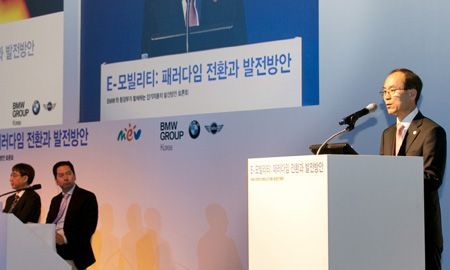
Environment Minister Yoon Seong-kyu, right, speaks during the E-mobility Conference co-hosted by BMW Korea and the ministry at the Grand Hyatt Seoul, Tuesday. / Courtesy of BMW Korea
BMW takes lead in EV market
By Kim Tae-jong
BMW Korea will launch an electric vehicle, the BMW i3, next year.
Electro-mobility is considered a fast-approaching reality in Korea with a lot of automakers developing electric vehicles (EVs) and the government trying to build infrastructure, such as charging stations.
Many experts point out, however, that the biggest challenges is driver’s negative views on the new type of mobility such as high costs and travel ranges.
Glenn Schmidt, head of Steering Government Affairs at the BMW Group, said Tuesday it is critical to promote positive aspects of electric vehicles for an e-mobility paradigm shift in the future.
“There are certainly lots of challenges and potential barriers such as costs, ranges of vehicles, charging infrastructures,” he said. “But I think ultimately those barriers and challenges are also largely mental in terms of psychological barriers.”
He said there are many more benefits and advantages EV drivers can enjoy, such as driving pleasure and reduction of CO2 emission, and EVs are well suited to megacities like Seoul.
The remarks came during an E-mobility Conference co-hosted by BMW Korea and the Ministry of Environment at the Grand Hyatt Seoul.
The conference was attended by government officials including Rep. Hong Young-pyo of the main opposition Democratic Party and Environment Minister Yoon Seong-kyu; industry experts including Samsung SDI Senior-executive Kim Ki-ho and POSCO ICT Director Lee Gyu-je; and academics including Kukmin University Prof Park Joon-seok and Daelim University Prof. Kim Pil-soo.
The event was aimed at enhancing public awareness and understanding of EVs, ahead of the local launch of BMW i3 and i8 models in 2014.
The leading German automaker is convinced EVs are a key technology of the future, also emphasizing sustainability as a corporate objective.
“E-mobility is not something that you can only see in movies. It’s reality,” BMW Korea CEO Kim Hyo-joon said. “Of course, there are many challenges, but what’s required most is the change of people’s perception of EVs. They are not direct replacements of combustion engine cars. They are completely new types of vehicles.”
The conference consisted of four different sessions along with a keynote address by Seoul National University Prof. Kim Ran-do.
Kim said in his keynote address that automakers and the government can take advantage of today’s consumption trends, in which more customers want to buy environmentally-friendly products, to promote EVs.
“What makes people buy is not just good social causes. Along with them, customers want to get benefits from their purchase,” he said.
In the first session, speakers discussed the environmental necessity of EVs and the government’s vision for the sector, and battery technology.
Park Kwang-chil, an official from the Environment Ministry, also said the government has been making efforts to build infrastructure for the commercialization of EVs.
“We first supplied EVs to public organizations last year. But we will increase the number of charging stations so customers can use EVs without experiencing inconvenience,” he said.
Regarding concerns over possible blackouts from too much consumption of electricity for EVs, he said the government is developing a system to properly control electricity consumption at charging stations.
“Even if 100,000 EVs are sold, which is about 10 percent of the commuter vehicles in Seoul, there will be no danger of blackouts, because we have enough capacity to afford it. We’re also developing an electricity control system to prevent blackouts from overuse of electricity in peak hours,” he said.
In the second session, Kim Hong-doo, an official from the Jeju Special Self-Governing Province, introduced its policies to make the island a CO2 emission-free region by 2030 by building renewable energy plants and converting combustion engine vehicles to EVs.
In the third session, speakers discussed how to build infrastructure for EVs and standards for charging stations, while panelists discussed the EV industry and its economic impact as a business in the last session.