ASIAN STORIES Abuse and anger: Inside the online groups spreading stolen, sexual images of women and children

By Raquel Carvalho
This is the second in a series of stories on image-based abuse supported by the Judith Neilson Institute’s Asian Stories project, in collaboration with The Korea Times, Indonesia’s Tempo magazine, the Philippine Center for Investigative Journalism, and Manila-based ABS-CBN. Sonia Sarkar, Tashny Sukumaran and Lee Min-young contributed reporting. The piece contains descriptions of a sexual nature. This story has been made freely available as a public service to our readers. Please consider supporting SCMP’s journalism by subscribing.
Amala*, 22, from Malaysia, recalls the day it felt like her mobile phone would never stop lighting up with Instagram follow requests from men.
“My stomach instantly dropped when I realised what was going on,” she said. A male friend later told her that her Instagram posts and username had been shared with some 40,000 members of the Telegram channel V2K.
“I felt nauseated and pretty much clueless, like every other person who has been in this situation,” Amala said.
V2K – which was last year denounced by women on social media, who also reported it to the Malaysian authorities – is one of hundreds of groups that have sprung up on chat apps such as Telegram.
The encrypted messaging platform, which has half a billion users, gained popularity amid a drive to protect user data from governments – but it has also come under increasing scrutiny for being used to share illegal and abusive content.
This Week in Asia analysed hundreds of posts on Telegram groups, where images of children as well as non-consensual content involving women have proliferated, while also looking into cases of pictures and videos shared by schoolboys on social networks such as Instagram.
Faced with a slow response from the platforms and the police, some women – and a few men – are taking the issue into their own hands by infiltrating these groups and assisting the authorities in their investigations.

Child abuse
Set up by self-exiled Russian brothers Pavel and Nikolai Durov in 2013, Telegram allows users to exchange messages and reach a wide audience through groups called “channels”. It has become the app of choice for protest movements in places such as Hong Kong, where activists and others use it to organise demonstrations and share news while avoiding censorship and ensuring privacy.
However, Telegram has also been criticised for allowing the proliferation of malicious activity such as terrorism, rampant misogyny, and other forms of abuse in its chat rooms.
Two Italian scholars, Silvia Semenzin and Lucia Bainotti, found that the sense of anonymity provided by the platform, its weak regulation, and the ability to create large male communities had contributed “to the reinstatement of hegemonic masculinity”.
This Week in Asia reviewed more than 20 channels – some of them extremely graphic and involving the online sexual exploitation of children. Many of these groups can easily be found by searching keywords on the Telegram app as well as through invitation links, and their content can often be accessed without even having to join the groups.
These channels not only re-shared screenshots of photos and videos from social media platforms such as Instagram and TikTok, but also nude pictures and messages that had been sent privately; home-made sex videos, some of which were taken without consent; and photos of sleeping women.
The personal information of women and girls – including their social media handles, phone numbers, and even home addresses – had also been published.
In a Telegram channel named “Gadis Melayu” – or “Malay Girl” – we found dozens of posts with pictures of children’s faces and bodies, as well as images of women that appeared to have been posted without their consent. By early June the channel – identified in the invite link as “melayutop” – had more than 2,800 members, and displayed more than 1,500 photos and 915 videos.
Several posts showed screenshots of entire galleries of images and videos involving children, with one of the holders of this illegal content described as a“trusted dealer”. At least 20 other posts were even more graphic, showing girls and boys engaging in sexual acts with adults.
Bahasa Malaysia was often used in chats and some payments were requested in ringgit, though Indonesian children were specifically mentioned in the written description of at least two of the messages we reviewed.
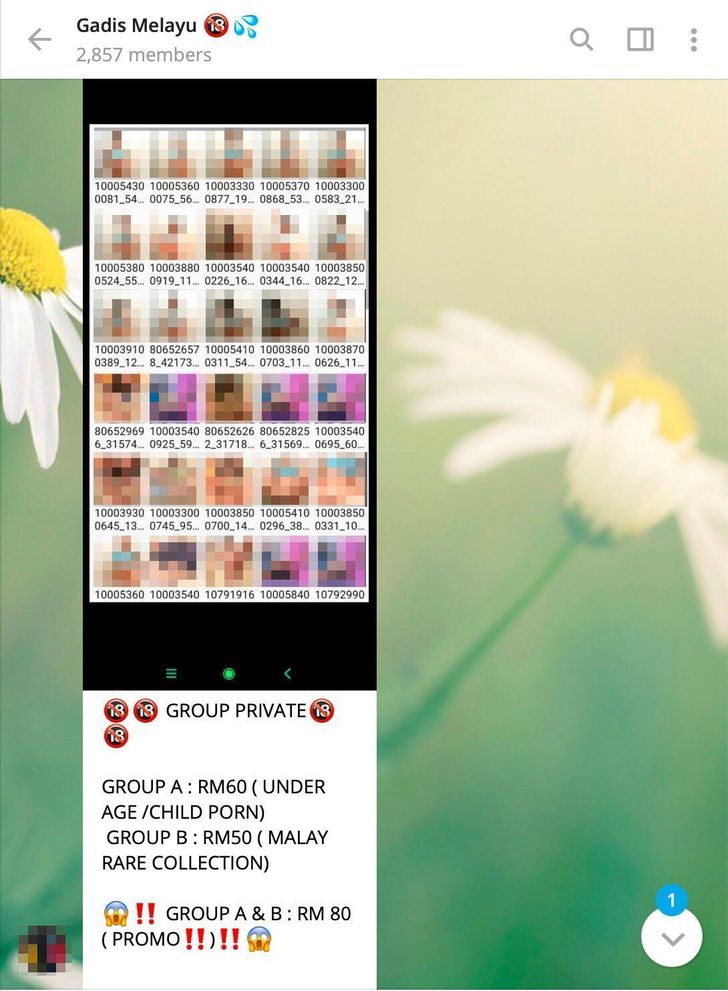
We reported the channel to Telegram for child abuse on May 7, but no action had been taken as of publication time. In fact, more posts with such content have been shared in recent weeks.
On May 11, for instance, another collection of photos and videos of children was promoted in the channel, with prices and contacts for those who wanted access to it. The same day, a video of an Asian girl exposing her genitals was posted in the group.
More recently, another user wrote: “I just want links to sex videos of little boys and girls.” There were also messages that referred to a “pedomom” – an allusion to a mother’s involvement in pedophilic content.
In countries such as the Philippines, where millions of families lost their income during the Covid-19 pandemic, more parents are turning to selling their children online for sexual exploitation.
We also filed a report to the Internet Watch Foundation (IWF), which is responsible for finding and removing images and videos of child sexual abuse from the internet. Its response was swift, but its hands were tied.
“We are aware of many file sharing programmes available and that they are open to abuse,” the Britain-based charity wrote in a May 13 email, four days after our report.
“The services are based on a peer-to-peer system, without any ISP-hosted content,” the IWF added, referring to internet service providers in a specific geographic location. The foundation does not have the authority to investigate individual internet users and the content of their hard drives.
“This is currently under the sole remit of the police,” it said. “We can only investigate content that is hosted in the public domain.”
Nevertheless, the IWF processed a record 299,600 reports of child sexual abuse imagery last year, including tipoffs from members of the public – close to 40,000 more reports than in 2019.
The charity has also seen a staggering 77 per cent increase in the amount of “self-generated” abuse material, as more children and criminals spend longer online amid the Covid-19 pandemic.
Content of this nature includes child sexual abuse captured by webcams, often in the child’s own room. In some instances, the foundation said, children are groomed, deceived or extorted into producing and sharing a sexual image or video of themselves.
Experts note that there is still limited research on child online safety in the Asia-Pacific region, with many countries still failing to provide sex education.

Under the radar
While some Telegram channels are more focused on explicit content, others share images portraying women in everyday situations such as having fun with their friends at beaches or swimming pools, and working out at the gym – albeit often without their knowledge and consent.
In a group named “SG Sports Bra Babes”, a post read: “Hi everyone, if you’re going to submit pics, please crop out the Instagram slide numbers or tagged icon. You can wait for about two seconds before screenshotting and the icons will fade away.”
This suggests that the photos – and some videos – are screenshots from social media accounts, rather than being shared by the women themselves. The channel, which was set up in February, had 179 subscribers at the end of last month, but some posts had more than 1,000 views.
In another message from March, the administrator decided to run an anonymous poll, which asked users: “Planning on starting a SG Bikini Channel, anyone up?”
On a channel called “Mysggirls”, with more than 4,000 subscribers, there were photos and videos of girls, including some in school uniform. Upskirting videos had also been uploaded, and the administrator wrote in January that people who felt offended should leave the group rather than reporting it.
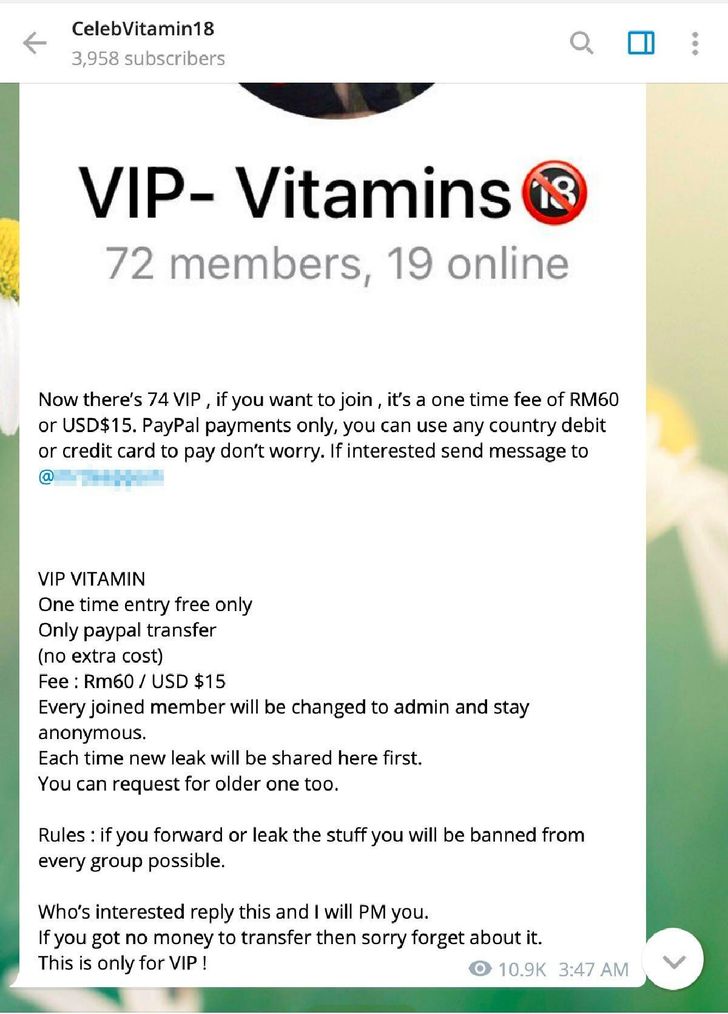
Those who set up such channels on Telegram, and many of their members, are often aware they are being monitored. Some even teach subscribers how to evade authorities and activists.
In a private group called “Love United”, which is believed to be based in Singapore, an active user with the handle “Just Siew Mai” warned others about the risks in late March.
“Stay here but keep no traces of your online identity. Change your DP [profile picture], your username and most importantly, don’t get too attached to your Telegram stuff. Be ready to delete your Telegram account at a moment’s notice. That’s how we combat those white knights,” the user said. “What we are doing is lawfully wrong already, so we must do it smartly in order not to get caught.”
Just Siew Mai also told others not to worry if activists had exposed the group on Twitter, adding: “Make sure your online identity and character is totally different from your real life persona.”
The user later deleted these messages.
On “Vitamin4Testicles” – a channel in which more than 19,000 members shared over 15,000 photos and 6,000 videos, mostly of women from Malaysia – there were frequent requests for leaks about specific women. Some also openly offered and sold images of their ex-girlfriends.
“If your friend’s photo is in [the] group then it’s already with many people,” a user wrote on May 13. “Something [that] is online is always online. You are here to watch nudes, just accept it.”
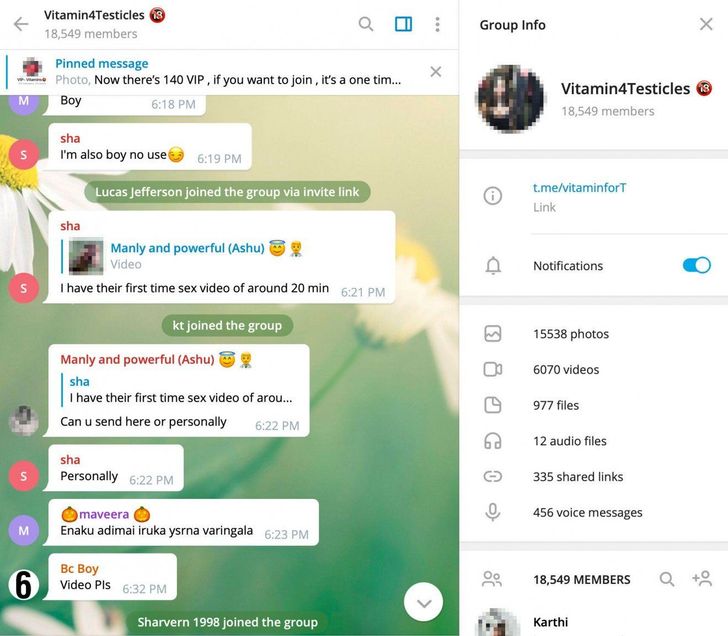
There are even users who warned others not to post content about a specific woman after realising she had filed a police report.
While some channels are public, other rooms are private – and access to those has varying requirements, including payments in cryptocurrency, or photos of the users’ genitals and faces.