Google broadening machine learning tech

Professional nine-dan go player Lee Se-dol, right, answers reporters’ questions during an interview after the first game against Google’s artificial intelligence machine, AlphaGo, at the Four Seasons Hotel in central Seoul, Wednesday. / Korea Times photo by Hong In-kie
By Yoon Sung-won
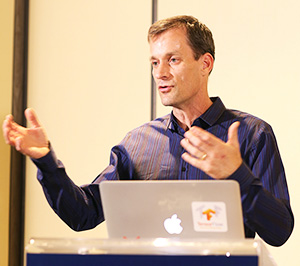
Google’s senior artificial intelligence researcher Jeffrey Dean speaks during a press conference at the Four Seasons Hotel Seoul, Wednesday. / Courtesy of Google Korea
Google said Wednesday it is applying its artificial intelligence (AI) learning technology to increasingly diverse sectors such as healthcare and robotics.
Jeffrey Dean, who heads the company’s deep learning research team, said the technology will benefit human lives in general as its learning capacity improves.
“Machine learning technology is already contributing to the improvement of Google’s existing products,” the Google senior fellow said during a press conference in Seoul. The conference took place on the sidelines of the first match between Korean professional go player Lee Se-dol and AI system AlphaGo, developed by Google’s AI business subsidiary DeepMind.
“We expect that the technology can be applied to new areas such as healthcare and robotics, tapping into the deep neural network,” he said.
Google has pushed for the deep learning technology, which is a type of machine learning method in which machines mimic humans’ ways of recognizing things.
The technology aims at empowering machines to autonomously analyze data, recognize similarities and differences and learn from them, with or without instructions by humans. This technology has been considered one of the cutting-edge points of AI.
Dean said the machine learning technology will ultimately combine both supervised and unsupervised learning methods. In supervised learning, humans provide labels and instructions to data analyzed by the machine, while the unsupervised learning method lets the machine learn independently without such guidance.
“Supervised learning has been more preferred so far. Unsupervised machine learning still remains in the trial stage,” Dean said. “But ultimately, both supervised and unsupervised machine learning methods should be used at the same time.”
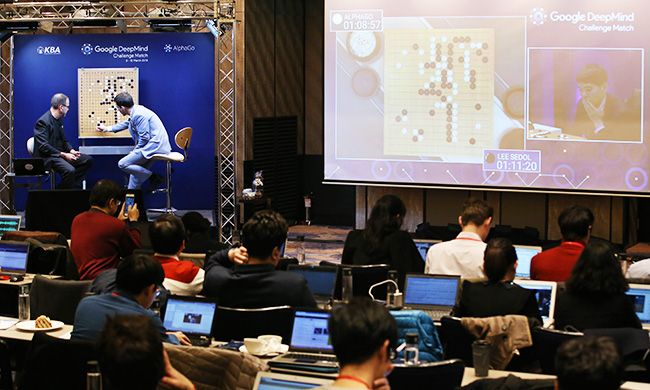
Reporters at home and abroad take a look at a historical match between Google’s artificial intelligence system AlphaGo and the World No. 1 player Lee Se-dol, at the Four Seasons Hotel in Gwanghwamun, central Seoul, Wednesday. / Yonhap
The Google researcher said the company is expanding the application of deep learning technology to its software services such as Gmail, Google Photos, Google Maps, Google Translate and the Android mobile operating system.
Dean said the technology is flexible enough to support diverse input and output options as well as applicable to video, audio and text in multiple languages.
“At Google, we have boosted the use of deep learning technology in developing our software services between 2014 and 2015,” he said. “As of now more than 20 percent of our services use the technology and the rate is rapidly increasingly.”
The AI expert pointed out that machine learning technology still has problems. It requires further improvements to be able to apply a limited number of supervised, labeled data to a high volume of unsupervised data.
“More fundamentally, machine learning technology cannot change or evolve the neural networking algorithm even through learning processes,” he said. “But humans can do that. Our learning capability can be improved as we continue to train.”
Meanwhile, DeepMind is expected to test its AI technology in other games such as Starcraft, the world’s most-sought-after real-time strategy game.
“DeepMind’s CEO Demis Hassabis is considering applying the technology to Starcraft,” Dean said. “Unlike in Go, players cannot monitor the entire in-game space in Starcraft while things continue to happen outside their view. This will be a challenge in another sector.”
About Dean’s remark, Hassabis briefly answered, “We will see.”