Reportage Hanwha Impact to reduce carbon emissions via modified hydrogen gas turbines

Photo of FlameSheets, which are key components of hydrogen co-firing power generation plants / Courtesy of Hanwha Impact
Hanwha Impact procures deal to remodel U.S. hydrogen co-firing gas turbine power plant
By Kim Hyun-bin
PYEONGTAEK, Gyeonggi Province _ Conglomerates have been getting on board with the government's carbon neutrality 2050 efforts to reduce the emissions of carbon dioxide. One of the leading examples is Hanwha Impact, with its state-of-the-art technology to modify gas turbines, so as to reduce carbon dioxide emissions via hydrogen co-firing technology.
"Hydrogen co-fired power generation is a method of generating power by burning hydrogen and natural gas together in a gas turbine. It is possible to reduce carbon dioxide emissions while using old gas turbines from existing liquefied natural gas (LNG) power plants at low cost. It is expected to serve as an intermediate stage in the generation of zero-hydrogen power plants,” a Hanwha Impact official said.
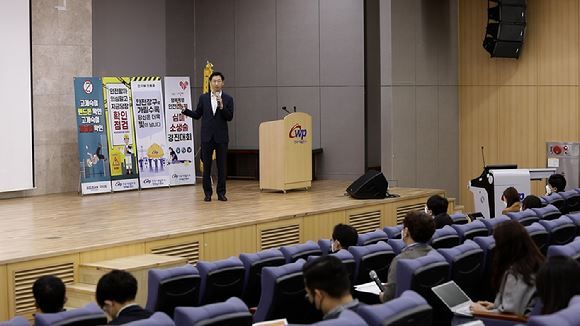
A Hanwha Impact official briefs reporters about the technology of hydrogen co-fired power generation at the Korea Western Power Co. in Pyeongtaek, Gyeonggi Province, on November 30. Courtesy of Hanwha Impact
To provide more information on the new technology, Hanwha Impact invited reporters to Korea Western Power Co., located in Pyeongtaek, Gyeonggi Province, on November 30th, where Hanwha modified turbine technology is being demonstrated.
Hanwha Impact is the only company in the country that has the technology to modify the turbines.
“Doosan Heavy Industries is working to build new turbines, while we are modifying the existing old turbines to become more eco-friendly by burning hydrogen to reduce carbon dioxide,” a Hanwha Impact official said. “There are no local competitors in the field and vast opportunities exist to transform scores of antiquated gas turbines around the country.”
The company acquired Power Systems Mfg (PSM) in the U.S. and Thomassen Energy in the Netherlands in March to accelerate its transition to eco-friendly energy, as well as to be the first to obtain hydrogen co-fired power generation technology in Korea.
With the technology, Hanwha Impact was able to ink a memorandum of understanding (MOU) with Korea Western Power Co. to implement the first demonstration hydrogen co-firing gas turbine project in the country, which was the reason reporters were invited to the site.
Hydrogen co-fired power generation is a method of running a gas turbine by mixing hydrogen fuel with liquefied natural gas (LNG). The higher the proportion of hydrogen in the fuel mix, the more carbon dioxide emissions can be reduced, which is in line with the country's carbon neutrality efforts and aids in building the hydrogen economy.
In the briefing, Hanwha Impact explained in detail the current status of hydrogen gas turbine technology development, and the prospects of the hydrogen co-firing power generation business through the remodeling of existing gas turbines.
The gas turbine has the characteristic of obtaining higher output compared to other engine types. However, the problem is that the emission of nitrogen oxide (NOx) increases as the turbine inlet temperature (TIT) continues to rise.
Gas turbines are divided into classes according to their TIT. The high-performance turbines are categorized as “J-Class” and “H-Class,” while the “F-Class” and “E-Class” gas turbines are in the lower-efficiency category.
Recently, more J-Class and H-Class gas turbines have been implemented locally, gradually reducing the utilization of gas turbines in the F-Class and below.
More than half of the F-Class and lower gas turbines are aged and have been in operation for more than 15 years. As a result, the operation these turbines was prematurely stopped, due to their low efficiency, and they became stranded assets at their sites for several years.
Currently, Hanwha Impact operates co-combustion technology that utilizes gas turbines fueled by mixed hydrogen and LNG. The move requires advanced technologies to maintain high stability, flame control technology through aerodynamic and combustor modification and replacement technology for hydrogen co-firing.
After a test-run of the hydrogen co-firing project, Hanwha Impact plans to apply the technology to gas turbines below F-Class around the country. To this end, along with Korea Western Power Co., the company is launching the “Daesan Demonstration Project,” in which it will install a gas turbine at the Pyeongtaek Power Plant.
This project is the first in Korea to move an aging E-Class gas turbine, along with its ancillary equipment, to the site of Hanwha Impact's Daesan plant, and to apply hydrogen co-firing technology to carry out a demonstration project. Through the demonstration project, carbon dioxide and nitrogen oxide emissions are measured and tested.
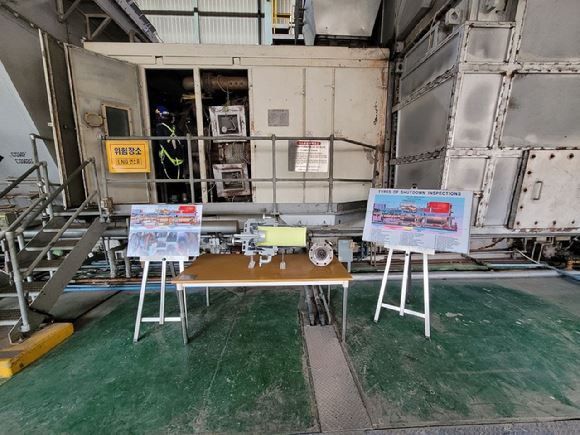
Korea Western Power Co.'s gas turbine and FlameSheet module / Courtesy of Hanwha Impact
With this project, Hanwha Impact aims to become the world's first to raise the hydrogen co-firing proportion of gas turbines to more than 50 percent, with a carbon reduction effect of 20 percent to establish the foundation for the commercialization of hydrogen gas turbines better. The company expects the results of the demonstration project to be released in 2023.
"Our competitiveness is based on the fact that we already have a power plant running on our hydrogen co-firing technology, as well as the capability to increase the hydrogen co-firing rate continuously," Song Yong-sun, the managing director of Hanwha Impact, said.
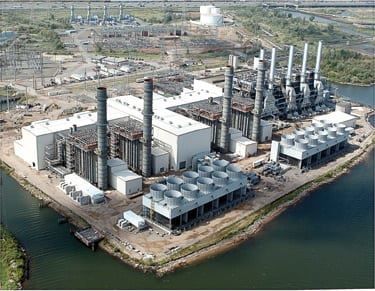
The Linden Cogeneration plant in the U.S / Courtesy of Hanwha Impact
Meanwhile, Hanwha Impact announced earlier this month that it had procured an order for a hydrogen co-firing gas turbine remodeling project at the Linden Cogeneration plant in the U.S. This order is expected to be the first case in the world to apply a 40-percent hydrogen co-firing rate to a 172-megawatt (MW) natural gas turbine.
In September, the company changed its name from Hanwha General Chemical to Hanwha Impact, embedding the company's motives to create a positive impact on humanity and the earth through technological innovation, leading to a sustainable future.