Korea makes strides in lunar mission to catch up in global space race

A scientist at the Korea Institute of Civil Engineering and Building Technology tests a rover in a dirty thermal vacuum chamber in this file photo. Courtesy of KICT
By Holly Chik
In Korea, scientists are making blocks from moon soil simulant for space architecture and testing newly developed rovers and satellites in the world's largest chamber for recreating the harsh environment on Earth's only natural satellite.
They ultimately hope to be able to build structures on the lunar surface, which will enable space construction and manned explorations.
As a latecomer to the global space race that is aiming to land on the moon in the next decade, the country is working to equip itself with the right scientific capabilities for future missions. The projects at the Korea Institute of Civil Engineering and Building Technology (KICT) are an example of what the local research community is doing to advance space exploration.
“On Earth, most of our construction uses concrete. But from Earth to the moon, transportation is expensive. So why don't we use lunar soil?” said Lee Jang-guen, a research fellow at KICT's department of future and smart construction research.
The researchers first produce simulated moon soil by grinding black volcanic rock from Cheorwon County bordering the North. They then use a microwave to turn the sand-like simulant into solidified blocks.
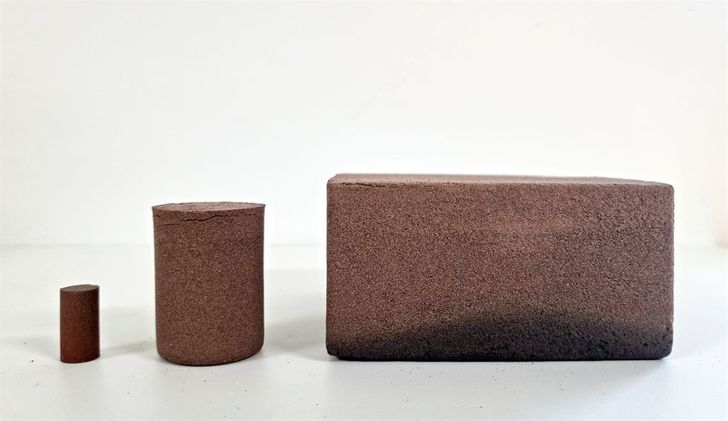
Scientists at the Korea Institute of Civil Engineering and Building of Technology create blocks from lunar simulant using a microwave sintering technique in this file photo. Courtesy of KICT
Lee said the team has developed a technique to make blocks by heating the soil in a mold to more than 1,000 degrees Celsius in two to three hours and cooling them. In space, the process could be powered by nuclear energy.
“Now it's just small pieces of blocks. We're trying to make larger blocks so that we can combine them and make real structures,” the researcher who leads KICT's space research program said from a laboratory at the government-funded research institute specializing in construction technology.
Cho Sun-hak, director general of the space policy and nuclear energy bureau at the Ministry of Science and ICT, said the potential building capability could open the doors to more possibilities in lunar missions.
“If they were to build something in a human space flight mission to the moon's surface, it could contribute to (or extend) a mission. There are many possibilities,” he told The Korea Times from his office decorated with models of local and international satellites and rockets, including Arirang-1, the country's first satellite launched in 1999.
“Back then, there was a lot of disbelief in the program. (Some asked) 'we can't even launch a satellite into Earth orbit, so what are you going to do with the lunar surface?'” he recalled from his time as the program manager who funded the lunar research project in 2011.
He said Korea had been “late to the game” when it started space research in the late 1990s, but the need for space has grown to encompass economic, safety and security goals. He pointed to the recent floods that took at least 40 lives across the country.
“We are late to the game in terms of launch vehicles and satellite hardware, but we could use supercomputing to have the right model for weather predictions and work with other countries in sensing and detecting climate-related factors.
“For climate mitigation and predictions, space is an essential tool. Its role is expected to become more important in the future,” he said, adding that satellite imagery and sensing information could help monitor the weather and assess environmental impacts to aid policymaking.
He said the administration also aims to go further into space for exploration, transportation and research, as well as support industries centered on space.
“We believe that compared to leading space nations, we still have some room to fill. We still could play some role in the international order in using space and try to leverage it together.”
Cho, a mechanical engineer by training who has served as a public officer for decades, was also behind the launch last August of Danuri, Korea's first lunar orbiter named after the Korean words for “moon” and “enjoy.”
“Ten years ago, nobody thought it would be successful,” Cho recalled, from his time as the lead negotiator with American counterparts at NASA and the State Department in 2013.
“There had been doubts. Even us, we weren't really sure it could go well in the first shot,” he said. “It took some time. International collaborations and partnerships have been the prerequisites. It took almost four months to get into the lunar orbit. If you make a small error or mistake in the calculation, it will just go somewhere else. With the partner's help, Korea was able to accurately calculate the trajectory and it was precisely on orbit. It was so precise that we saved so much fuel for it to be used for three years.”
The Korea Pathfinder Lunar Orbiter was originally planned to run for one year. It was launched last year aboard a SpaceX rocket from the United States.
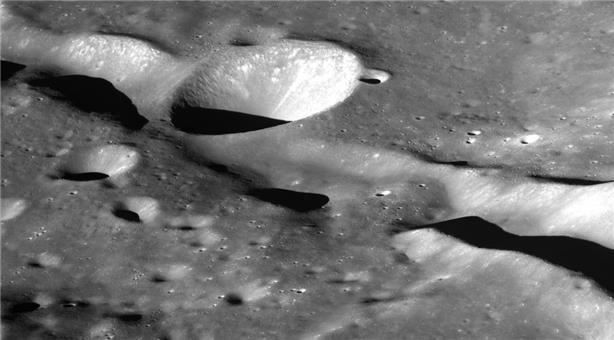
Seen is Vallis Schrodinger, a long and narrow valley on the far side of the moon. The Danuri lunar orbiter took the photo of the valley on March 24. Courtesy of Ministry of Science and ICT
“It was very surprising to us. For our researchers, it was their first shot to the moon. It was a very successful one,” he said, adding that the orbiter is now taking images of the dark side of the moon to lay the grounds for future missions. Korean scientists are sharing the data with their international peers.
The country aims to launch another lunar orbiter in 2031 to locate a precise landing site for a lander in 2032.
Cho said the mission will look into the material characteristics of the lunar surface soil, gather more precise information about astronomy and explore ways to apply space technologies on Earth, including new materials and control systems.
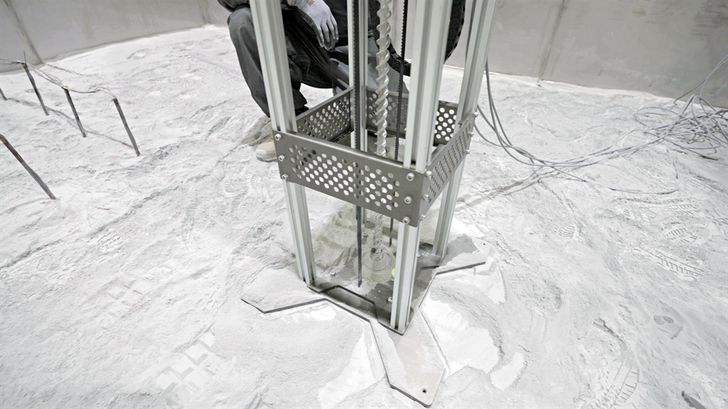
A simulation of the lunar subsurface is investigated under extreme environmental conditions at the Korea Institute of Civil Engineering and Building Technology in this file photo. Courtesy of KICT
To enter orbit around the moon, which is more than 380,000 kilometers away from Earth, he said the country will need a new launch vehicle three times the propulsion of the existing homegrown Nuri rocket so that it can carry a heavier payload.
The Nuri was launched earlier this year to put satellites into low orbit 600 kilometers to 800 kilometers above Earth. The country plans to launch more Nuri rockets for three years in a row from 2025 to improve its reliability and cost efficiency.
“(Space) is a field that we only entered a couple decades ago. It was a first and something that was not proven,” Cho said.
“Over the last decade we were able to prove one by one. That does not only illustrate our scientists' abilities, but also the result of hard work and tenacity.”
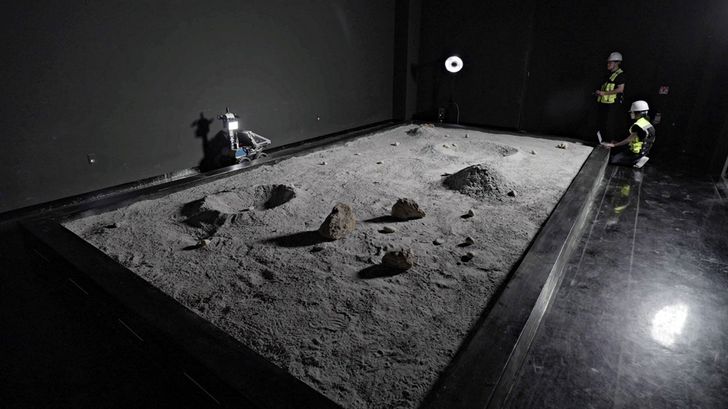
Scientists at the Korea Institute of Civil Engineering and Building Technology develop a rover-based 3D mapping system for detailed geographical exploration in this file photo. Courtesy of KICT
Back on Earth, researchers are busy running tests in the lunar simulation chamber at KICT.
The giant dirty thermal vacuum chamber mimics the very thin atmosphere and wide temperature range on the moon. It can be cooled down to minus 190 degrees Celsius with liquid nitrogen and heated to 150 degrees Celsius.
It is called “dirty” because it can house a container that is filled with 20 tons of simulant to create a two-meter deep lunar surface environment, according to Lee.
He said the chamber is an ideal test bed for researchers who are developing lunar devices like rovers to boost chances for success of future missions.
“We want to ensure cost efficiency and mission performance. (Researchers) can put equipment over here to test it up, so they can make sure that every system is working well. It gives us a higher possibility for mission success,” Lee said.
Holly Chik is a science reporter with the South China Morning Post. She is currently based in Seoul, reporting for both The Korea Times and the South China Morning Post under an exchange program