Korean battery makers lukewarm about expanding production for Renault

Renault Korea Motors factory in Busan / Courtesy of Renault Korea Motors
By Park Jae-hyuk
Renault Korea Motors is facing uncertainties about its plan to manufacture 200,000 electric vehicles (EVs) in Busan annually, as battery makers here remain reluctant to increase their domestic production, according to industry officials, Monday.
During Renault Group Senior Vice President Francois Provost's recent closed-door meeting in Korea with Prime Minister Han Duck-soo, the French firm's executive is said to have complained about difficulties securing enough EV batteries here.
Renault Group Executive Vice President Guido Haak also asked Busan Mayor Park Heong-joon to support the company's planned investments in the city, during their meeting in Paris last Tuesday.
Their remarks came as LG Energy Solution, SK On and Samsung SDI regard Renault's EV production capacity in Korea as insufficient for them to build new plants here.
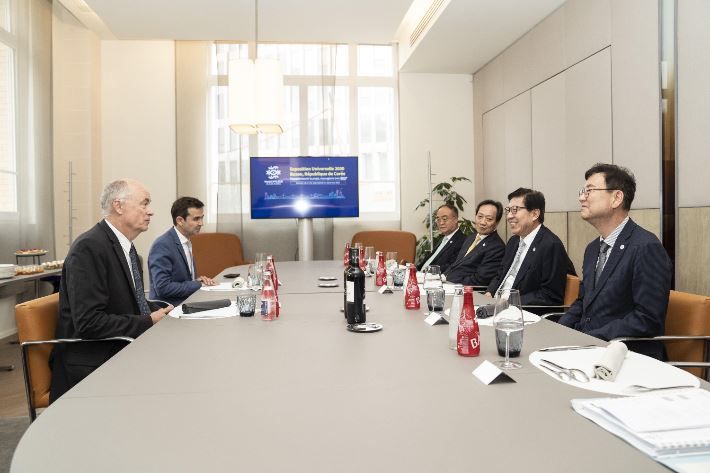
Renault Group Executive Vice President Guido Haak, left, speaks with Busan Mayor Park Heong-joon, second from right, during their meeting at the carmaker's headquarters in Paris, June 20. Courtesy of Busan Metropolitan Government
Although Chinese batteries are mentioned as alternatives, Renault is desperate to secure Korean batteries to comply with international trade regulations. The carmaker also hinted that it may nullify its plan to produce EVs in Korea, if it fails to secure enough batteries here.
“Our company seeks to invest in a local EV factory with a plan to export 70 percent of the production,” Renault Korea Director Park Jeong-ho said at a conference hosted by the Korea International Trade Association (KITA) last Thursday. “We need to secure batteries in Korea for export, but due to the short supply of local batteries, it is difficult for us to make investment decisions.”
He also emphasized that a communication channel is needed between carmakers and battery manufacturers, in order to enable General Motors and Renault to secure enough EV batteries in Korea.
However, Korean battery firms have focused more on their investments in the U.S. and European countries, to receive larger incentives.
BlueOval SK, a joint venture between SK On and Ford Motor, secured up to $9.2 billion in low-interest loans from the U.S. Department of Energy. A battery plant to be built in Georgia jointly by SK On and Hyundai Motor will receive $700 million worth of subsidies.
Samsung SDI and GM will also receive tax incentives for 15 years to support their joint battery plant in Indiana.
“Because of Korea's insufficient support for local battery plants, EVs equipped with batteries made in Korea will face difficulties securing price competitiveness in foreign markets,” an SK On official said during the KITA conference. “Subsidies and tax incentives are needed on production, facility investments and R&D.”