Korea's self-developed space rocket Nuri ready for launch

Korean space rocket Nuri is erected at a launch pad at the Naro Space Center in Goheung, South Jeolla Province, June 1. Courtesy of Korea Aerospace Research Institute
By Baek Byung-yeul
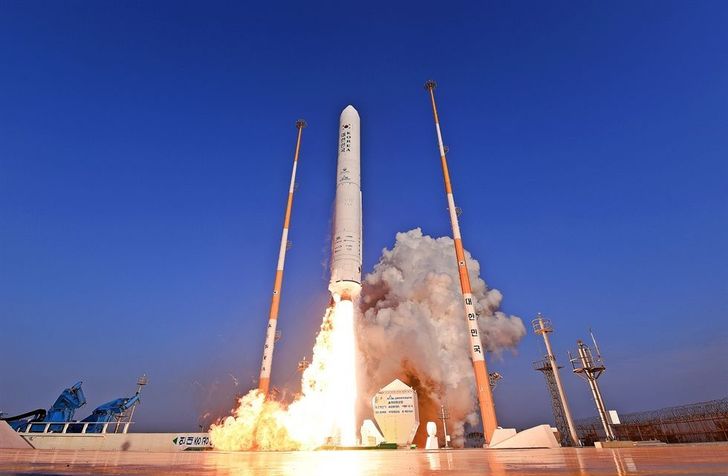
Korea is set to launch its domestically developed Nuri rocket, Oct. 21, which will be a historical step forward for the country to become a prominent player in the space industry.
The Korea Aerospace Research Institute (KARI), which will oversee the launch, said the 200-ton Nuri rocket will lift off from the Naro Space Center in Goheung, 473 kilometers south of Seoul, Thursday. It is expected to be launched at around 4 p.m., but KARI will announce the exact time in the morning, after considering weather conditions.
If the launch is successful, Korea will be the seventh country to launch a space rocket with domestically developed technology ― following Russia, the United States, France, China, Japan and India ― that has the independent capability of placing an over 1-ton satellite into orbit.
A single-stage launch vehicle, propelled by a 75-ton liquid-fueled engine is launched on a test flight from the Naro Space Center in November, 2018. Courtesy of Korea Aerospace Research Institute
Since 2010, Korea has invested around 2 trillion won ($1.7 billion) in the Nuri development project. As the October launch is a test, the rocket will carry a 1.5-ton dummy satellite into space to see if it can reach an orbital altitude of 700 kilometers, KARI said.
The Thursday launch could be delayed in case of bad weather or technological issues although there will remain a launch window from Oct. 22 to Oct. 28. The institute said weather conditions such as optimal temperature, humidity, wind and cloud cover, must be met for a successful launch. Regardless of the success or failure of the test, KARI's next trial launch is scheduled for May, next year.
“Currently only six countries have succeeded in developing medium and large engines with their own technology,” Oh Seung-hyub, director of the Launcher Propulsion System Development Division of KARI, said during a media briefing, Oct. 12.
If Korea succeeds in the test launch, Korea could become a powerhouse in the space industry, Oh said.
“It is meaningful that KARI supported the creation of a space industry ecosystem with the launch vehicle and the strengthening of industrial capabilities while conducting the Nuri development project,” he said.
“When it comes to a launch vehicle-related development project for instance, about 30 companies have joined the project. If we count companies associated with these 30 companies, around 500 people from 300 companies have taken part in the project,” the director added. Hanwha Aerospace joined the project to develop a 75-ton engine for the space rocket.
At a time when even private companies are fiercely competing in the space race, Korea expects the Nuri will signal that the country is joining the industry with huge potential. Korea has been almost fully dependent on the U.S. for intelligence satellites, and so the rocket will provide the country an opportunity to build its own satellite-based navigation system and a sixth-generation communications network, and venture into other industrial sectors in the space industry.

A night view of the Naro Space Center in Goheung, 473 kilometers south of Seoul, where Korea's Nuri space rocket will be launched Oct. 21. Courtesy of Korea Aerospace Research Institute
Despite the Nuri drawing keen attention from many Koreans, the public are prohibited from closely viewing the rocket launches as the science ministry and Goheung-gun where the space center is located decided to completely control access within 3 kilometers of the center over safety concerns.
Instead, they asked the public to watch launches on TV or livestreaming platforms such as YouTube and Naver TV.