Sharp Technics K seeking to expand MRO biz to Southeast Asia
'Tech transfer from IAI to help raise competitive edge of Korean firms'
By Jun Ji-hye
Sharp Technics K (STK), a Korean aircraft maintenance, repair and overhaul (MRO) company, recently signed a memorandum of agreement with Israel Aerospace Industries (IAI) and Incheon International Airport Corp. (IIAC), under which IAI will establish its first overseas production base at the Incheon airport to convert wide-body passenger planes to freighters.
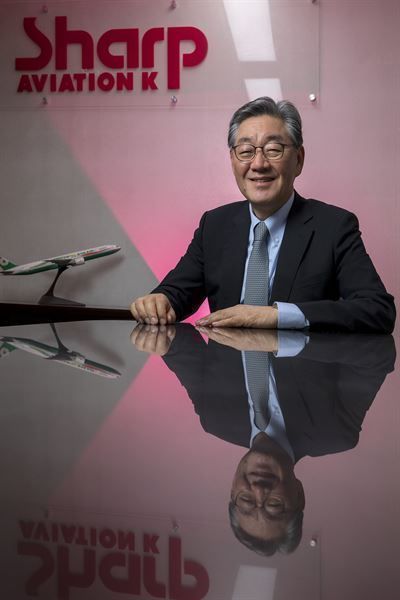
Paik Soon-suk, president and CEO of Sharp Technics K and its parent company Sharp Aviation K, holds an interview with The Korea Times at the company in Seoul, June 30. Korea Times photo by Shim Hyun-chul
Paik Soon-suk, president and CEO of STK and its parent company Sharp Aviation K, said STK will capitalize on the latest agreement to learn advanced technologies and knowhow from Israel's major aerospace company, and will seek to expand its MRO business to the global market, especially Southeast Asia.
Under the agreement signed May 4, IAI will set up a joint venture with STK to convert the 777-ERSF passenger planes into freighters in a bid to meet the expected increase in demand for wide-body freighter aircraft with long-haul capacity.
IIAC, the operator of Incheon airport, will be in charge of constructing the necessary infrastructure, such as a hangars.
“We currently have 350 engineers, and will hire an additional 500 to execute the agreement. In four to five years, we will have 1,000 engineers in total,” Paik said during an interview with The Korea Times at his office in Seoul, June 30.
“I believe IAI selected Incheon as its first overseas production base over other countries where the MRO business is well established, such as China and Mexico, because the Israeli company trusts Korean engineers who have a strong sense of responsibility in doing such an important project. Plus, the Korean government's full support played a part,” he said.
Paik said converting passenger planes to freighters requires a high degree of technology that is very difficult for a company to acquire in a short period of time. Through the agreement, such advanced technologies will be transferred to STK from IAI, which will help the domestic MRO industry raise its competitive edge.
“In the medium term, we will be able to convert not only Boeing planes but also others such as those made by Airbus. This will create many business opportunities and profits for Korean companies,” Paik said. “STK is seeking to expand its MRO business to the Southeast Asian market after learning technologies and knowhow from IAI.”
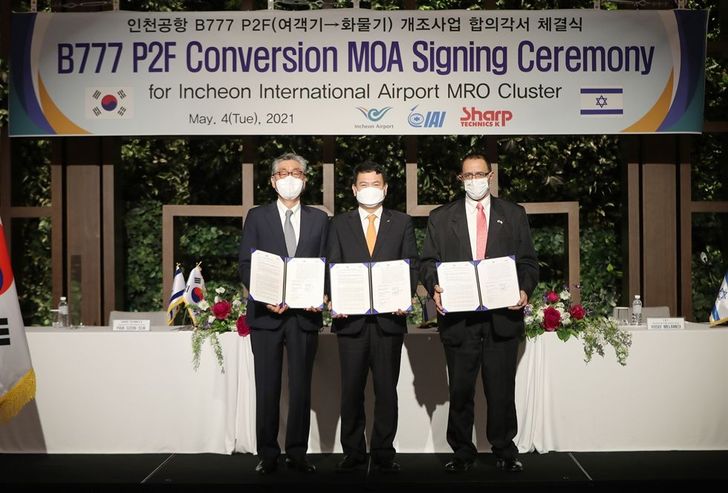
Paik Soon-suk, left, CEO and president of Sharp Technics K, holds a memorandum of agreement with Kim Kyung-wook, center, Incheon International Airport Corp. president and CEO, and Yossi Melamed, general manager of Israel Aerospace Industries, during a signing ceremony at Paradise City in Incheon, May 4. Courtesy of Incheon International Airport Corp.
Although IIAC and STK said their agreement with IAI would contribute to developing the country's entire MRO industry, politicians in South Gyeongsang Province and Sacheon City there have been protesting, claiming the agreement will only disperse investments in the industry and result in weakening regional economies.
Sacheon City, where Korea Aerospace Industries (KAI) is headquartered, has invested in the MRO business in the region, with KAI setting up its MRO subsidiary, Korea Aviation Engineering & Maintenance Service (KAEMS) there, in 2018.
Regarding this, Paik said, “Some 200 parts are necessary for one door of a freighter. Companies in Sacheon could win these orders when IAI's conversion project commences full-scale operations at Incheon, and this will help all the firms grow together.”
He noted wide-body passenger planes cannot land at an airport in Sacheon because its runway is too short, adding that this was one of the reasons why Incheon was selected.
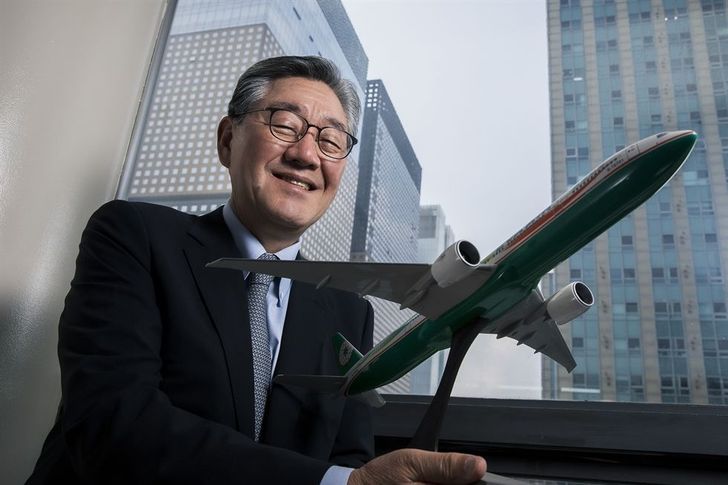
Paik Soon-suk, president and CEO of Sharp Technics K / Korea Times photo by Shim Hyun-chul
Paik also serves as the president and CEO of Sharp Aviation K, the largest independent aviation and airport service provider in Korea, and the parent company of STK.
He said Sharp Aviation K, which was established in 1964, offers ground handling services in eight airports in the country, handling over 3 million passengers, 280,000 tons of cargo and 135,000 flights annually.
Like many other companies in the aviation industry, Sharp Aviation K was also hit by the COVID-19 pandemic, with its sales having fallen by 90 percent in February last year, but the company has not laid off any of its employees. Rather, it recruited more employees and raised wages of the entire employees by 4 percent this year.
“Our businesses have been normalized to some extent since May last year when the cargo plane market became active,” Paik said. “Our divisions dealing with passengers are still experiencing difficulties, but it has been offset to some extent as other divisions have made profits.”
Paik noted his company is expected to see the fruit of its investments, which have been made over the last few decades, in 2025, adding that it expects its sales to increase to about 300 billion won ($263 million) in that year from the current 140 billion won.
“By that time, the number of our employees will increase to 2,500 from the current 1,500,” he said.