Market Kurly seeks W300 bil. in investments before IPO

Market Kurly's corporate image / Courtesy of Kurly
Online grocer's future looks tough in competition against Shinsegae, Lotte Shopping
By Kim Jae-heun
Fresh food delivery platform Market Kurly is seeking 300 billion won ($269.8 million) in investments prior to its listing that could happen this year.
The move is a part of the firm's broader strategy to bump up its monetary value on the over-the-counter market to 3 trillion won before an initial public offering (IPO).
The firm separately raised 200 billion in a previous round of funding in May 2020. At that time, Market Kurly was valued at an estimated 900 billion won.
The company has sought to expand its business across the country, increase sales and improve its enterprise value with the money it attracts.
Market Kurly has accordingly pushed to expand overnight delivery services nationwide. The service is currently available only in the greater Seoul area.
Starting in May, Market Kurly will introduce the service in the central Chungcheong provinces and expand it to major cities including Gwangju, Daegu and Busan.
“We are thoroughly reviewing the expansion of our overnight delivery service outside of the capital area, along with the opening of a logistics center here in Gimpo,” Market Kurly CEO Sophie Kim said during a press conference held in Gimpo, Gyeonggi Province, March 30.
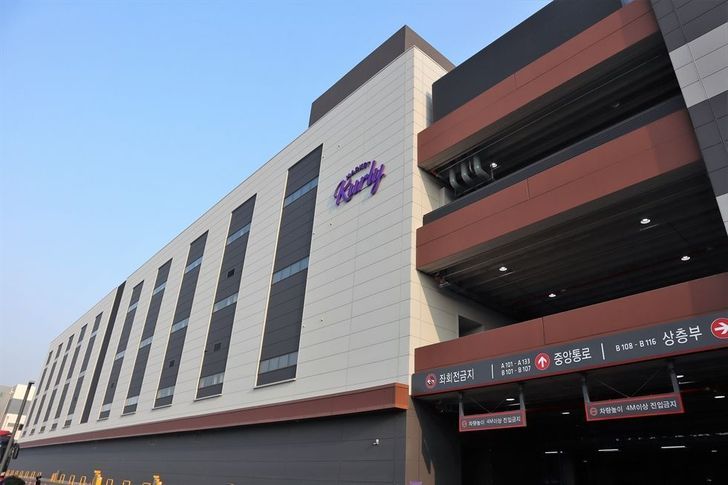
Market Kurly's new logistics center in Gimpo, Gyeonggi Province / Courtesy of Kurly
Market Kurly spent 30 billion won to build the distribution facility in Gimpo. The company now has four distribution centers in Korea. The new logistic center has allowed it to double its deliveries to 440,000 orders per day.
The firm has also seen its sales more than double every year. When it was established in 2015, its revenue stood at 2.9 billion won ― five years later, the figure skyrocketed more than 300 times to 952.3 billion won.
It believes this can triple in one year.
Local investment banks also project the online grocer's value to rise as high as 5 trillion won to 6 trillion won on the U.S. stock market.
Coupang, whose annual sales stand at 13 trillion won, saw its total market value reach 85 trillion won when it went public on the New York Stock Exchange. Simply applying the same multiple of price per sales ratio, Market Kurly's enterprise value could surge five or six times to around 5 trillion won.
The only setback is its snowballing losses that grew from 5.4 billion in 2015 to 116.2 billion in 2020. The company's accumulated deficit stands at 270 billion won, due mostly to money spent on marketing and building logistics centers.
Market Kurly believes it can achieve a turnaround in two to three years once it secures more distribution centers in Korea; but market watchers see things differently.
“Recently, retail giants have launched fresh food delivery services and this will limit Market Kurly's potential growth or improvement in profitability. It will be hard to compete against major companies like Shinsegae or Lotte Shopping that have lots of capital and nationwide distribution channels,” an industry source said.