Moon bets high on future mobility as economic driver

President Moon Jae-in speaks during his visit to Hyundai Motor's plant in Ulsan, Friday. Behind him is a mockup of Hyundai Motor's air taxi vehicle. Yonhap
President visits Hyundai Motor plant, praises EV efforts
By Nam Hyun-woo, Do Je-hae
President Moon Jae-in announced Friday a plan to strengthen Korea's presence in the future mobility market, highlighting the next five years will be a “golden time” for the country to secure a leading position.
The plan is aimed at meeting the government's policy goals of turning the country into a leader in eco-friendly vehicles and autonomous driving technology. President Moon pledged the country will have 1.13 million electric vehicles (EVs) and 200,000 hydrogen fuel cell EVs; export 530,000 EVs and hydrogen vehicles; and nurture domestic battery makers to log more than 50 trillion won ($44.15 billion) in sales by 2025.
“The global automobile market will be reshaped promptly and future mobility technologies will be at the center of the change,” Moon said during a visit to Hyundai Motor's plant in Ulsan.
“The market is seeing heated competition in EVs and Tesla is rolling out models which combine autonomous driving and eco-friendly technologies. We also need to make bold and fast moves in order to retain the country's status as an automobile powerhouse and a leading nation in the Fourth Industrial Revolution. … The next five years will be the golden time for the country to secure that status.”
Moon's visit to Hyundai Motor's manufacturing base came after the government announced the Korean New Deal initiative in July, in which the eco-friendly mobility industry will play a key role in the country's future economic growth. As part of the initiative, the government will invest 20 trillion won in the eco-mobility sector by 2025, and Friday's policy package was part of the initiative.
In the policy package, the government pledged to increase the number of EV charging stations to enable “people to charge their EVs as they would their smartphones.”
As of September, the country has approximately 59,000 EV charging facilities, and the government plans to increase the number to 500,000 by 2025. To do so, it will raise the mandatory number of parking spaces with charging stations in new buildings from 0.5 percent of the total area this year to 5 percent in 2022, as well as installing 15,000 charging stations at highway rest areas.
To expand the use of hydrogen vehicles, the government said it will set up 450 hydrogen filling stations by 2025, especially in Seoul and the surrounding Gyeonggi Province.
Moon said all new vehicle purchases by the government and public institutions will be either EV or hydrogen EV from next year.
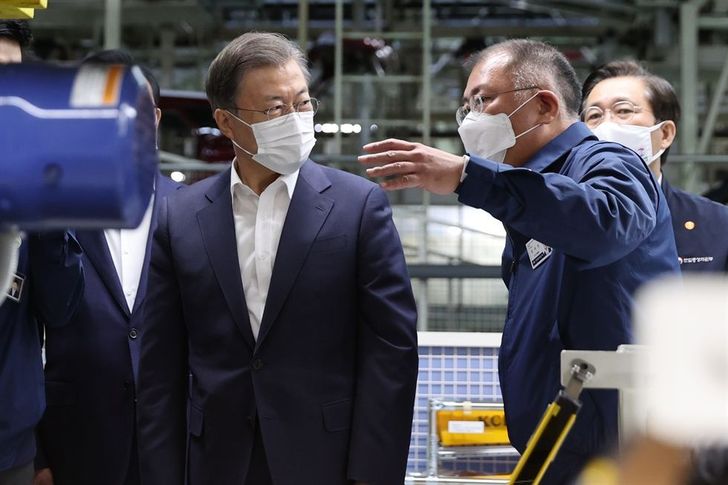
President Moon Jae-in listens to Hyundai Motor Group Chairman Chung Euisun, right, during a visit to the carmaker's plant in Ulsan, Friday. Yonhap
Along with the government, the private sector is expected to expand the EV and hydrogen EV penetration rate. The government said it will provide more than 70 billion won in support to drive and battery makers to improve the price competitiveness of EV components so they can lower prices by an average 10 million won.
By growing the domestic EV industry, the government said the country will be able to export 460,000 EVs and 70,000 hydrogen EVs in 2025, occupying 10 percent of the global market.
The government also released its policy goals on autonomous driving technology. By 2022, the country will roll out vehicles capable of Level 3 self-driving, and commercialize some of the technologies for Level 4 self-driving in 2024. Level 3 means drivers are not required to maintain control of the vehicle under certain circumstances.
Through this, the government anticipates the number of traffic accidents will drop 40 percent and traffic jams will be lowered 20 percent by 2025.
To make a soft landing into this transition, the government also pledged it will provide financial and R&D support for small and midsize components makers so they can secure EV-related technology and facilities.
Currently, there are 400 Korean companies making components for either eco-friendly or autonomous driving vehicles, accounting for only 4 percent of auto parts makers in the country. The government said it will raise the number to 1,000 by 2030 through the support.
During Moon's visit, Hyundai Motor held a delivery ceremony for the 10,000th Nexo hydrogen vehicle to its buyer, surnamed Lim. The Nexo debuted in March 2018, and took 31 months to reach this figure.