Will Kona EV fires dampen Hyundai's electric drive?

gettyimagesbank
By Nam Hyun-woo
Hyundai Motor is striving to contain the impact of fires in its Kona Electric vehicles, deciding to launch recalls affecting more than 77,000 of the electric vehicles (EV) worldwide.
The move is interpreted as an effort to rule out concerns and doubts surrounding Hyundai Motor's EVs, before the carmaker launches its IONIQ EV-only brand and rolls out three models under the brand by 2027.
Industry officials and analysts said the root cause of the fires will be the key in gauging the damage to Hyundai Motor, as it will decide how the company will determine the cost of recalls and prevent additional dents to its EV reputation.
According to industry officials, Hyundai Motor will recall more than 77,000 Kona Electric vehicles delivered across the world. It will affect 25,564 vehicles in Korea, 11,000 in North America, 37,000 in Europe and 3,000 in other markets.
The recalls came after 13 Kona Electric vehicles were reported to have caught fire globally. The most recent fire took place in Daegu on Oct. 4, when a parked Kona EV ignited after being fully charged.
On the recalls, Hyundai Motor called it a battery issue, citing an investigation by Korea's transport ministry.
Analysts assume the cost of the recalls will go up to 600 billion won ($523 million), with Hyundai first reflecting the costs in its book then demanding LG Chem indemnify a certain proportion of the costs later.
“If you assume the battery cost at 120,000 won per kilowatt-hour, the cost for replacing batteries will sum up to 7.68 million won per Kona Electric,” KB Securities analyst Kang Seong-jin said.
“If Hyundai Motor replaces batteries for all 77,000 vehicles, the cost will go up to 591.4 billion won. However, the company is anticipated not to replace batteries for all vehicles. A more realistic anticipation is replacing batteries for 10 percent of the vehicles, which will lower the cost to 60 billion won.”
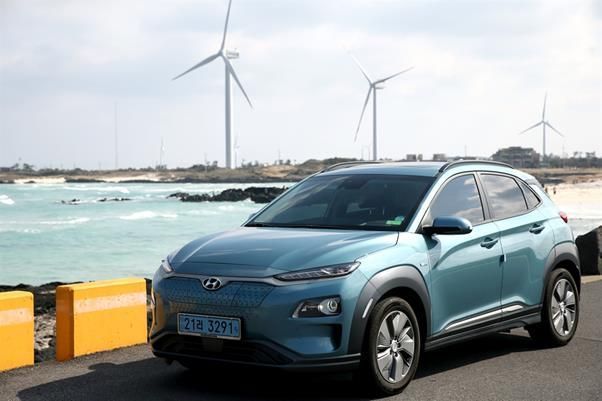
Hyundai Kona Electric / Courtesy of Hyundai Motor
Experts said, however, the bigger concern is which firm is more responsible for the recalls, because either Hyundai Motor or LG Chem will take sizable hits to the reputation and reliability of their EV-related business.
So far, LG Chem's battery is being alleged as the main cause of the fires, according to the transport ministry's findings so far. Some experts say, however, that it is too early to reach a conclusion.
Professor Park Chul-wan of Seojeong University claimed the fire cases could be stemming from “progressive errors,” in which the burnt battery cells were under severe stress due to operating at conditions nearing their tolerance and triggering unexpected errors.
“For example, LG Chem's batteries in GM Bolt EV produced until last year label that a cell holds 57 kilowatt-hours of rated energy, though its nominal pack energy is 60 kilowatt-hours. Its actual capacity remains at 55 kilowatt-hours, because carmakers and battery makers regulate a battery's state of charge with a battery management system in order to have a safety margin,” Park said.
The Kona Electric's battery management system is supplied by Hyundai Mobis' subsidiary, Hyundai Kefico, and its battery pack is supplied by HL Green Power, a joint venture of Hyundai Mobis and LG Chem. HL Green Power assembles LG Chem's battery cells.
The Kona Electric's nominal capacity is 64 kilowatt-hours. According to a National Forensic Service report on a Kona Electric fire, the EV's actual energy capacity reached 62 kilowatt-hours, meaning its safety margin was 3.2 percent. That of GM Bolt is 8.4 percent.
According to Park, there is no fixed rule on how to set a battery cell's rated and actual capacity, and most carmakers determine their safety margin on it. Since the carmaker and battery supplier share responsibility, more thorough investigations are required on this matter, he said.
“This issue is way more difficult than previous recall cases and bears extra significance because it can jeopardize a company's reputation,” Park said.
If the fires' causes are found to be progressive errors, industry officials said a large-scale battery replacement will be required, and this will raise the cost of the recalls too. Currently, Hyundai Motor plans to update the battery management system first and then replace batteries if necessary.
Hyundai Motor refused to comment on the safety margin it determined. LG Chem was also unavailable to comment on this issue citing the sensitivity of the issue.
Hyundai Motor Group is making efforts to become a leading player in the global EV market, with its Executive Vice Chairman Chung Euisun saying the group will sell 1 million EVs and occupy a 10 percent market share globally.
LG Chem is also placing extra emphasis on its EV battery business, with a plan to spin off its battery division later this year.