'No more mobility unicorn firms expected in Korea'

Vehicles used by Tada ride-hailing services are stationed at a parking lot in Seocho-gu, Seoul, Thursday. The National Assembly on Friday passed a bill aimed at Tada. Yonhap
Law banning Tada service nips mobility innovation in the bud
By Nam Hyun-woo
The National Assembly's approval of a revision bill aimed at curtailing popular ride-hailing service Tada is feared to put the brakes on mobility unicorn firms, with industry officials saying the decision will have a negative impact on the country's startup ecosystem and discourage entrepreneurs from starting their own companies.
On Friday, the Assembly approved a revision to the Passenger Transport Service Act that only allows transport service providers to provide outsourced drivers of 11- to 15-seat rental vans if the customer uses the vehicle for more than six hours for tour purposes, or the operators rent the vehicles at ports or airports.
This effectively prohibits the main service of Tada, which has been offering ride-hailing services through an app since October 2018 with 11-seat Kia Carnivals. The app has more than 1.7 million registered users who choose the service as an attractive alternative to a taxi.
Tada and taxi operators have been in a fierce dispute, with three taxi drivers burning themselves to death after leaving messages condemning Tada and other ride-sharing or ―hailing services.
Hours before the revision was passed, Transport Minister Kim Hyun-mee told reporters that it was “not aimed at prohibiting Tada” but sought to “renew the regulatory system on transport platform services.” She cited the revision allows Tada and other rental car-based ride-hailing service firms to operate if they win a transport platform service license, pay certain “monetary contribution” to compensate taxi drivers, and abide by a government-set cap in the number of vehicles being operated.
“Tada can operate because it has an 18-month period before the revision takes effect. It can then continue its service if it acquires a platform service license,” Kim said. “The revision will help more service providers be registered and create more jobs.”
Tada said it was impossible to follow such rules, saying the “monetary contribution” was 100 billion won ($84 million), a vast amount compared to its annual sales of 26.8 billion won.

Lee Jae-woong, CEO of Tada operator VCNC's parent company SoCar / Yonhap
Tada said in a statement that it will stop it basic service, which is a standard ride-hailing service, within a month after the revision is promulgated.
Lee Jae-woong, CEO of Tada operator VCNC's parent company SoCar, said on Facebook that “a foreign investor who promised to invest in Tada said the revision approval was shocking and that he would not be investing in Korea anymore.” Lee added that he “doesn't know what to say to the future generation,” demanding President Moon Jae-in veto the revision.
In a statement, Tada operator VCNC CEO Park Jae-uk apologized to customers “who love Tada services,” to Tada drivers whose jobs will be at stake, and other startups for “making a bad case.”
Startup industry officials says the revision puts Korea behind the global trend of allowing and encouraging startups to develop innovative mobility services.
Uber is currently picking up speed in embracing artificial intelligence (AI) into its services for self-driving cars. In June last year, Uber acquired computer vision startup Mighty AI to help advance its technology for self-driving cars, and aggressively expand its AI portfolio. Grab is tapping into financial business, launching the GrabPay mobile wallet service based on its accumulated big data.
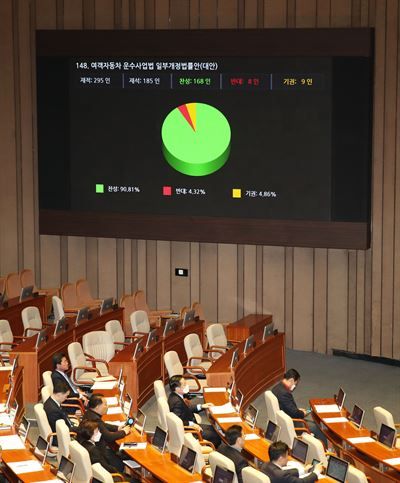
Lawmakers approve a revision aimed at banning the Tada ride-hailing service during a plenary session at the National Assembly on Yeouido, Seoul, Friday. Yonhap
“The revision could be a way for mutual prosperity between conventional mobility firms and startups, but at the same time it is a heavy regulation structurally hampering the emergence of mobility unicorns in Korea,” Korea Startup Forum President Choi Sung-jin wrote on Facebook.
“With the regulation, only companies with massive funding can tap into new businesses and startups will face an enormous hurdle in starting new businesses. … When startups are dead, there will be no innovation or mutual prosperity. The ministry should show why this law is not a ban on innovation.”
Other mobility industry officials also criticized the government's outdated view on mobility services.
“The regulation shows why global mobility service providers do not want to start businesses in Korea,” an industry official said. “Not only startups but also the country's conglomerates, such as Hyundai Motor Group, are making efforts to provide advanced mobility services, but they are not making their first moves in Korea, due to this. The government should understand that the market and the private sector are behind innovation, not government-led subsidies or programs.”
.