'Nurturing female scientists, engineers key to 4th Industrial Revolution'

Ahn Hye-yeon, president of the Center for Women in Science, Engineering and Technology (WISET) speaks with The Korea Times at its office in southern Seoul, Aug. 5. Courtesy of WISET
By Baek Byung-yeul
Coupled with a low birthrate and rapidly aging population, Korea is struggling to secure a talented workforce in science and technology, which are crucial to the development of its economy.
Against such a backdrop, Ahn Hye-yeon, president of the Center for Women in Science, Engineering and Technology (WISET) stressed the need to boost the number of female scientists and engineers, saying this will improve the national competitiveness of Korea.
Korea has about 260,000 women who once worked in these fields, but quit their careers when they got married or had children. Ahn stated the importance of focusing on providing support to these women who want to return to the information technology sector, which is key to progress in the Fourth Industrial Revolution.
“A country's science and technology capabilities are important factors to decide national competitiveness. To achieve technological hegemony, securing talented workers is the top priority. As Korea is struggling with a rapidly decreasing birthrate, the country needs to nurture female scientists and engineers and ensure women returning to the workforce can find quality jobs,” Ahn told The Korea Times during a recent interview.
WISET is a state-run agency that has been providing various vocational programs to nurture women in the science and technology sectors. It also has been offering support to those returning to the workforce so that they get trained and matched with suitable employers.
Ahn said tech companies and science institutions have been desperate to secure talented employees regardless of gender.
“The country is suffering from a staff shortage in key sectors in the Fourth Industrial Revolution era. Prominent tech companies here such as Samsung Electronics and Naver have been desperately seeking talented workers in artificial intelligence (AI), big data and other emerging sectors to enhance their technology capabilities," she said.
“As it is hard for the companies to scout skilled employees, they are even establishing overseas branches to recruit people. To keep up with the world's tech powerhouses, WISET is creating support programs to foster women entering the workforce."
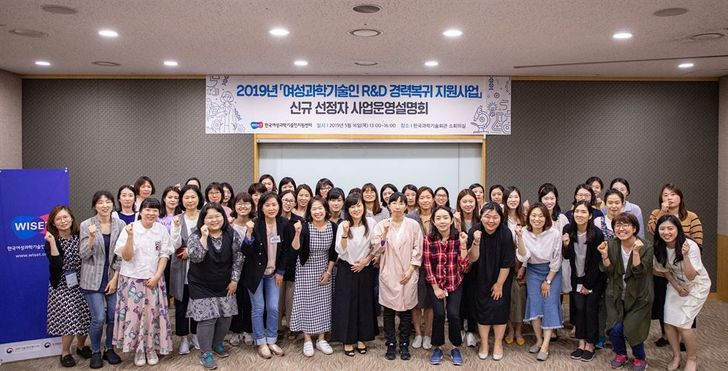
Female scientists, who are set to return to scientific research after being supported by a returners program run by WISET, pose at the Korean Federation of Science and Technology Societies office in Seoul, May 16. Courtesy of the WISET
With the aim of cultivating female researchers and engineers, the government created a program to foster and support women in science, engineering and technology in 2002, and has operated various related organizations. In 2013, those organizations were integrated and became WISET in order to enhance independence and ensure long-term development.
Thanks to the government's effort, Korea has made progress in improving the number of female scientists, but the country is still short of female workers in industry, Ahn said.
“WISET originally focused on helping women returners in the natural sciences field such as biology and chemistry. Though we did make progress, the country still lags behind in hiring female workers in related industries. This can be seen in data showing that male students who major in engineering or IT outnumber female students,” she said.
According to data from WISET, the male-to-female ratio in information technology is overwhelmingly male at 65 percent, while natural science majors had a relatively even gender ratio as of 2017.
To solve the problem of skewed gender ratios, Ahn vowed to improve engineering awareness among female students and promote career discovery programs during her term.
“The science and technology fields have been traditionally regarded as being male-dominated and this applies to not only Korea but also every other country. However, many advanced countries are trying to foster more female workers in the sector as they are witnessing an increasing demand for talented workers," she said.
“WISET is trying to help improve the number of female workers in these industries in cooperation with tech companies. For instance, we are scheduled to hold an expert training program in AI and big data starting Aug. 26, teaming up with Intel."
Earning her bachelor's and master's degrees at Ewha Womans University, Ahn received a Ph.D. in computer science at the University of Massachusetts.
She also built a long and successful career in the IT industry, working at Samsung SDS, an IT affiliate of Samsung Group, and cybersecurity firms.
Based on her experience, Ahn, who was appointed as the third president of WISET in April, said there is a growing need for women in IT.
“I especially recommend female students to work in the cybersecurity sector, which has seen explosive demand in the digital age,” she said.
'Adoption of donation-based model needed'
To make it possible to provide more support to female scientists and engineers, Ahn stressed that WISET needs to adopt a donation-based business model. Though the support organization has been successfully running assistance programs thanks to state funding, she said it is crucial to procure more corporate sponsorship to broaden its operations.
“We have offered various support programs to women returners and future scientists and engineers with the help of state funding. This is a rare and successful case, but given the annual budget we receive from the government is 18 billion won ($14.8 million) and most programs we provide are dependent on this funding, we need to get more companies involved in our programs to better provide support for them.”
WISET is planning to hold a series of mentoring programs supported by corporate sponsors.
In cooperation with the U.S.-based cybersecurity firm Palo Alto Networks, WISET is scheduled to hold a seminar for female engineers in the cybersecurity sector Sept. 17.
“The program is designed to provide job descriptions and a future vision of the cybersecurity sector for female students,” Ahn said.
She added WISET is trying to offer more networking opportunities to female employees who have worked for more than 10 years in IT companies.
“To provide networking opportunities, we also plan to hold an event for female employees working in IT firms such as Samsung, LG, Microsoft, Oracle and IBM in October. We expect the event will help the country get a bigger pool of female employees because fewer women are found in higher positions,” she said.