Gov't pressures convenience store chains over minimum wage

Fair Trade Commission Chairman Kim Sang-jo speaks during a press conference at the Government Complex in Sejong, Monday. / Yonhap
By Nam Hyun-woo
The government is tightening its rein on domestic convenience store franchisers, launching a probe into whether they are unfairly burdening store owners, who are expressing their strong opposition to the minimum wage hike for next year.
However, franchisers also cry foul over the government's pressure to enhance support for store owners, claiming they are “scapegoated” and they too are having hard times because of faltering profitability.
According to industry officials, the Ministry of Trade, Industry and Energy on Wednesday had a meeting between officials at four major convenience store franchisers and the Korea Association of CVS Industry.
The meeting was titled as “a meeting to support small businesses,” but reportedly was a gathering in which the government urging franchisers to shoulder store owners' burden stemming from the recently agreed 10.9 percent minimum wage hike for next year.
On Tuesday, the Fair Trade Commission (FTC) investigated 7-Eleven and Emart24, just a day after FTC Chairman Kim Sang-jo pledged to enhance investigations on franchisers' purported unfair business practices which increase the burden for store owners.
“This seems to be the government's move to toss the issue to franchise headquarters as shop owners are expressing their anger over the minimum wage hike,” an official at a domestic franchiser said. “Compared to other franchisers, franchisers have been making efforts to build cooperative relations with shop owners, but companies are still pressured to do more.”
Following the recently agreed 10.9 percent minimum wage hike for next year, store owners will have to pay workers at least 8,350 won ($7.40) per hour, compared to this year's 7,530 won.
Over the wage hike, an association of store owners in Korea has pledged collective actions, including a night-time fee, but withdrew them and asked for franchisers to cut franchise fees instead.
According to the association's survey on 10,000 convenience stores in Korea, the average monthly labor cost stood at 3.98 million won last year, while their monthly profit remained at 1.96 million won.
The survey said the labor costs increased to 4.64 million won this year and are expected to reach 5.14 million won next year. Their profit declined to 1.32 million won in this year and projected to remain at 797,000 won next year.
While store owners complain about declining profitability and have asked for franchises to take on more of the burden, franchisers say they are also having a hard time and there's “nothing to spare to support shop owners.”
In the first quarter, CU logged 26.1 billion won in operating profit, down 1.5 percent from a year earlier. Rival GS25 posted 19.9 billion won, down a whopping 37.3 percent from a year earlier. Their operating profit ratio plunged to 1.9 percent and 1.3 percent, respectively, down from 3 to 4 percent last year.
Seven-eleven turned to profit by posting a 200 million won operating profit in the first quarter, but its operating profit rate is still below 1 percent.
“Franchisers have already announced plans of providing a significant amount for store owners, in a recognition that both store owners and franchisers are undergoing headwinds,” an official from a separate franchiser said.
“However, whenever there is a minimum wage issue, franchise headquarters are pinpointed to support shop owners. With the market being saturated, companies also have no more room to compromise their profitability, by lowering franchise fees additionally.”
Currently, large franchisers in Korea, except for Emart24, take 35 percent of a store's sales as a franchise fee. Emart24 receives a fixed fee from shop owners. But franchisers say the actual amount shop owners pay to headquarters will remain below that because headquarters support shop owners through sharing electricity costs and providing other aides.
BGF Retail, which runs CU, announced last year to support up to 450 billion won directly to franchisees, such as guaranteeing their bottom line. GS Retail, running GS25, has also announced a similar aid package, amounting to 375 billion won.
GS Retail also supported its partners with aid worth 900 billion won for the same period. Of them, 375 billion won is direct support.
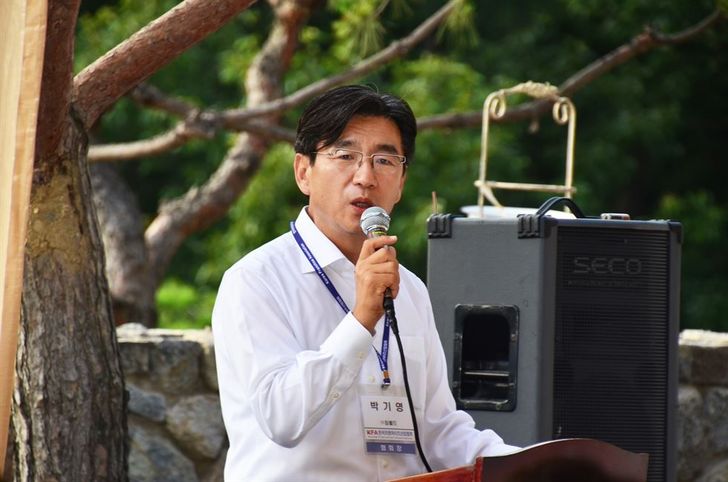
Korea Franchise Association Chairman Park Kee-young speaks during a meeting with its members in Yeoju, Gyeonggi Province, Wednesday. / Courtesy of Korea Franchise Association
As the government's pressure is growing, the Korea Franchise Association released a statement on Wednesday and called for the government to stop scapegoating franchisers.
“The government should come up with complementary plans for the minimum wage hike, which can be acceptable by both franchisers and franchisees,” the statement read.
“The government's abusing of its investigative authority is seen as an attempt to scapegoat franchisers for the fallout of a forceful minimum wage hike and political responsibilities for that. It should stop trying to place on the political blame to franchisers.”
Over the three-party conflict, analysts point out the problem stems from the excessive growth in the number of CVSs. Last year, the number of CVSs in Korea grew 12.9 percent from a year earlier to reach 36,823, while the revenue for each store increased by 0.2 percent during the same period.
“Currently, franchisers are posting growth through increasing the number of shops,” Hana Financial Investment analyst Park Jong-dae said. “If franchisers are unable to make an additional franchise fee cut or extra support to shop owners, the most realistic solution could be lowering the number of new stores.”