KIOST pioneers in marine biotechnology

Officials at the Korea Institute of Ocean Science and Technology (KIOST) test an unmanned submersible probe it developed in this file photo. / Courtesy of KIOST
By Yi Whan-woo
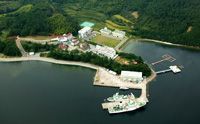
An aerial view of the Korea Institute of Ocean Science and Technology (KIOST)’s research center on Geoje Island
The Korea Institute of Ocean Science and Technology (KIOST) has enhanced its research on marine biotechnology (MBT), prompted by the untapped potential of developing resources from the sea.
KOIST, founded in 1973, is the country’s only extensive marine resources research agency and operates under the Ministry of Oceans and Fisheries. It seeks to become a global pioneer in MBT, which still requires extensive study and development despite its significant profit potential.
Its esearch focuses on a convergence of marine biology in relation to bio, information, nano and other advanced technologies to explore resources in the deep-sea.
The research includes a study of marine creatures, development of biomedical materials from those creatures, extraction of green energy sources from maritime materials, and development of cutting-edge devices to carry out such missions.
Regular observation and analysis on characteristics of the sea has become essential, while study on coastal disasters also plays a key part in improving prediction accuracy for coastal disasters such as storms and coastal erosion with concern growing over climate change
“MBT is emerging as Korea’s future growth engine in the same way information technology did,” KIOST said in a statement.
The agency’s efforts toward the development of MBT have grown with the support of the Park Geun-hye administration, which seeks to ensure the country’s economic growth through a creativity-based economic paradigm. The government has selected the marine industry as one of the fields in which Korea can make such progress.
“Besides shipbuilding and other shipping-related industries, we can develop undersea robots and focus on many other fields that are related to the ocean,” KIOST said.
The value of global ocean resources, including marine ecosystems, is estimated at $26 trillion. The world’s MBT industry is anticipated to be worth $4.6 billion by 2017, up from $3.6 billion in 2012, according to the agency.
Market research firm Global Industry Analyst ranked Korea 24th in terms of its MBT market share. The United States tops the list with a 45 percent market share, followed by Canada, Australia, Germany and France.
KIOST, however, stressed it still can be a global pioneer in the industry, adding there is still much knowledge to be discovered about ocean resources.
Over 10 million species live in the sea. This figure accounts for 90 percent of the total number of species on Earth, but research has been conducted on only 1 percent of them, KIOST explained.
“You can see that MBT is still a blue ocean market for all countries, and it’s not too late to become a major player,” it said.
As its strategy, KIOST seeks to develop technologies and generate profits by commercializing and licensing the ideas. To achieve these goals, the government should support the agency’s R&D, it said.
KIOST has expanded its research by setting up branch offices in the country and in neighboring countries. The Gyeonggi Province-based agency runs offices in Daejeon, Geoje Island and Uljin in Korea, and in China, Micronesia, Peru, the U.S. and the U.K.