Hyundai supports returned Vietnamese divorcees

Attendees cut the ribbon for the opening of a facility for returned Vietnamese divorcees in Can Tho City, Vietnam, Thursday. Hyundai Motor established the facility to support the divorcees and their children. / Courtesy of Hyundai Motor
By Park Jae-hyuk
Hyundai Motor has opened a facility in Can Tho City, Vietnam, Thursday, to support women from the Southeast Asian country who returned to their homeland with children after divorcing their Korean husbands.
One in five Vietnamese wives in Korea come from the southern Vietnamese city in the Mekong River basin.
Korea’s leading carmaker remodeled a health college building there and set up the city’s first multicultural center on a 2,800-square-meter plot of land. The center includes a children’s library, legal advice office, kitchen, lecture room and auditorium, as well as accommodation and showers for volunteers.
The opening ceremony was attended by 400 officials from the Korean Consulate General in Ho Chi Minh City, the Overseas Korean Foundation, the Vietnam Women’s Union, the Can Tho People’s Committee, the Korea Center for United Nations Human Rights Policy (KOCUN) and Hyundai Motor.
Hyundai said it established the center as part of its corporate social responsibility activities, amid the growing number of divorces in the nation’s multicultural families.
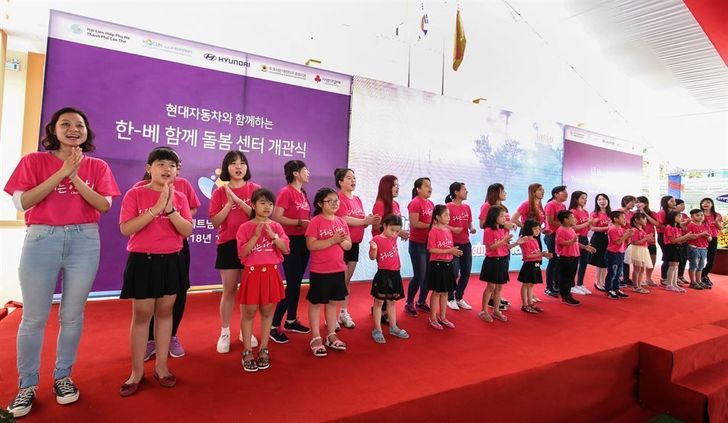
Returned Vietnamese divorcees perform Thursday with their children, during an opening ceremony of a facility for them. Hyundai Motor established the facility in Can Tho City, Vietnam. / Courtesy of Hyundai Motor
According to the KOCUN, 346,585 foreign women married Korean men between 2000 and 2016.
Vietnamese women accounted for 25 percent of the foreign wives. However, 16,755 Vietnamese women divorced their Korean husbands during the period. Among them, 3,183 had children.
If foreign women separate from their Korean husbands they have limited rights in this country, so most of them decide to return to their homelands. Some may go home without legal divorce procedures due to ignorance of Korean law, financial difficulties or family violence.
Those who return to Vietnam with their children tend to face poverty and social prejudice as well.
Given that 80 percent of the children have Korean citizenships, they are hardly guaranteed residential rights, regular education and medical treatment.
Hyundai said the company will continue to try its best to support the returned Vietnamese women and their children.
According to the carmaker, 81 volunteers sponsored by the company also improved the dwellings of Can Tho City residents. The volunteers introduced Korean culture as well, giving Korean and Vietnamese traditional performances at the opening ceremony.
In addition to its efforts in Vietnam, Hyundai Motor Group has supported multicultural families in Korea. The automotive group has sponsored medical services for foreign workers and offered counseling for multicultural youths and North Korean defectors.