Imjin War: General leads big defeat of Japanese in 'river of hell' battle

The entrance to Chungjangsa Temple at Haengju Fortress dedicated to General Kwon Yul. Robert Neff Collection, March 2020.
By Robert Neff
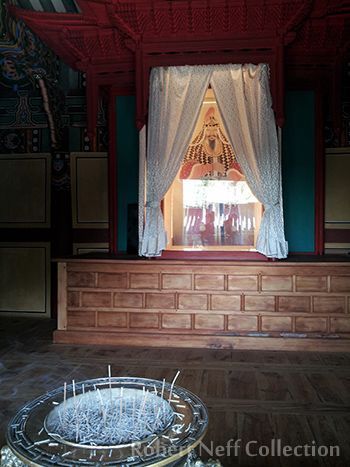
The interior of Chungjangsa Temple with a painting of General Kwon Yul. Robert Neff Collection, April 2015.
One of the most important battles during the Imjin War (1592-1598) took place just outside Seoul at Haengju Mountain Fortress near Goyang City.
In the early hours of March 14, 1593, a Japanese army of 30,000 men marched from Seoul and arrived at the foot of the stronghold just before dawn.
The fortress (on a cliff overlooking the Han River) could only be approached on one side that was fortified with earthen walls and a palisade of wooden spears. Manning the walls were 2,300 Korean soldiers and warrior-monks under the command of General Yul Kwon (1537-1599). In addition to the soldiers were several thousand civilians who fled from their villages for the relative safety of the stronghold.
In the morning light, the Koreans could see the vast army of Japanese warriors attired with red and white banners on their backs. Many of these Japanese wore frightening masks depicting ferocious animals and supernatural creatures. Vastly outnumbered, fear must have rippled through the Korean ranks but it was quickly tempered by the calm attitude of their general ― he ordered his men to eat their breakfast while the enemy prepared to attack.
Shortly after dawn the Japanese attacked. The Koreans enjoyed the advantage of elevated cover and easily repelled wave after wave of Japanese attacks. In his book, “The Imjin War,” Sam Hawley wrote:
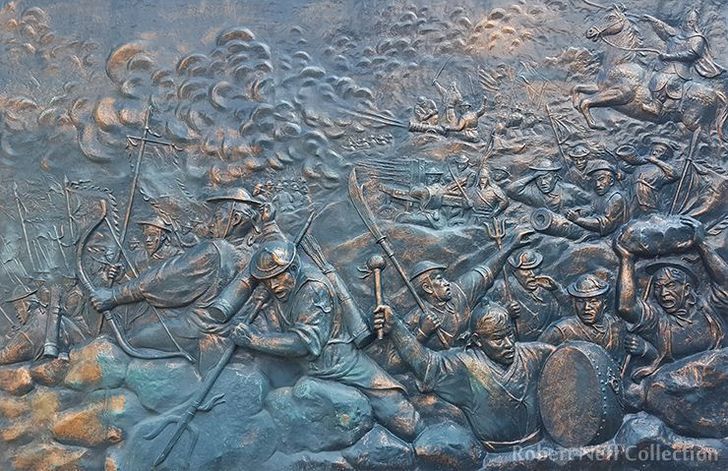
An engraving of General Kwon Yul and his soldiers defending the fortress. Robert Neff Collection, March 2020
[The] muskets of the Japanese were of only limited use, for in having to fire uphill they were unable to effectively target the defenders holed up within. Their lead balls simply flew in an arc over the fort and into the Han River beyond. The advantage was with the Koreans, firing down upon the attacking Japanese with arrows and stones and anything else that came to hand. They had a number of gunpowder weapons as well, including several large chongtong cannons and a rank of hwacha (fire carts), box shaped devices built onto wagons that fired up to one hundred gunpowder propelled arrows in a single devastating barrage.”
Throughout the morning the Japanese were repulsed ― their losses were severe ― but by the afternoon the Korean defenders were exhausted and so, too, was their supply of arrows. Fighting was now hand-to-hand and the Koreans used spears, swords, rocks, boiling water and handfuls of ash (tossed into the faces of the Japanese). The Korean women contributed to the defense by gathering stones and carrying them in their skirts to the soldiers so that they could be used as weapons. According to Hawley, “this traditional type of skirt is still known as a Haengju chima (Haengju skirt) in remembrance of this day.”
Just when it seemed the Japanese would overcome the arrow-less defenders, salvation arrived in the form of two ships filled with 10,000 arrows. Resupplied with arrows, the Koreans mowed down the attacking Japanese.
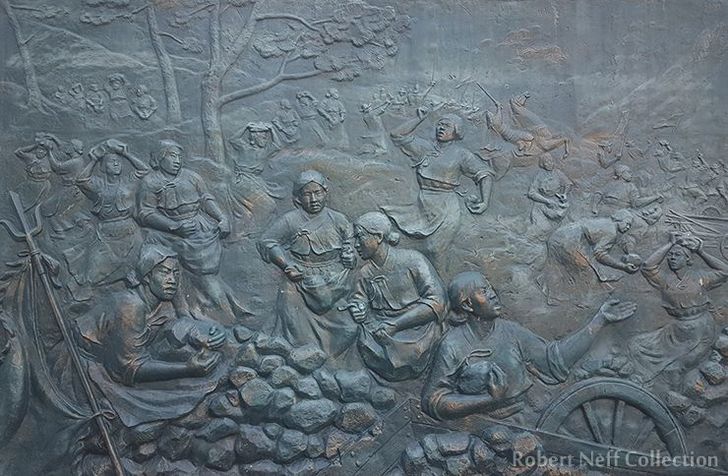
An engraving of the Korean women carrying stones in their skirts. Robert Neff Collection, March 2020.
As the sun set the battle ceased. The Japanese gathered up as many of their dead soldiers as they could and burned them. They then walked back to Seoul ― a defeated army that had suffered thousands of casualties.
Once the Japanese were gone, the Koreans gathered the Japanese bodies that had not been burned and mutilated them. They were ripped and cut into pieces and hung from the walls. A Japanese officer later described the Han River and the battlefield as the “river of hell.”
The Koreans had suffered relatively few casualties and had dealt the Japanese a demoralizing blow. General Kwon Yul became a national hero ― one that is still remembered.
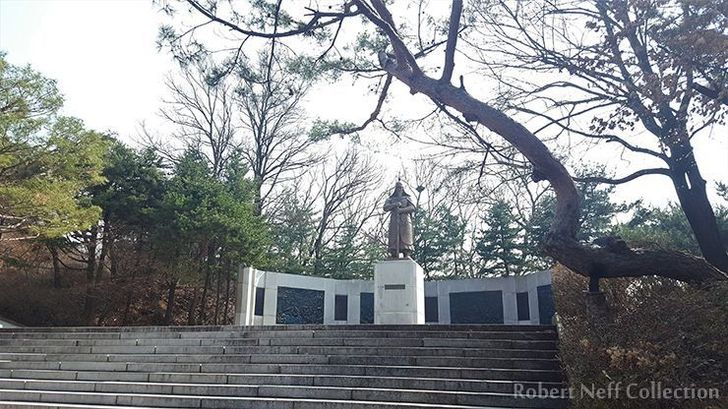
A statue of General Kwon Yul. Robert Neff Collection, March 2020.
The fortress still stands and is one of those secrets that bicyclists would probably like to keep to themselves. Located near the bike lanes, it is a popular haunt for cyclists and the residents of Goyang City who want to get away from the crowds and bustle of daily life.
Due to the coronavirus, most of the site's buildings are closed but the handful of visitors seem more relaxed ― lowering their masks while wandering the lonely paths leading up to the monuments, the temple and the earthen wall. Peacefulness reigns, except for the noisy squabbles between the birds in the chestnut and pine trees fighting over choice morsels of food or nesting rights.
But not everything about this site pertains to General Kwon Yul and his battle against the Japanese. Near the earthen walls is another monument ― rather humble and not even mentioned in the information brochures. Perhaps because it memorializes a powerful woman from Korea's distant past ― one who many might wish to remain forgotten. Who was she? We will find out tomorrow.
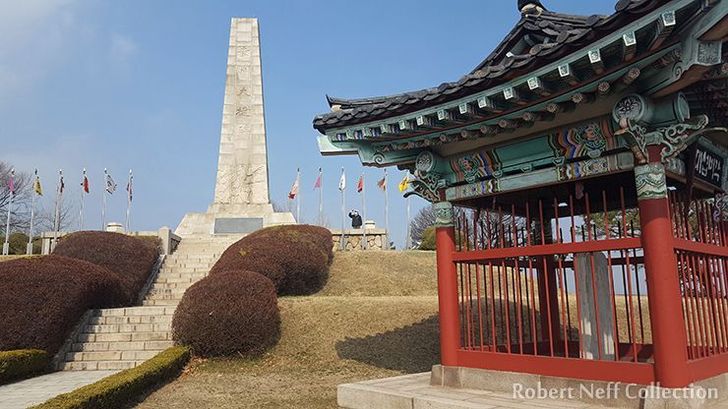
The old and new “Siege of Haengju” monuments. Robert Neff Collection, March 2020.
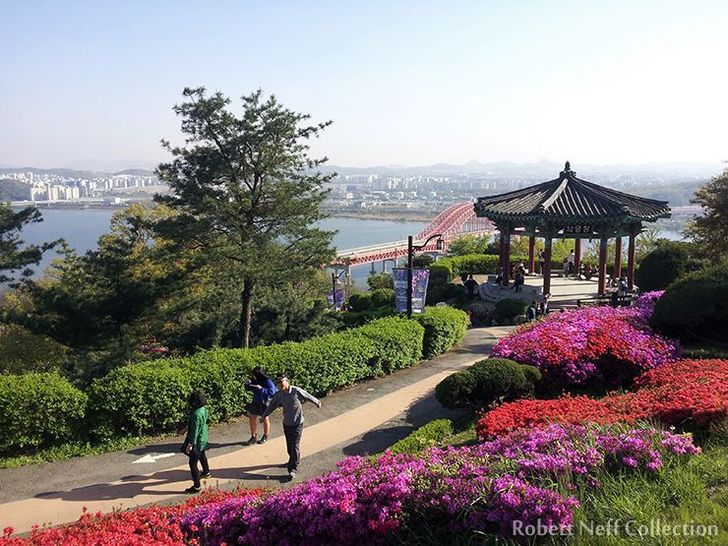
Deokyangjeong Pavilion and the Han River from Haengju Fortress. Robert Neff Collection, April 2015.
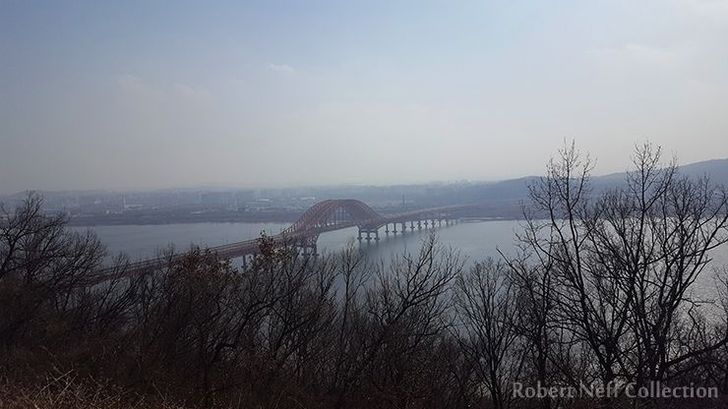
A view of the Han River from the fortress. Robert Neff Collection, March 2020.
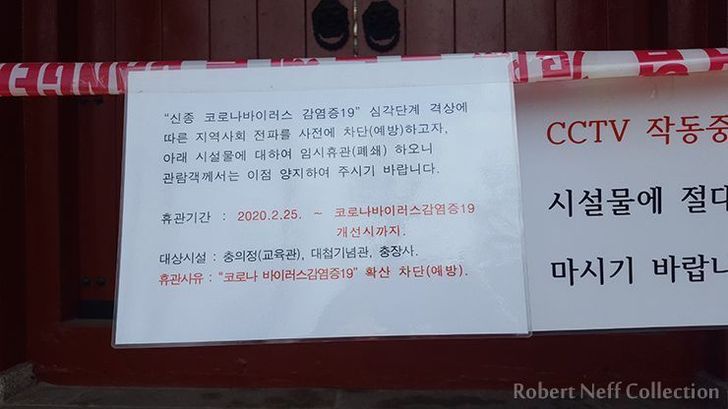
Unfortunately, due to the coronavirus, most of the buildings are now closed to the public. Robert Neff Collection, March 2020.