Smoking with class in Joseon
By Robert Neff
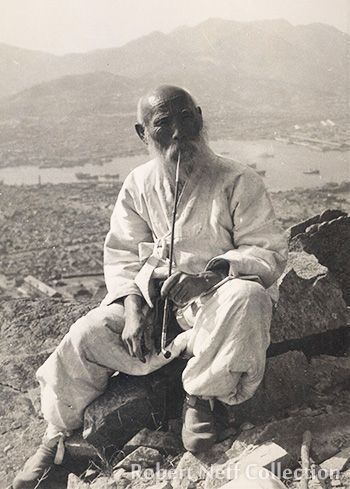
An elderly Korean man smokes his pipe overlooking Busan. Circa 1953.
In late 19th century Korea, almost everyone smoked.
According to George W. Gilmore, an American teaching in Seoul in the late 19th century: “The use of tobacco is universal, even boys and women are using the weed. A part of the dress of a Korean is his tobacco-pouch, his flint, steel and tinder or his matches. Without it he never goes abroad…”
Most tobacco was smoked in pipes. The cheapest pipes, used by the lower classes such as coolies (bearers), were made with metal ― mainly copper or nickel-plated ― bowls and mouthpieces and with plain reed stems.
Smokers in better financial situations often invested a little more into their pipes, which were considered a status symbol.
Agate mouthpieces of all sizes and colors were readily sold at the markets, and for those who had money to burn, jade mouthpieces were costly but fashionable.
These more expensive pipes used stems “decorated with paints in dainty patterns or carved” and were quite long.
In the 1890s, foreign pipes began to appear in the market and were popular with the lower classes. They were shorter in length and less expensive but, according to Gilmore, “a short pipe is to a man of note an abomination.” Apparently, it was possible to judge the rank of a Korean by the length of his tobacco pipe ― the longer it was, the higher the rank.
“The official is unable to light his pipe by holding a match to it ― he cannot reach the bowl. So men of rank have their pipes filled and lighted by their servants, and it usually takes two to accomplish the lighting.”
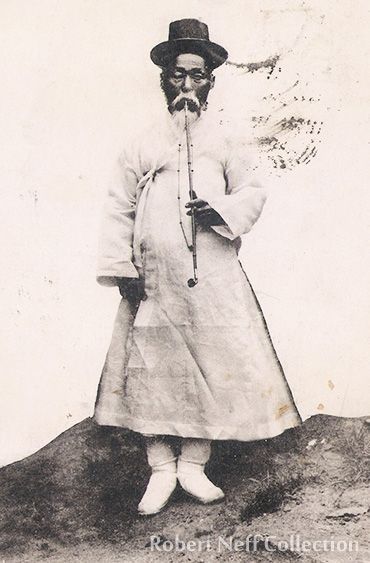
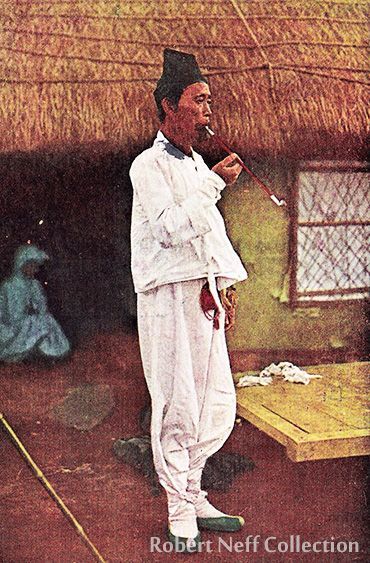
A Korean man smokes a pipe. Circa 1913
Long pipes may have been fashionable but they were also dangerous ― especially in the crowded streets of Seoul. A foreign visitor reported:
“The commonest surgical operation in Korea, the medical missionaries say, is to pull a two or three foot pipe stem out of the back of a Korean neck; by accidents in wheeling around corners or by falling down when intoxicated, these pipe stems are jammed downwards or backwards, ad infinitum.”
Cigar smoking was also perceived as classy and cosmopolitan. When George C. Foulk, an American naval officer visited (somewhat illegally) Busan in 1882, he noted that tobacco leaves were sometimes tightly rolled up and smoked in the manner of a cigar. It isn't clear who these cigars were popular with.

A Korean postman armed with the essentials: a hat, an umbrella and a pipe. Circa 1900.
In 1883, a cigar company was built in Jemulpo with the idea that the company would export its products abroad but the company seems to have failed shortly after its establishment. Tobacco remained a fairly low-scale and localized industry in Korea until 1898 when The Independent reported:
“Enterprising spirit is slowly but surely permeating the hearts of Koreans. One of the latest indications of it is that a Korean company has been formed to manufacture cigars in Songdo [modern Gaeseong] and Seoul with Koksan tobacco. Koksan is a mountainous district in Whanghai and produces a considerable quantity of tobacco … The company ships on the average 10,000 cigars daily to various cities in the country and the demand is said to be increasing. They burn fairly well and considering the price (which is thirty-four cents per 100) it is a reasonably good smoke.”
The cigars may have been popular for the lower classes but for the upper classes (and foreigners), cigars from abroad were the preferred choice. At the palace, imported cigars were always on hand for diplomatic functions and, unquestionably, they made great but expensive gifts between officials.
Considering how desirable (despite the expense) cigars were, it is no surprise that some were illegally procured and resold ― even by high-ranking officials. In 1888, Park Jeong-yang, the first Korean Minister to the United States, had a brush with American customs officials after he “used his diplomatic privileges to import cigars without paying a customs duty and then […] sold the cigars in America.”