Shock arrival: The Wanderer's 1882 visit to Busan

A street in Fusan, circa 1900.
By Robert Neff

A sketch of a Korean man, circa 1882.
It was at dawn on January 4, 1882, when the Wanderer sailed into Busan harbor to the “semi-fortified Japanese settlement” known then as Fusan. It was a fairly large ship ― 186 feet long, with a displacement of 840 tons ― powered by steam and sail and able to glide through the water at about 12 knots an hour.
The British flag flew from its mast and its smartly dressed crew of 50 men and 13 passengers gave it a formidable appearance as it sailed past the Korean junks. But it was not a warship, it was a private yacht owned by Charles Lambert.
Lambert was a very wealthy Englishman who desired adventure and had the money to buy it. He bought and outfitted the Wanderer so he could embark on a round-the-world cruise starting from England, around the tip of South America, then up through the Pacific to Japan, where he would then sail along the Chinese coast and Southeast Asia and around Africa back to England. It was an epic adventure that would take about 22 months to complete.
Accompanying him was his wife and their four children: Helen Mark, Beatrice Kate, George Maximiano and William Stanley. As his guests, Lambert invited the Reverend H.E. Witherall and Robert T. Pritchett, an artist. The Lamberts also brought their personal servants: Julia Power, governess; Agnes McAllan, ladies' maid; Elizabeth Cordell, nurse; John Harris, valet, and John Dadge, footman.
Lambert's reason for visiting Korea probably stemmed from an unexpected and brief encounter in Yokohama:
“[On December 17] we fell in with some Coreans, part of an embassy sent to Tokio to settle differences, and discuss appearances of Russian aggression in their part of Asia. They are chiefly remarkable for their broad-brimmed hats, with open horsehair work in the upper part of the crown. One of them, who looked about twenty, had a singularly good-tempered and lively look, and laughed with every muscle of his body, as he looked at us with a critical eye, and said inquiringly: 'Yankee? English? French?'”
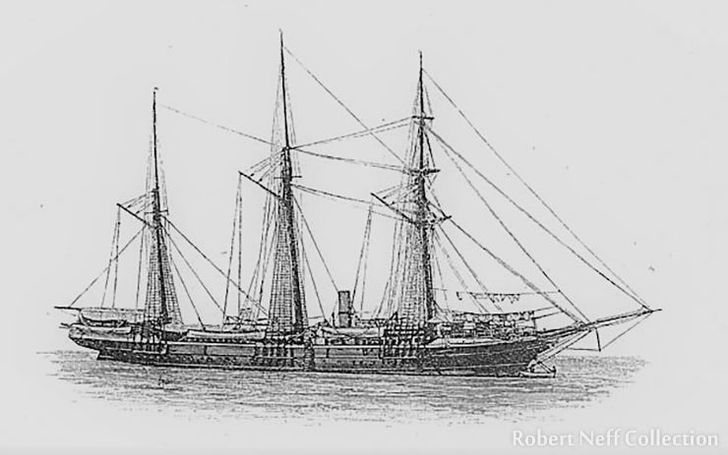
A sketch of the Wanderer, circa 1882.
The conversation was in English, but, unfortunately, it was very short. It did, however, awaken a desire in Lambert to visit the land popularly known as the Hermit Kingdom. His expectations, however, were not met.
Whereas he found the Japanese to be “very clean and orderly,” he found the Koreans to be the opposite. His observations were biased and highly critical:
“The [Korean] men were of a finer physique than the Japanese, but the expression of their faces is decidedly evil. They wear loose baggy trousers and a jacket, and a most extraordinary hat, the use of which it is difficult to understand, as it certainly will keep off neither sun nor rain, being made of horse hair, in the shape of a Welsh-woman's hat, and not fitting the head, but being tied down.”
When the Lamberts set ashore they were mobbed by curious Koreans. Mrs. Lambert was likely wearing her sable coat with its little tails, which had excited great curiosity in Japan: “The men and boys lifted up the little tails, stroked the fur, turned it up to look inside, and were evidently much exercised as to what sort of an animal it was made from.” But in Busan, it wasn't her coat that generated excitement ― it was her.
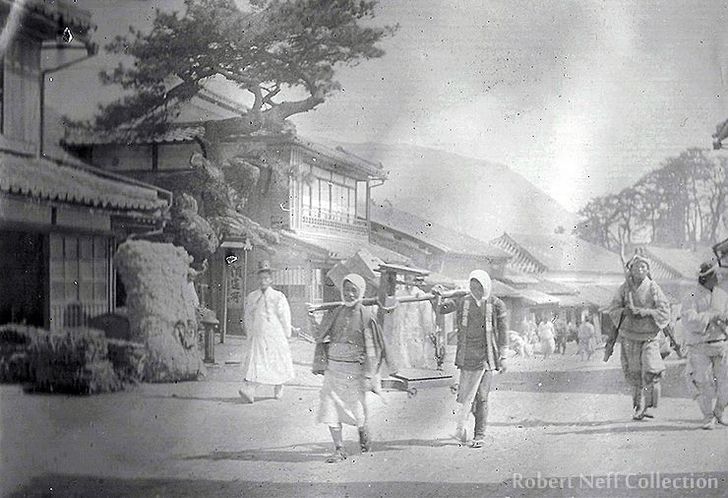
A street in Fusan, circa 1890s.
Lambert wrote: “The ladies of our party were the first English women who had ever landed, so were soon surrounded and followed by a mob, but we had two or three Japanese policemen to follow and keep order.”
The mob of Koreans following them was made up of only men and boys. Lambert explained: “We didn't see any of the women, as they never leave the [Korean] town, into which no strangers are allowed to enter.”
The Japanese consul, probably perturbed at the arrival of these unexpected and unwanted guests, guided them around the Japanese settlement and, in turn for his kindness, Lambert invited him and the Japanese chief of police aboard the Wanderer for lunch.
Part of the Wanderer's crew took a hunting excursion to Deer Island, a small island just off the coast of the Japanese settlement. They bagged several pheasants but were unable to get any of the many small deer that roamed the island. The would-be hunters blamed their inability to get a deer on the lack of communication with the Koreans. They claimed that they spent most of the day trying to find a place to hunt because the Koreans they met could not understand their desires. The Englishmen were doubtlessly unaware that a popular method for Koreans to hunt deer on the island was with a pit trap.
At 5 p.m., the Wanderer left Pusan and sailed to Tsushima, and then to the main Japanese islands. Its short visit has, for the most part, been forgotten in the annals of history.