Treasures along the Han River: The White Buddha

The White Buddha, circa 1910-1920s. Robert Neff Collection
By Robert Neff
In the late 19th and early 20th centuries, one of the most popular sites for foreigners to visit in the Seoul region was the White Buddha.
During summers in the 1890s, the small Western community in Seoul would often enjoy picnics at its base ― sheltered from the heat by its shadow and refreshed by dipping their feet into the cool stream. It was idyllic, except when the servants forgot to bring the kettle, thus depriving the parched picnickers of their tea.
The White Buddha was frequently mentioned in travelogues. When Burton Holmes, an American, traveled to Seoul in the early 1900s, he declared “the ghostly outline of the 'White Buddha' [was] the most curious sight in the environs of the capital.” He stopped long enough to set up his camera and take a picture of “a priest from the neighboring monastery [who was] presenting offerings at the instance of the boy who has come as messenger from someone who desired prayers and sent the cash to pay the priest for saying them.”
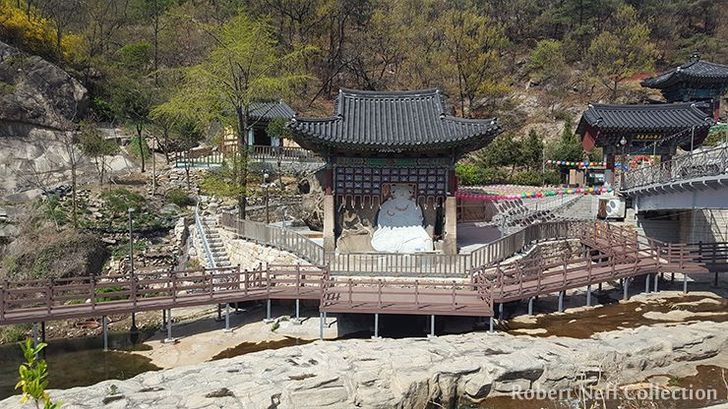
The White Buddha complex. Robert Neff Collection, April 2020
But not all foreigners were impressed with the White Buddha. Thomas Philip Terry, an American travel writer, wrote in 1914:
“The body of the seated image is painted white; the heavy, chiseled features show little of the calm Buddhistic spirit characteristic of certain Buddhas in Japan, and the bizarre head-dress and gaudy enrichments accentuate its cheapness.”
I am somewhat suspicious of some of Terry's descriptions and suspect he may have plagiarized them as they seem very similar to a Japanese travel guide published a few years earlier than his own.
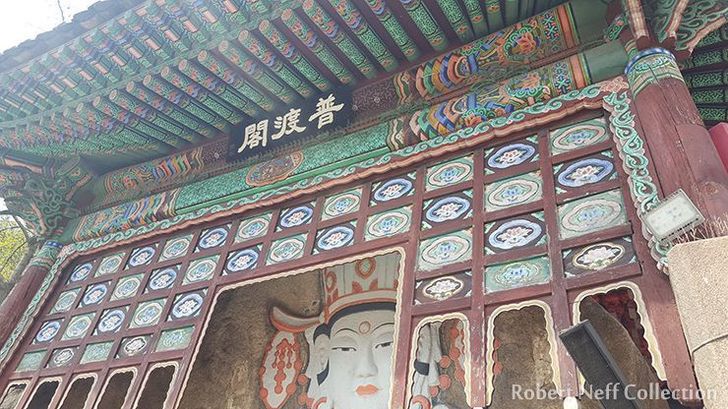
Sereneness surrounded by bright colors. Robert Neff Collection, April 2020
When Joseph Waddington Graves, an Englishman, visited in the summer of 1919, he wrote:
“Leaving the main road to the right and taking the narrow paths across the tiny rice fields, we came in sight of the White Buddha. To our right was a stone quarry, and the process of blasting was being employed to split the rocks and secure the necessary material for the good roads throughout the peninsula, on which Japan has set her heart.
“To our left, and at the foot of the rocks, was a wide but shallow river, so shallow that pieces of rock which would serve as stepping-stones were everywhere visible. Directly across the river we saw the quaint object of our search. On a big rock, with a flat wall surface jutting out into the water, had been carved the head and shoulders of Buddha, a representation so familiar to every traveler in the Orient.
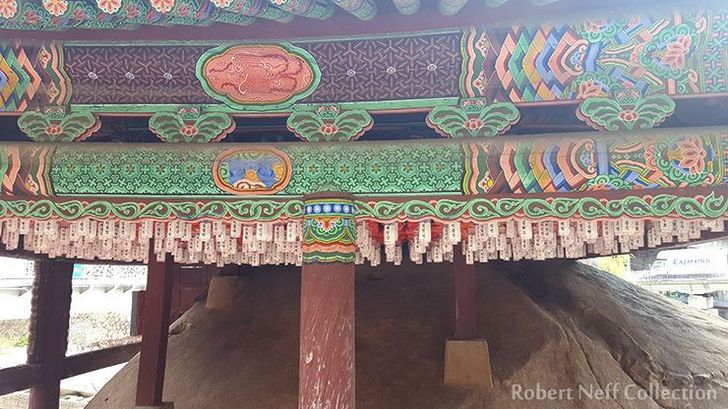
The unforgotten. Robert Neff Collection, April 2020
“Having been carved on the gray rough rock, the carving had been painted over with white, giving it the name by which it is known, and making it stand out with an almost startling distinctness from the background setting of rocks and trees. But from where we stood and studied the figure it seemed to be incomplete, suggesting that not all of the artist's original work was visible to us. So it proved on closer scrutiny.
“We climbed into our rickshas, and the coolies, wading into the water, pulled us across, halting on a bank of sand and stones immediately in front of the Diabutsu. Then we saw the reason for the apparent direct descent of the figure into the ground. It was not that the rock had sunk, nor that the sculptor had worked below the ground level. What had happened was the deposits of sand and stones had been washed down by the shallow but fast-flowing stream, and that the great figure of Buddha was being gradually buried under the accumulation.”
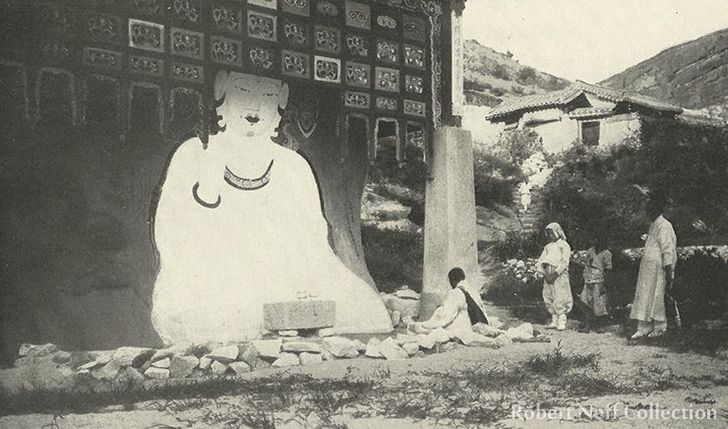
A priest offering prayers in 1901 ― image taken by Burton Holmes. Robert Neff Collection
Graves was moved by the image ― not by its beauty but by his perceived parable of what he was seeing. To him, the stream represented the Korean renaissance that was slowly, but steadily, burying “the idols and the skeletons and the ghosts of many unhappy centuries.” Nothing can stop the stream ― not even the Japanese “dam of annexation can permanently resist the flood tides of awakened nationhood,” he declared.
Graves was partially correct. Korea did regain its independence but not even the stream was powerful enough to bury the White Buddha. Tomorrow we will find out why.
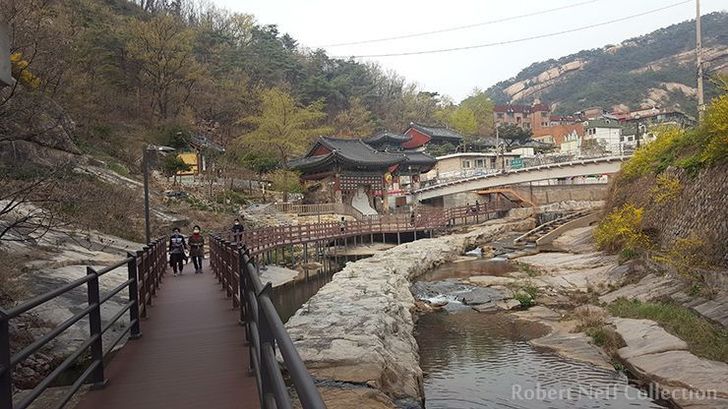
The pedestrian path leading to the White Buddha. Robert Neff Collection, April 2020