An emperor delivers 'a Great Declaration' of Aug. 15, 1945

Namdaemun in Seoul during the Japanese occupation / Robert Neff Collection
By Robert Neff
On Aug. 14, 1945, Koreans and Japanese on the Korean Peninsula were surprised by notices in the newspaper and radio broadcasts that on the following day, at noon, there would be “a great declaration.”
This caused great excitement and many rumors began to circulate, but few thought the proclamation would amount to much ― perhaps a declaration of new restrictions or increased rationing.
An Hong-kyoon, at that time a 12-year-old schoolboy, recalls that the morning of Aug. 15 was just like any other hot sultry morning ― he got up, ate breakfast and went to school. His classmates gathered pine needles (which were used for oil) from the nearby mountain and then returned to the school courtyard with their teacher to await the great proclamation. Nearly seven decades later, An recalled:
“Exactly at noon, a radio announcer stated that his majesty the emperor would read an edict to his subjects. The Japanese national anthem streamed through a loudspeaker as we stood at straight attention. Then there was the voice of Emperor Hirohito, the living god, no ordinary people had ever expected to hear in their wildest dream. The highly formal court language he delivered in his high-pitched voice via the poor reception was nearly impossible to follow, however. Standing in tight attention under the glaring sunlight, I quickly lost my interest. Bored, I looked at my Japanese teachers standing in front of us. Most were listening intently. One seemed unimpressed. He appeared puzzled, and his face grew slowly contorted as the emperor's voice continued. He must have sensed something ominous. I did not care. I was thirsty and wanted to go home. A while later, it was over. Our teachers dismissed us. No more work for the remainder of the day. We gave a cheer and hurried home.”
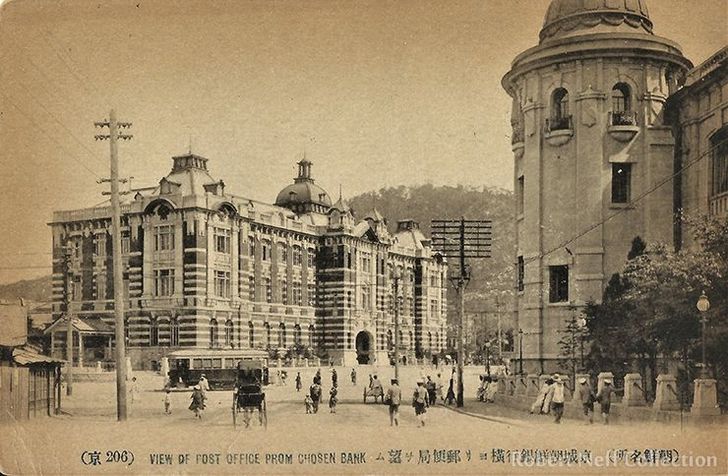
The view of the post office from the Choson Bank during the Japanese occupation / Robert Neff Collection
The innocence of youth robbed him of the understanding of what had just happened but the adults around him knew.
Weeks later, The Korea Times, an English-language newspaper published in Seoul (which has no relationship to the present The Korea Times founded five years later), reported:
“It was the first time that the Emperor spoke to the people. It meant the end of the war. It meant that the heavy burdens, which weighed so cruelly upon the Koreans, were relieved. It meant new freedom of the downtrodden 26 millions. People came out in crowds into streets in thousands and thousands. Among these crowds were seen those who were released that very morning from the prison, where they had been kept for political reasons. Thousands and thousands of people who had been employed for making military provisions, rushed out into the streets.”
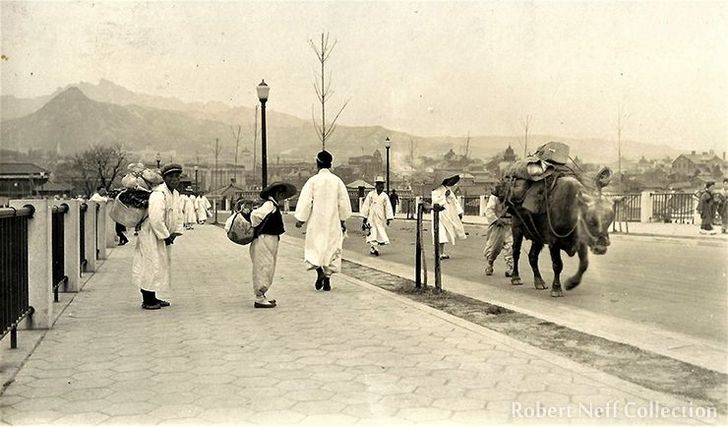
Slow traffic in Seoul during the Japanese occupation / Robert Neff Collection
The same paper described the following day as “a memorable day in recent Korean history.” For Koreans, the peninsula was awash with jubilant excitement. Korean flags appeared everywhere and cars and trucks ― packed with cheering people ― drove up and down the streets. The Japanese police quietly disappeared from public view as did the Japanese flags on the police stations ― replaced with Korean flags. The Korean people, “who had been forced to keep silence for half a century,” would be silent no more.
And yet, the following day, everything was quiet. American reconnaissance flights revealed the streets and roads were empty and the factories seemed idle ― production had stopped ― as if everyone was waiting for the other shoe to drop.
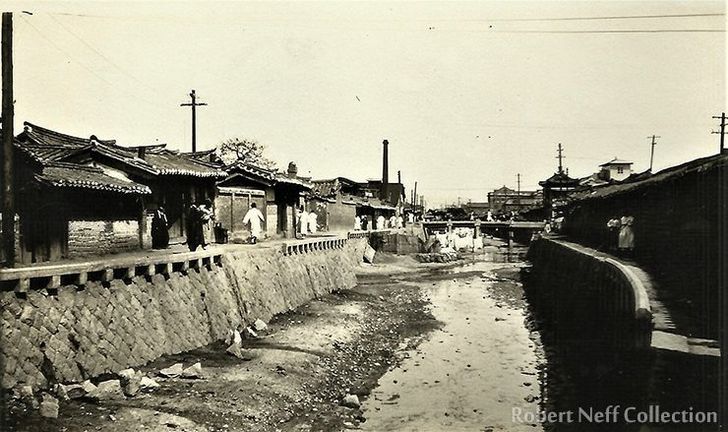
Cheonggye Stream in April 1931 / Robert Neff Collection
For the Japanese, the atmosphere permeating the peninsula was one of fear. Donald Clark, in his book “Living Dangerously in Korea,” wrote:
“When the Americans finally made radio contact with Seoul, Japanese officials reported that chaos was imminent and pleaded with the Americans to help keep order.”
In response, by the end of the month, American military planes began dropping leaflets over Korean cities urging the population to remain peaceful: “Do not let hate, excitement, or selfishness lead you into foolish action,” and “maintain peaceful and orderly conduct at all times. It is only by doing these things that you may speed the lifting of restrictions on your country and your daily life.”
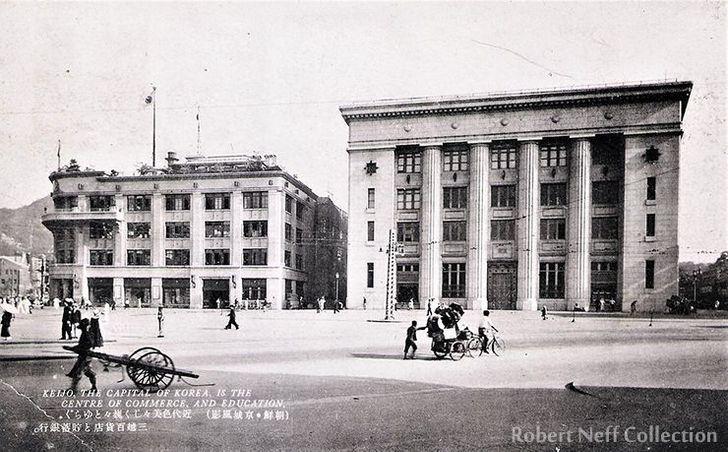
Downtown Seoul circa 1938 / Robert Neff Collection
The leaflets also indicated the Japanese were responsible for maintaining order until the arrival of the Allied forces. The duties of the regular police (who had disappeared on Aug. 16) had fallen on the shoulders of Korean volunteers and Japanese soldiers but their efforts were not that effective.
“Fearful of the consequences of their failure, the Japanese authorities again called out the regular police force; but the police and the detectives were no longer what they used to be, and the continued presence of the Japanese police excited uneasiness among the populace.”
Once again, “Korean volunteers, both student and citizen, lent a helpful hand.” Their efforts, however, were not coordinated and there were clashes between the Japanese with their “sinful past” and the enraged population resulting in the loss of lives. Many felt that the only solution was for the Japanese ― both soldiers and civilians ― be deported back to Japan.
“The Koreans [feel] they [are] free now and that the foot-steps of the Allied Armies [will] be heard before long, with these foot-steps, the first page of the free nation will begin.”
Not everyone was willing to wait around for the Allied Armies to arrive ― some went out to meet them.
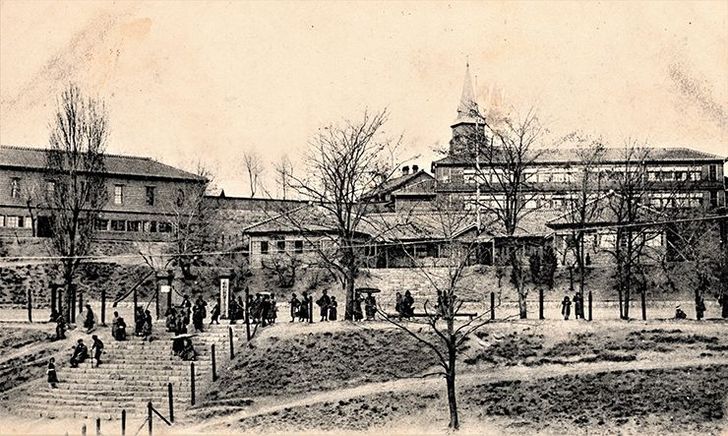
A primary school in Incheon / Courtesy of Diane Nars Collection
According to Seoul Press (an English-language newspaper that seems to have started publishing in August), Yeo Un-hyeong and other delegates of the Provisional Korean Commission of 1945 traveled to Incheon on Sept. 3 “in order to have the opportunity of meeting the prominent members of the U.S. Armed Forces which was to arrive on Sept. 8 and lay bare the existing conditions in Korea and the opinions of the Korean people.”
Yeo was no stranger to politics. He studied at Baejae School in Seoul in the early 1900s, then with American missionary Charles Clark, and, in 1911 enrolled in Pyongyang Presbyterian Theological Seminary. He later worked with the independence movement in China, traveled to Russia, opposed British imperialism, served three years in a Korean prison and, after his release, worked as a newspaper editor and then served as its president.
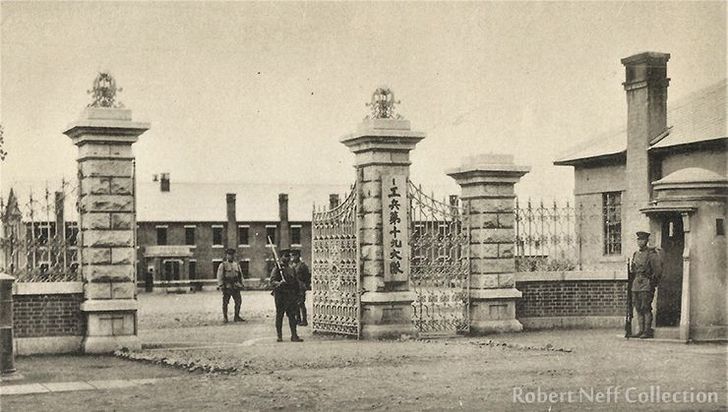
A Japanese military base during the occupation / Robert Neff Collection
He was obviously well-known to the Japanese authorities and feared they might try and stop him and his companions from meeting the Americans. To avoid being recognized, they disguised themselves as members of the Coast Guard and put out to sea in a small boat. They waited at sea in inclement weather until the morning of Sept. 8 when “their patience and zeal” were rewarded by the approach of No. P38 ― an American transport that was part of the fleet of ships transporting the XXIV Corps. The delegation was taken aboard the ship and met General Hodges and his staff. According to the article, Yeo “delivered the welcome message from the chairman of the Provisional Korean Commission of 1945 along with some information on the existing conditions in Korea.”
He claimed that the Japanese authorities were: (1) burning valuable charts and records; (2) “burning, selling, or hiding an enormous quantity of rice” ― which threatened the large Korean cities with starvation; (3) preparing for guerrilla warfare in Seoul; (4) “a goodly number of persons have been found murdered at night. It is certain that they are done to death by Japanese soldiers running amuck”; and (5) finally, to tell the American authorities about the Provisional Korean Commission which was formed after the surrender of Japan, its purpose to maintain peace and order and function as a provisional government until a “properly constituted” government could be established.
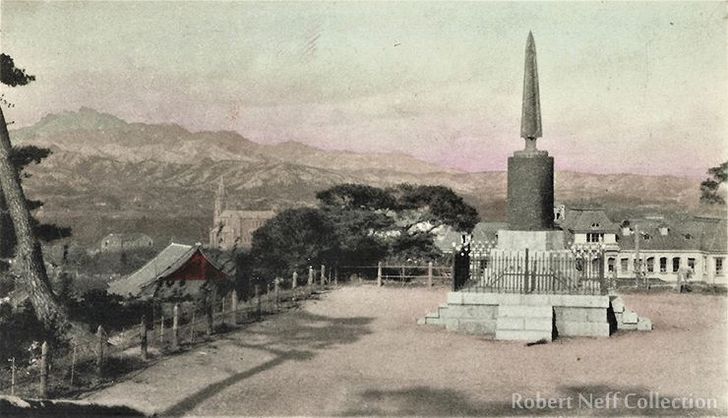
A Shinto shrine on Mount Nam in Seoul during the Japanese occupation / Robert Neff Collection
And, finally, he warned: “There are some reactionary Koreans, even pro-Japanese Koreans, who are apt to mislead you. They are the black sheep of our land. Please beware of them!”
Hodges would soon learn that Korea was not the Land of the Morning Calm.
Robert Neff has authored and co-authored several books including, Letters from Joseon, Korea Through Western Eyes and Brief Encounters.