Lebanese ambassador promotes environmental message through Korean artist's work

Ambassador of Lebanon to Korea Antoine Azzam performs watering of artist Jang Jun-seok's sculpture “Fantasiless” at the Trinity Gallery in Yongsan-gu, central Seoul, Aug. 5. Courtesy of the Trinity Gallery
By Kwon Mee-yoo
An art exhibition featuring sculptures of hangeul, describing aspects of nature and supported by the Embassy of Lebanon in Korea, but Antoine Azzam, ambassador of Lebanon to Korea, finds the exhibition a nice way to build bridges and reinforce mutual understandings between the two countries, based on the commonalties of art and the environment.
Lebanon and Korea established diplomatic relations on Feb. 12, 1981, and this year marks their 40th anniversary. The Lebanese embassy in Seoul looked for ways to commemorate the occasion amid the pandemic, which has swept away the joys of diplomatic receptions and events, and Azzam collaborated with The Trinity Gallery in Seoul to promote Jang Jun-seok, a Korean artist who creates environmentally-themed artworks using hangeul.
At the "Image Sculpture" exhibition, Jang presents his ecological sculptures, which consists of mono-syllabic word-shaped sculptures forming the words for flower, forest and star. Though his works do not directly use images of nature, he evokes the imagery through the words he models.
The centerpiece of the exhibit is "Fantasiless,” a sculpture in the shape of the Korean word for “flower,” accompanied with a watering can. Visitors can participate in a performance in which they water the word, flower.
When he was approached about the idea for the partnership, the ambassador had an insight into the message resonating within Jang's works.
"He is touching a very sensitive subject: the environment. Most countries today spend a lot of money to raise environmental awareness, and his approach to these common and universal issues through art made me (wish to) promote this exhibition," Azzam said.
"The subject matter is important for Lebanon because we suffer from environmental problems. We suffer from (issues of) waste management after the Beirut blast, deforestation and pollution. We need to raise awareness more and more. You many think this is a simple exhibition, but it holds a big message not only for Koreans, but to the (whole) world."
Lebanon is strong in calligraphy and typographic design due to the influence of the cosmopolitan eastern and western culture, so the use of hangeul also intrigued the ambassador. Last year, the embassy and the Korea Foundation presented "Visual Synonyms," an exhibition presenting typographic designs inspired by Arabic calligraphy.
"I thought it would be a nice way to celebrate hangeul and the universal Arabic alphabet. His work is a beautiful message of hope; watering a flower is like giving birth. His approach touched me personally,” the ambassador said.
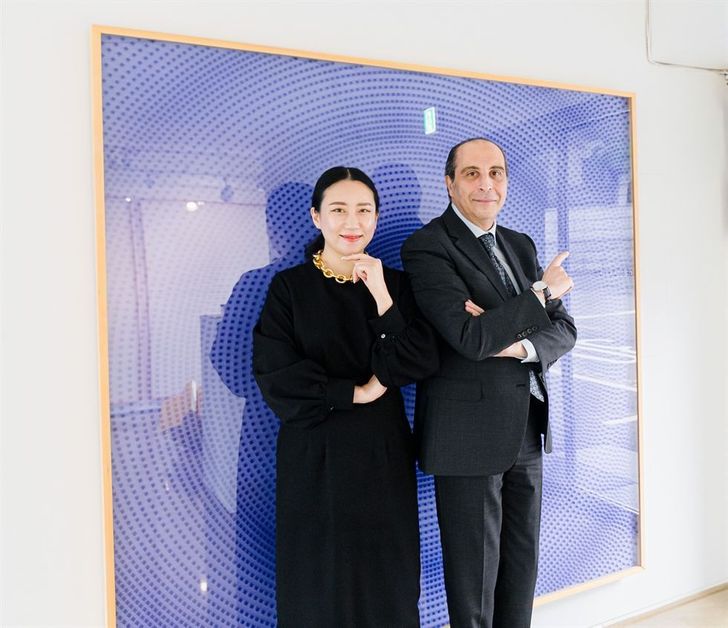
Ambassador of Lebanon to Korea Antoine Azzam, right, poses with Park So-jung, director of the Trinity Gallery who organized the “Image Sculpture” exhibition together, at the gallery in Yongsan-gu, central Seoul, Aug. 5. Courtesy of the Trinity Gallery
"Cultural events or exhibitions bring people together, and when people get together, they communicate, and when they communicate, they establish a bond. Relations develop through understanding and accepting other people's ideas and points of view. We live in a global world and we have to be open. Sometimes I may not understand the ideas (of another person) due to the language barrier, but I can sense or understand through art."
The artist also added another layer of meaning to his work in collaboration with the Lebanese embassy.
"My works are motivated by letters, and it was interesting to work with the embassy. In my opinion, the formativeness of the Korean alphabet reminds me of a three-story modular block house, while the English alphabet gives the impression of a musical scale. The Arabic alphabet is like a living creature with its curvy shape, and so I think it is suitable for expressing nature," Jang said.
As part of the exhibition, an opening reception at the ambassador's residence, which is across the street from the gallery, was planned with Jang's artworks in the garden, but the event has been postponed, due to the heightened COVID-19 distancing measures.
“We invited diplomatic missions in Seoul to celebrate the occasion and take a look at Jang's works, including watering the flower sculptures,” Park So-jung, director of The Trinity Gallery, said.
“The Ambassador of Lebanon understands the importance of cultural diplomacy very well and accepted my idea of commemorating the 40th anniversary of diplomatic ties by sending an environmental message through a Korean artist's work amid the pandemic. We hope to continue the partnership with the ambassador promoting Jang's works in Korea and Lebanon.
"This is a good time for cultural diplomacy, but cultural exchanges are almost shut down due to the pandemic. However, I believe that the importance of cultural communication and understanding is bigger than ever and try to play a role in cultural diplomacy despite the pandemic by organizing exhibitions and events that could provide an international insight.”
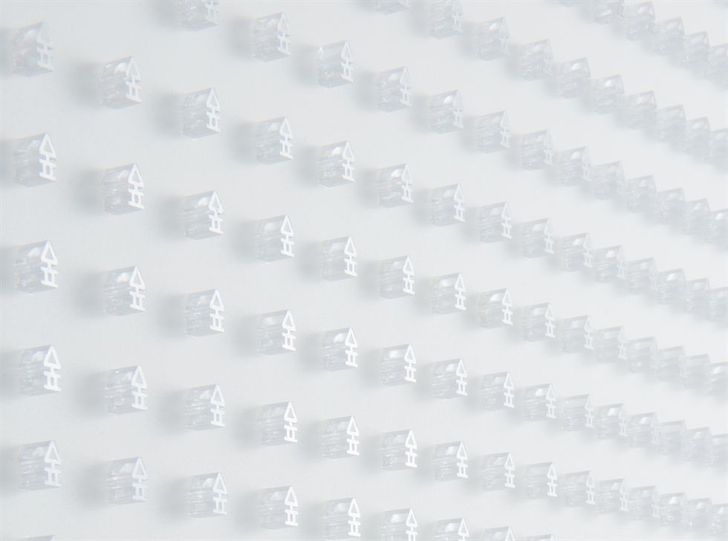
Detail of Jang Jun-seok's “Transparent Forest,” which consists transparent polyethylene letters showing Korean word “forest” / Courtesy of the Trinity Gallery
Rising from ashes
Lebanon has a history of 6,000 years, beginning with the Phoenicians.
"Lebanon witnessed the presence of so many civilizations. Among them, the Phoenicians were great sailors and they gave the world the alphabet. They built ships from cedar trees, and that's why the flag of Lebanon has a cedar tree on it," the ambassador explained.
Lebanon also witnessed the presence of the Ottomans for 400 years, from the 16th century onwards, and of the French, as mandated after World War I, before the country became independent in 1943.
Modern Lebanon suffered from the Lebanese Civil War from 1975 to 1990, while the impacts of the Syrian War have also spilled over to Lebanon. Most recently, Lebanon has faced political and social unrest, following instability and economic difficulties since 2019.
"Lebanon is geographically located between Syria and Israel. Sometimes geography is a blessing. Most of the time, it's a curse. And you Koreans know something about it: having neighbors is not always easy," Azzam said.
The ambassador said that there is great potential for Lebanon-Korea relations even after the explosion at the port of Beirut last year.
"Beirut was destroyed last August due to the big blast at the port. The Korean government sent $1.5 million for relief. And I think Korea can contribute to rebuilding infrastructure projects, such as electric power plants and water and waste management facilities. Korea is already involved through the military," he said.
Korea has maintained the Dongmyeong Unit, a peacekeeping force under the U.N. Interim Forces to Lebanon, since 2007.
"They are in the peacekeeping forces in the southern part of Lebanon and very much appreciated by the people of Lebanon. It's a great venture with Korea and never has a military group had this much affection from the locals. The Koreans have zero problems.”
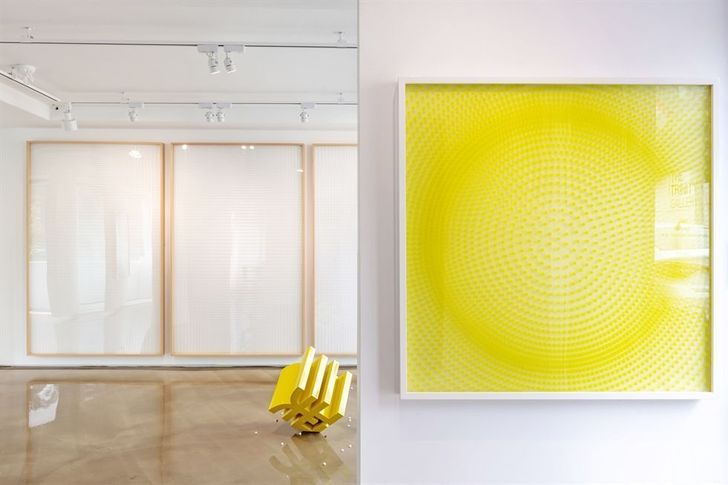
Installation view of Jang Jun-seok's “Image Sculpture” exhibition at the Trinity Gallery / Courtesy of the Trinity Gallery
Since his arrival in Korea in January 2018, Azzam has been focusing on promoting Lebanon by participating in fairs and events and giving lectures.
"When I give a lecture, I emphasize that Lebanon is not a country, but 'a message for peace and tolerance in the Middle East' ― a quote from Pope John Paul II. It was two years of productive exposure for Lebanon. Unfortunately, COVID-19 slowed our visibility, but we try as much as we can to continue bilateral exchanges and promotion," he said.
Azzam believes that cultural exchanges are crucial in taking the relationship between Lebanon and Korea to a higher level.
"It's important to have a Korean cultural center in Lebanon to promote Korean traditional music and art and vice versa. And translating Lebanese literature into Korean and Korean authors into Arabic is another major key," he said.
"Kahlil Gibran's 'The Prophet' is translated into over 100 languages and Korean is one of them … I encourage Korean people to read it. It's a simple book that will change your life."
The embassy also supported screening "Capernaum," an Oscar-nominated Lebanese film revolving around the Syrian refugee crisis in Lebanon in 2019. Bordering with Syria, Lebanon is hosting 1.5 million Syrian refugees, and the film sheds light on the poor conditions of the refugees, sending a message of awareness.
“Our story has not been like a flower garden due to the neighboring countries and regional crisis. But like the Phoenix, we will be rise from our ashes,” the ambassador said, referring to the name “Phoenician” coming from phoenix.