Gov't to expand stricter gathering ban to non-capital areas

Vacationers have fun in the sun at Sokcho Beach in Gangwon Province, Sunday, with the new virus cases hitting a new record of 1,454 for Saturday. Amid the fourth wave of infections sweeping the country, the government has decided to expand its ban on private gatherings of five or more people nationwide from Monday. Yonhap
By Lee Hyo-jin
The government has decided to expand its ban on private gatherings of five or more people nationwide, alarmed by the rise in COVID-19 cases outside the capital region amid the fourth wave of infections sweeping the country.
“Starting Monday, the ban on private gatherings of more than five people will be expanded nationwide,” said Prime Minister Kim Boo-kyum at a COVID-19 response meeting, Sunday.
“Although the toughest distancing measures have been implemented in the metropolitan area for a week, the number of infections is not going down. All resources should be poured into curbing the spread of the virus.”
According to the Ministry of Health and Welfare, the measure will be effective for two weeks until Aug. 1.
Since last week, Seoul, Gyeonggi Province and Incheon have already been under the private gathering ban during the daytime. In addition, after 6 p.m. the private gathering limit is just two people.
The decision came as a recent resurgence of infections in the capital region seems to be rapidly spreading to other parts of the country.
The Korea Disease Control and Prevention Agency (KDCA) reported 1,454 daily new cases for Saturday, a record-high total for a weekend, bringing the total caseload to 177,951.
Despite the toughest restrictions under social distancing Level 4 imposed in Seoul and its surrounding areas, the ongoing spread of the virus is showing no signs of abating, with the daily tally staying above 1,000 for 12 consecutive days.
Adding to concerns is the spike in non-capital regions. Among the 1,402 local transmissions for Saturday, 443 cases, or 31.6 percent were reported from outside the Seoul metropolitan area, up from 22.1 percent recorded July 9.
The number of infections in these regions is feared to increase as more people from the capital area are traveling to other parts of the country in the summer holiday season.
While most regions are currently under social distancing Level 2, the ceiling on the number of participants in private gatherings vary by region, with some allowing gatherings of up to four, while others permitting as many as eight people.
The health authorities viewed that the complicated measures may lead to public confusion, and expressed concerns about a possible “balloon effect,” where antivirus measures in the capital area lead to spikes in other areas with less stringent curbs.
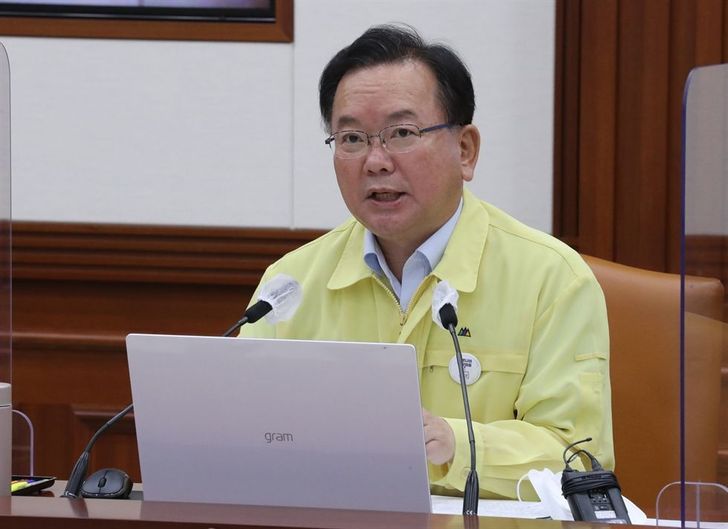
Prime Minister Kim Boo-kyum speaks during a COVID-19 response meeting at Government Complex Seoul, Sunday. Yonhap
Against this backdrop, the government has decided to impose a unilateral restriction on private gatherings of five or more people nationwide.
But experts viewed that the measure will have limited effects as the current virus situation is much affected by the highly contagious Delta variant. They called for tougher restrictions such as scaling up the distancing level to a higher notch.
“Stronger measures are needed in order to bring the virus situation under control, such as raising the distancing level further or imposing gathering bans on nighttime entertainment facilities in non-capital regions,” said Chon Eun-mi, a professor at the Department of Pulmonology of Ewha Womans University Mokdong Hospital.
Kim Woo-joo, an infectious disease specialist at Korea University Guro Hospital also said the government should not hesitate in implementing stringent restrictions. “At this rate, the new daily cases can reach 2,000 any time,” he warned.
Meanwhile, starting Monday, Korea will administer the first dose of Pfizer vaccines to high school seniors and teachers nationwide. The students, who are scheduled to take the national college entrance exam in November, have been included among priority groups.
As this is the first time the coronavirus vaccine will be administered to teenagers in Korea, the government has thoroughly prepared for the rollout in close cooperation with regional education offices, according to the KDCA.
Around 630,000 students and teachers, as well as employees at schools have made appointments to be vaccinated. They will receive their first shots between July 19 and July 30. The second round of inoculations will begin Aug. 9.