THAAD will be deployed in 8-10 months: USFK commander
By Jun Ji-hye
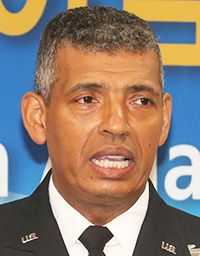
Gen. Brooks
The commander of the United States Forces Korea (USFK) said Friday that an advanced U.S. missile defense system will be deployed in South Korea in the next eight to 10 months.
The comment was seen as an apparent effort to calm growing concerns here that South Korea’s deployment decision could be derailed following a massive political scandal surrounding President Park Geun-hye and her longtime confidant, Choi Soon-sil.
“You’re going to see the deployment of a Terminal High Altitude Area Defense (THAAD) battery. This is an alliance decision. It will come in the next eight to 10 months,” USFK Commander Gen. Vincent K. Brooks said at a seminar hosted by the Association of the Republic of Korea Army in Seoul. “That is an Army unit and a larger configuration than the one in Guam.”
In Washington, Assistant Secretary of State Daniel Russel also said that he has not seen any change in South Korea’s national security lineup in the wake of the scandal and that the U.S. alliance with the Asian ally will “continue to function effectively.”
“I don’t see any change to any of the important priorities in the U.S.-ROK alliance, including the timeline for the deployment of the THAAD system,” Russel said during a Foreign Press Center briefing. “We have every confidence that notwithstanding any political development in Seoul, the alliance will continue to function effectively as it has for more than six decades and we will continue to definitively deter and to further develop the capability to defend against the significant threat from the DPRK.”
Seoul and Washington announced in July that the THAAD system will be stationed in Seongju County, North Gyeongsang Province, by the end of next year to better deter evolving threats from North Korea’s nuclear and missile capabilities.
However, with hard-line politicians even calling for Park to resign or be impeached, concerns have been growing that the Park administration could be put into a vegetative state, and ongoing diplomatic talks, including one regarding THAAD, could be suspended.
As the latest opinion poll showed Park’s approval rating plummeting to an unprecedented low of 5 percent, people appear to have lost trust in her following allegations that Choi, with no official standing, has exerted influence in state affairs related to national security and foreign affairs.
The remark made by a prime minister nominee, Thursday, further fueled concerns over the possible review of the deployment decision.
Kim Byong-joon ― a former close aide to late President Roh Moo-hyun ― who was nominated as prime minister to replace Hwang Kyo-ahn, told reporters that his view on the THAAD deployment could be different from that of the President.
The issue has been much debated since the two countries’ announcement in July.
Many opposition lawmakers have called into question the government’s bungled management of the deployment decision-making process as well as its official announcement, which sparked severe criticism from local residents living in the area selected as the THAAD location.