Economics of plane crash investigation
Understanding motivation behind involved parties’ actions and reactions
By Kim Da-ye

National Transportation Safety Board Chairwoman Deborah Hersman briefs the media on the Asiana Airlines plane crash at the San Francisco International Airport, July 7. / Yonhap
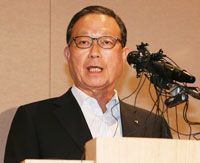
Asiana Airlines Chairman Yoon Young-doo talks in a press conference at the carrier’s headquarters in western Seoul, July 8. / Yonhap

Two killed Chinese teenagers Ye Mengyuan, left, and Wang Linjia, right, pose for photos with classmates in Jiangshan City in China’s Zhejiang Province in this undated photo. / AP-Yonhap
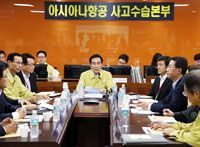
Yeo Hyung-ku, center, the deputy minister of land, infrastructure and transport, holds an emergency meeting on safety measures with representatives of domestic airliners in the government complex in Sejong City, July 15. / Yonhap
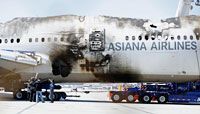
The wreckage of Asiana Flight 214 is seen at San Francisco International Airport in this July 12 photo. Boeing manufactured this B777 aircraft. / AP-Yonhap
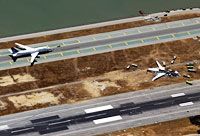
This aerial photo shows the crash site of Asiana Flight 214 at San Francisco International Airport, July 6. Some Korean media pointed out that the design and location of the airport makes it tricky for pilots to make a landing there. / AP-Yonhap
Following the crash of an Asiana Airlines plane at San Francisco International Airport on July 7, there has been much attention on three Chinese teenagers killed as a consequence of the incident, as well as a great deal of speculation about who is to blame for the disaster.
The U.S. National Transportation Safety Board (NTSB) began an investigation immediately after the crash and promptly released its discoveries. The information includes that captain Lee Kang-kuk had flown a Boeing 777 airplane for only 35 hours during his entire pilot career. Asiana corrected this statistic to 43 hours and made it clear that the plane seemed to have had no problem in terms of speed and flight altitude until 34 seconds before landing.
The tension among the involved parties heightened as the NTSB released its findings. On July 8, Asiana Airlines CEO Yoon Young-doo said in a press conference that he wouldn’t accept any assumption that the pilots were responsible. The Air Line Pilots Association, an international pilots union, issued a statement that urged the NTSB to “refrain from prematurely releasing the information from on-board recording devices.”
This led the Korean media and public to feel that the U.S. authority was treating the Korean carrier unfairly. In addition, some of them interpreted the American media’s focus on negligence of the pilots rather than errors in the aircraft as bias against Korea. These concerns prompted Korea’s Ministry of Land, Infrastructure and Transport to write an official letter to NTSB Chairwoman Deborah Hersman, asking for a fair investigation and indirectly complaining about the release of information from the voice recordings in the cockpit.
Boeing, the manufacturer of the B777, stayed mostly quiet, so did the San Francisco airport and air traffic controllers who the Korean media speculated were also responsible.
Playing the blame game isn’t unusual in high-profile accidents such as a plane crash when the reputation of business is at stake. For example, on the same day of the plane crash, oil-carrying trains derailed in Canada and devastated a scenic town in Quebec, killing 50 people. The head of the U.S. rail company initially suggested that firefighters were responsible and later blamed an engineer.
The handling of the Asiana plane crash by potentially liable parties resembles a political drama in which each of them has a different reason to act and react in certain ways. The Korea Times’ Business Focus talked to aviation accident lawyers and academics to find out probable liabilities of each involved party and therefore the motivations behind their actions.
One interesting finding is that the NTSB investigation’s main purpose is to improve safety of air transportation and the technical facts found by the independent federal authority cannot be used in civil lawsuits. This aspect has been ignored in the Korean media’s criticism toward the NTSB’s fairness.
“In principle, that is, according to international aviation rules made by ICAO (the International Civil Aviation Organization), the results of this technical investigation may not be used for establishing civil or criminal liability,” said Pablo Mendes de Leon, professor of air and space law at Universiteit Leiden in the Netherlands
“This point — the results may only be used for the technical investigation as it is designed to promote safety of international air transport — raises a lot of controversy as people want to know what happened in order to identify the liable person. However, as stated, international air law has the promotion of safety as its principal objective.”
Thomas Demetrio, personal injury attorney at Chicago-based law firm Corboy & Demetrio, agreed, saying, “The NTSB has no interest in protecting the air traffic controller. NTSB is interested in safety of the air-travelling public whether they fly from Iran or from Ohio. What they want from the investigation is that the causes of the accident are corrected, and something like this doesn’t happen again. NTSB is not political.”
It will be civil lawsuits that identify the parties to blame.
“They (the NTSB) will investigate the operation of all essential systems, including the engines, flight control, crew, airport operations and equipment, etc.,” said Ronald Goldman, senior trial attorney for the Los Angeles-based Baum, Hedlund, Aristei & Goldman.
“In civil litigation, plaintiffs’ lawyers must go further and assign blame.”
Civil lawsuits can deal a heavy blow to the involved parties. Lawyers representing passengers go beyond the NTSB investigation and conduct separate, independent investigations, potentially bringing more parties into lawsuits. To identify liable parties in an airplane crash, Goldman said that three basic questions must be asked: why the airplane crashed; why anyone was injured; and why anyone died.
Furthermore, most lawsuits are expected to be brought in the U.S. where courts tend to be favorable toward passengers and airplane crash victims, compared to Korea and China. According to Demetrio, the Asiana passengers can bring lawsuits in their home countries, the final points of their destinations, California where the accident took place and Chicago where Boeing is headquartered.
Business Focus examined possible liabilities of each involved party.
Asiana Airlines
Pilots and their airlines are often found liable for causing accidents.
“Typically in an airplane disaster, the airline blames the manufacturer of the plane and the manufacturer blames the airline,” said Demetrio.
If a pilot is found responsible, the damages to his or her airline could be immense.
“Damages depend on what laws apply. Under U.S. law, they (airlines) are entitled to all economic and non-economic damages, which include med bills past and future, loss of income past and future and non-economic damages which include pain suffering disfigurement anxiety and emotional distress,” said Brian Panish, personal industry trial lawyer who heads the Los Angeles-based Panish Shea & Boyle.
After a plane crash, an airline has to pay out compensation whether a pilot is found solely responsible or if the airline played a part. However, if a pilot is exclusively responsible by having operated against the airline’s policies and practices, the airline might be able to “escape from irreparable damage to its reputation,” Goldman said.
In the Asiana case, the airline’s policies and practices in relation to pilots’ operation are likely to be looked at by lawyers. According to Goldman, one could question if the pilots had been trained by the airline to depend too heavily on the automated flight systems including the auto throttle of the Boeing 777 or the airline’s decision to put together the two pilots — “one on with low time in a B777 and a check airman on his first check ride.”
Under these complex circumstances, involved parties would not immediately admit liabilities, knowing how it might affect litigation.
“Persons involved with the cause of the crash keep their cards before their chests, and are legally protected in doing so — as the results of the technical investigation may not be used for other proposes than for enhancing safety, excluding any liability questions,” Mendes de Leon said.
Goldman added, “While there appears to be a lot of information pointing to the pilots as being a cause of the crash, even Asiana Airlines is not going to accept responsibility until a thorough investigation is completed. This is due to the possibility that their pilots might be exonerated, completely or in part, by some as yet unidentified defect in the aircraft or some external system that was not working at the time of the crash.”
Boeing
In an airplane crash, the manufacturers of airplanes tend to be the targets of blame along with pilots and airlines. A lawsuit against Boeing, maker of the crashed B777, is already on the way.
Ribbeck Law Chartered, a Chicago-based law firm representing 83 passengers, filed a petition seeking evidence for the plane crash in a Chicago court. For initiating the litigation, the law firm cited a possible malfunction of the Boeing 777 aircraft’s auto throttle as well as emergency slides that inflated inside the airplane and some seatbelts that did not unlock and had to be cut with police knives by the cabin crew.
Korean government & domestic aviation industry
Korea’s Ministry of Land, Infrastructure and Transport immediately dispatched officials to the crash site. It is common that governments as regulators of aviation industries take keen interest in airplane crash investigations.
“In accordance with international rules as I presume that the Korean civil aviation authority has certified the Asiana Airlines’ aircraft. The question then arises whether certification and maintenance were carried out in accordance with Korean and international rules and procedures,” said Mendes de Leon.
In addition to cooperating with the NTSB, the transport ministry said that it’s going to conduct its own month-long investigation in Korea.
The domestic airline industry is bound to be influenced by the Asiana plane crash as investigations may lead to changes in the aviation regulations.
The transport ministry met July 15 with representatives of domestic airlines, urging them to strictly comply with operation and maintenance regulation. Asiana Airlines vowed to extend the hours of training that pilots have to complete in order to fly new aircraft models.
San Francisco airport & air traffic controller
Civil lawsuits in an airplane crash can target any party suspicious of negligence, and airports and air traffic controllers aren’t exceptions.
“Generally, the airport authority can be held liable in the same manner as an airline for injuries that arise from its own negligence in failing to operate and/or maintain an airport in a safe condition,” said Goldman. The attorney added, however, that the Federal Aviation Administration, a government entity, is subject to “various immunities that must first be dealt with.”
Airports and air traffic controllers are rarely found exclusively responsible. In the Asiana case, the media pointed out that the airplane landed at the runway 28L whose instrument landing system that provides guidance to an inbound airplane in poor weather was shut down.
Goldman said that the airport published a notice on this and pilots are required to check such notices. In addition, the weather was good and the pilot did not need the guidance, the attorney said. The San Francisco International Airport is owned by the city of San Francisco.
Demetrio said that in a case such as the Asiana crash, passengers wouldn’t directly sue the airport or air traffic controller but airlines might bring an action against the airport.
“An airline carries the highest duty to care for passengers. What the airline could do is bring an action against the owner of the airport and say that this is why the airport disrupted the landing,” said Demetrio.
Insurance industry
Because of the massive amount of compensation paid out to victims, a passenger airplane crash might affect insurance industries.
On the same day of the plane crash, Korea’s Financial Services Commission (FSC) said in a statement that Asiana Airline has $2.38 billion (2.67 trillion won) of insurance — about $130,000 for the aircraft and $2.25 billion for compensations. According to the financial regulator, nine domestic insurance firms led by LIG Insurance underwrote the amount. The local insurance industry will be little affected because more than 97 percent of this amount is re-insured by foreign entities, said the FSC.