Japanese scholar writes book on legendary Korean marathoner Son Kee-chung

Terashima Zenichi
By Park Ji-won
A retired Japanese scholar has released a book in Japan on legendary Korean marathoner Son Kee-chung to let young people know the true meaning of sports and the history of Korea and Japan.
“The true spirit of sports is to make friendship. I think Son lived the in this spirit his entire life. Through my book, I hope young people will learn the history of the Japanese colonization of Korea, which now is not being taught properly in Japan, and the pain of the Korean people under the oppression of imperial Japan,” Zenichi Terashima, 74, author of the book and honorary professor of Meiji University, told The Korea Times on the phone, Monday.
Terashima used to give lectures as a full-time professor about sportsmanship in the same school before retiring and had been a friend of Son's meeting from time to time from the 1980s until Son's death in 2002.
He was able to write the book with a donation of 1 million yen ($9,076) from Japanese and Korean people.
Citing the friendship of rival speed skaters Nao Kodaira and Lee Sang-hwa, Terashima added “I witnessed the friendship of Korea and Japan in the PyeongChang Olympics. This was what Son pursued.”
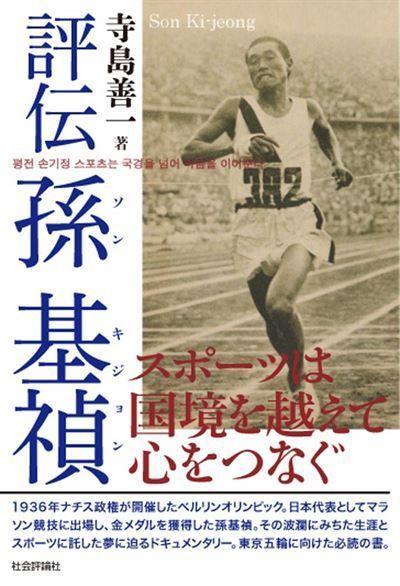
The book titled “Memoir of Son Kee-chung. Sports connect people's hearts beyond borders”
Son won the gold medal for the marathon at the 1936 Summer Olympics in Berlin. It was the first historic gold medal won by a Korean, but it was counted as a medal for Japan as he was representing the nation as a Japanese citizen under its 1910-45 occupation of Korea.
Son allegedly held a small oak tree in front of his chest to cover the Japanese flag on his uniform when he appeared on the award podium after winning the race, and the Japanese government suspended him from running in other marathons due to the act. Later, he graduated from Meiji University and worked as a banker in Japan but returned to South Korea after its liberation, devoting his life to fostering his portages and making a better environment for other athletes.
The former professor was thinking of writing the book later on but rushed it as he thought politicians were making the diplomatic situation uglier.
Terashima criticized Japanese politicians' political maneuvers for making ”defamatory remarks” and so-called right-wingers for making “hate speech” against Korea, but also said he saw hope in ordinary people.
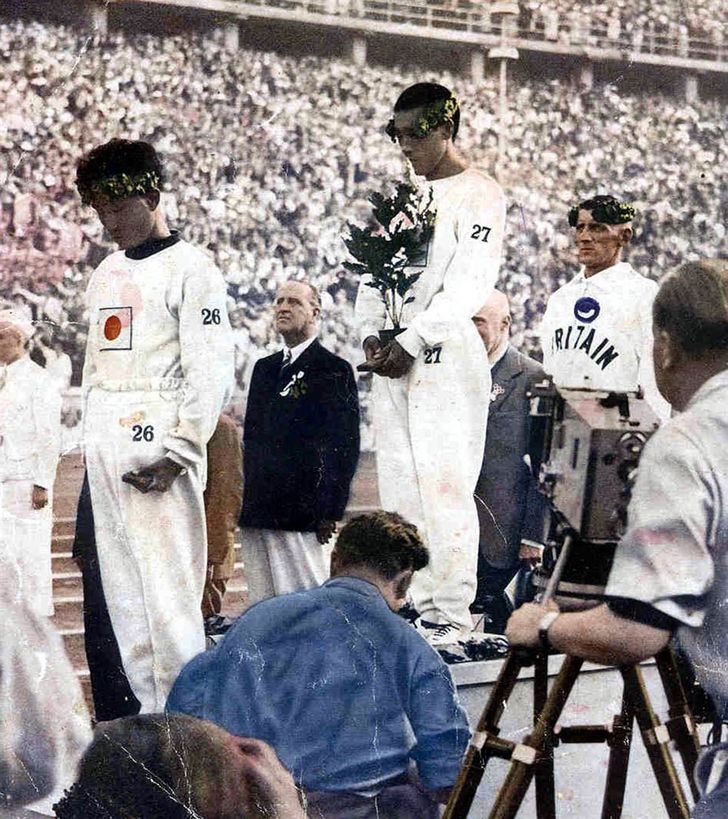
Son Kee-chung at the 1936 Summer Olympics in Berlin / Korea Times file
“More young people from both countries go to each other's country and learn about their neighbors. I assume they would know the reality beyond politics.”
He has been participating in the Son Kee-chung Peace Marathon in South Korea since 2016 with his friends and continuing to celebrate Son's philosophy of sports, hoping that the two countries could make cooperative relations in the future.
“Through sports, especially in the Tokyo Olympics, I hope the two countries can improve their relations. If it fails again, we should fight to achieve it.”