Families grapple with dementia as Korean society ages
While cancer still looms large as the main cause of death in Korea, some new chronic illnesses have taken hold in our lives. This is the last of a three-part series of articles on what plagues modern Koreans these days. — ED.
By Kim Ji-soo
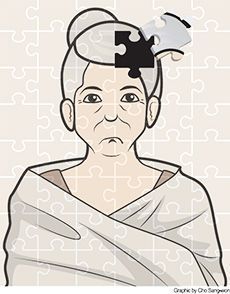
Dementia, which brings with it the loss of cognitive abilities, has become a part of many lives in the rapidly aging Korean society.
Dementia is caused by various factors, but the most common is Alzheimer’s disease, in which the beta-amyloid protein accumulates to destroy brain cells, resulting in the loss of memory, language skills, mental agility, judgment and visuospatial and executive functions.
At 63, Lee Yong-hee is a caregiver to both her mother, who has dementia, and another patient.
“After retiring in 2008 after working for 35 years, I studied to get a caregiver’s diploma. Then my mother was diagnosed in late 2013,” Lee said in an interview held at a cafe near her patient's house in Eunpyeong-gu, Seoul.
Her mother, 86, is still mobile, but she forgets what she does or says after just an hour or even minutes.
“She talks about things, like how she raised me, an infant who was put in a cradle in front of her house,” Lee said. “I have noticed her making up stories, for example, stories based on dramas that she may have seen.”
Lee, who is single, currently supports her mother and her younger brother. She has turned caregiving into full-time work, and because she has a caregiver’s diploma, she receives a government-subsidized pay of 500,000 won per month. In addition to her mother, she cares for the other patient for four hours in the afternoon, which brings in about 600,000 won per month.
“The financial toll is the biggest burden, followed by the emotional toll,” Lee said. “My mother has glaucoma and teeth issues, which I cannot afford to treat.”
Lee herself has a painful spine, which she treats with pain-relief patches from the drugstore. She ponders the possibility that she will have to support her mom even years from now, perhaps even until she’s 100 years old.
“I think about that …,” she said, calling the dreadful possibility a dilemma.
In the meantime, Lee is also thinking about present problems, such as how caregivers can receive their government-subsidized pay directly rather than through private-run centers that link the caregivers to the patients.
“We caregivers receive work through private-run centers that link us to the patients. In the process, portions of the government subsidy that could otherwise go to us are allotted to the centers,” Lee said.
The National Institute of Dementia in Korea estimated that as of late 2015, 648,223 Koreans or almost 10 percent of the elderly population (65 or older) of 6,624,120 suffer from dementia. By 2050, the number of Koreans aged 65 or older will rise to 17,991,052 or about 37.4 percent of the population, and the number of dementia patients will reach 2.71 million or about 15 percent.
“It is a critical time for our society with regard to dementia,” said Seong Su-jeong, professor at the department of psychiatry at Hallym University Kangdong Sacred Heart Hospital in Seoul.
“Korean society has seen the number of dementia patients double in 20 years. The pace at which Korea is forecast to move from an aging to a post-aging society, in 26 years, is too swift compared to 70 to 150 years it took for the United States and Europe,” Seong said. At this rate, about nine people of productive age (aged 15-64) will be needed to support one dementia patient by 2050. Back in 2010, 75 people together shared the burden of supporting one such patient.
Dementia is different from many other diseases in that it requires long-term care and affects the patient’s entire family. The social cost it poses on Korean society was estimated at slightly over 11 trillion won as of 2013, according to a National Assembly Budget Office’s report.
Kim Bang-sook, 63, also looked after her late mother-in-law who had dementia in Gwacheon. Kim and her husband supported the 88-year-old throughout the remaining years of her life, the last two or so of which were plagued by dementia.
“The hardest part was not necessarily having to change the diapers,” Kim said in a telephone interview. “It was seeing her odd behavior, like screaming day and night and attempting to eat the leaves of houseplants,” she said.
Kim’s mother-in-law showed delusional symptoms years before she was diagnosed. For instance, she would say bank employees were stealing money from her account. The symptoms worsened in April 2015 after a fall, after which Kim had to feed and bathe her and change her diapers.
Kim had the support of her husband and family members. But other people end up as sole caregivers for family members and often rely on senior care facilities, the number of which has been increasing since the government began to aggressively address dementia in 2008. However, the general sentiment that home care is the best remains.
“We need to change perceptions so that people with dementia can still be active in society,” Seong said. The perception about dementia in Korea was that it was old-age senility that struck near death, and people would often hide it if a family member was afflicted as towards the mid-late terms they become child-like and can turn violent.
To incorporate the patients in the community, the government runs the “Dementia Partner” campaign, for which 190,000 people nationwide have signed up to help dementia patients, she said. There is also a dementia hotline (1899-9988). Seong stressed early detection and preventive programs.
With the increase in the number of dementia patients, the government late last year announced a third set of comprehensive plans (to be implemented in 2016-2020) aimed at reducing the financial burden for caregivers by covering more advanced tests and developing more tailored treatments to deal with symptoms such as delusion, loitering and violence. The first and second plans focused on setting up the infrastructure needed to deal with dementia.
To people like Lee, some financial help could ease the daily burden. She admitted that the stress “clogs up” her heart. The stress has negatively affected her health too, causing some her hair to fall out, among other things. But she tries to take it all in stride, relying on her Buddhist beliefs.
“This reality won’t go away. I just have to deal with it,” Lee said. “Our generation is like that. But will younger people support their parents and work for such meager pay in the future?”