Gangwon to boost DMZ tours
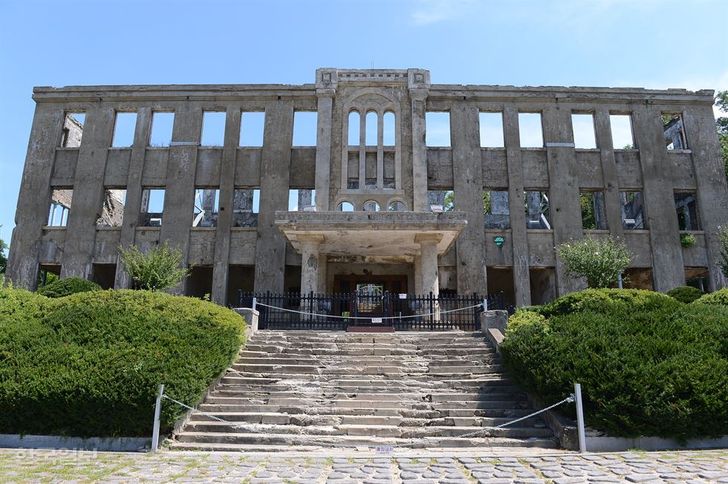
The former Cheorwon Korean Workers' Party Headquarters / Korea Times file
By Kang Seung-woo
Gangwon Province has stepped up efforts to ease regulations imposed by the military on some areas of the region in a move to boost tourism to the Demilitarized Zone (DMZ).
The move is being pushed after President Moon Jae-in and his northern counterpart Kim Jong-un agreed in the April 27 summit to transform the heavily fortified border into a peace zone.
As a result, five border counties _ Cheorwon, Hwacheon, Yanggu, Inje and Goseong _ are putting their heads together to attract more tourists amid skyrocketing interest in DMZ tour programs.
As discussions on formally ending the Korean War are in the offing, the province hopes the civilian control zone would be pushed northward, which could ensure more land to be used for DMZ-related tour programs as well as helping residents exercise their land and property rights.
Assuming that the two Koreas fulfill the bilateral agreement from the inter-Korean summit, the local government is set to seek to reduce or adjust the civilian control area south of the DMZ and other military reservation zones.
The military allows limited entry into the civilian control zone, a border area south of the DMZ _ a 250-kilometer strip of rugged no-man's land stretching from coast to coast and dividing the two Koreas.
Currently, the civilian control line is marked 10 kilometers south of the military demarcation line (MDL) and military reservation zones are 25 kilometers south of the MDL.
Gangwon Province accounts for two-thirds of the 907-square-kilometer DMZ and a combined 53.5 percent of the five counties' area belongs to military reservation areas that exclude them from many development projects.
If the control line should be moved within five kilometers of the MDL, 426.45 square kilometers of lands _ about 150 times the size of Yeouido _ will be freed from the regulations.
In addition, an adjustment of the military reservation zone to 15 kilometers northward will free up 400 square kilometers in the five counties.
To quickly take advantage of the sudden inter-Korean rapprochement for the regional tourism, the local government is also proposing to the defense ministry that it revise the regulations on the five counties in advance.
“A partial adjustment will greatly help draw many visitors to North Korea-related tourist attractions that also attracted many foreigners during the PyeongChang Winter Olympics in February,” a local government official said.
Last month, the local government held a meeting with representatives from the five counties to explore ways to promote DMZ tour programs.
One is, among others, to promote storytelling of peace and offer history-linked tour programs.
Gangwon is the only Korean province divided by the 1950-53 Korean War, so it has a great wealth of DMZ tourism assets.
Yanggu has the Eulji Observatory, which allows visitors to see North Korean troops on guard, and the Fourth Infiltration Tunnel dug by North Korea, while Goseong has the DMZ Museum and the Unification Observatory, the nearest place for viewing Mt. Geumgang in the North.
There is the former Korean Workers' Party Headquarters in Cheorwon, while Hwacheon has the Peace Dam, built in response to a feared flooding attack from North Korea.
Inje has the Livingston Bridge, dedicated to U.S. soldier Thomas Livingston Jr. who was killed in action while fighting communist forces during the Korean War.
“Amid improved inter-Korean ties, the local government has actively appealed to the central government about easing regulations on military reservation zones in the five counties as part of its plans to use the nation's territory efficiently and develop regions,” the official said.
“We are set to concentrate efforts on reviving the regional economy by making the most of tourism assets.”