Local festivals adapt to new normal amid pandemic

A fire in the shape of the phrase “COVID-19 Out” blazes on Saebyeol Oreum volcanic cone in Jeju Island during the Jeju Fire Festival in this March 13 photo. Visitors watch the fire from their cars after making reservations for participation. Yonhap
By Bahk Eun-ji
More than a year into the pandemic, many people are saying that the days of large festivals and concerts that draw huge crowds appear to be have ended for good.
As many cultural events across the country were cancelled last year and some of them this year too, people who have made a living from such events are suffering financially.
Some local governments, however, have begun to adapt to the “new normal” by using alternative platforms to continue to celebrate the festivals and revitalize the local economy.
Festival organizers are choosing realistic alternatives, such as focusing on outdoor activities when possible, limiting the number of visitors, and introducing pre-booking systems.
Jeju Island decided to hold many parts of its signature Jeju Fire Festival virtually in March, broadcasting the most popular program of the festival, the Saebyeol Oreum Torching.
The fire festival represents the livestock farming culture of the southern resort island. Farmers used to light fires during the winter to burn dead grass and kill harmful insects so as to protect their crops, horses and cattle.
By using augmented reality (AR) technology, the festival organizer broadcast the torching event online. Also, those who made a reservation were able to drive to the event and watch the torching from inside their vehicles. Only 400 vehicles were allowed.
As cultural events were cancelled, the organizer provided subsidies to 50 artists who were unable to perform during the festival, so that they could make videos of their performance and works, 10 of which were screened online.
While visitors to the festival used to buy Jeju's agricultural and fishery products during their visits, this year the local governments sold them through e-commerce platforms at special prices.
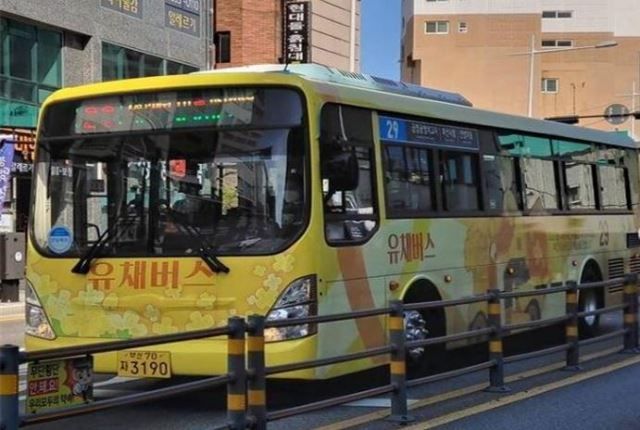
”Canola flower bus” operated by Busan City during its annual canola flower festival / Courtesy of Busan Metropolitan Government
Busan has been leading the paradigm shift for local festivals. The city government has come up with plans to hold festivals in a sustainable way even after the pandemic is over.
The Walking Festa, which was held for three days last week, was one example.
Under the theme of “homecoming,” the festival is aimed at encouraging more people to visit the four old districts of Busan, which were the centers of the city's industrialization.
In previous years, participants walked down trails and explored nature in large groups. But this year, small groups were arranged in different schedules through a booking system.
For its annual canola flower festival held along the Nakdong River, the city held this year's event last month using a new format ― it operated buses covered with canola flower photos so that citizens could enjoy the flowers without visiting the river gardens.
Small canola flower gardens were also created in Seomyeon Metro Station so that people could enjoy the flowers.
Busan city also offered a canola flower delivery service, which was conducted in collaboration with flower farmers and florists in the city. It sent canola bouquets to 500 people who were chosen among 15,000 applicants.
The event went viral as citizens who were chosen to receive the flowers uploaded photos on their social media.
“We tried to hold festivals in a different way so that we can give positive and hopeful messages to citizens who are tired of the prolonged pandemic,” Busan Mayor Park Heong-joon said.
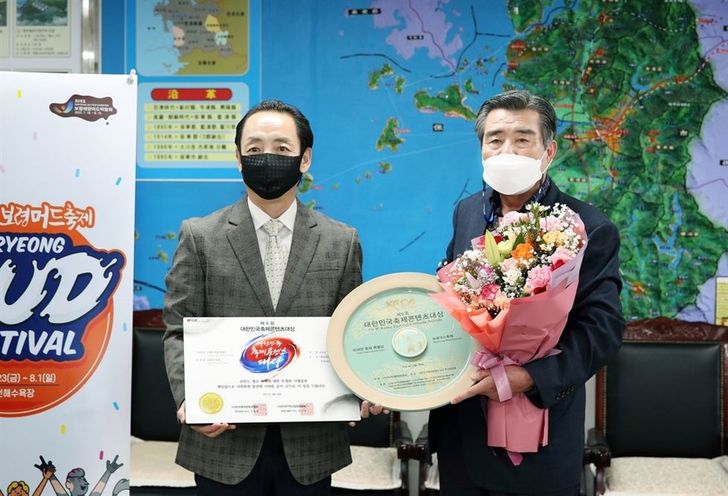
Boryeong Mayor Kim Dong-il, right, poses for a photo after the city in South Chungcheong Province was given a special award in the category of festivals adhering to social-distancing measures at the Korea Festival Contents Award, in this March 22 photo. Courtesy of Boryeong City
The Boryeong Mud Festival, the most popular summer festival in Korea attracting a large number of foreign participants, received a special award in March in the category of festivals held adhering to social-distancing measures. The prize was given during a ceremony at the Korea Festival Contents Awards, provided by the Korea Festival Contents Association.
The annual awards recognize local festivals that have played a key role in developing regional economies and the tourism industry, and this year, it added an online festival award.
With creative programs, the mud festival became a pioneer of virtual cultural events in Korea.
In July of last year, the Boryeong Festival Tourism Foundation, in collaboration with a photo filter app, Snow, came up with a special filter that made people appear to be covered with mud and people were encouraged to upload photos on their social media.
The festival organizer also provided mud-experience packages containing a miniature air-inflated pool and mud clay pack to use at home. Nearly 2,000 packages were sold during the festival.