Worn-down house Dilkusha reveals rich history

Mary Taylor sits near the fireplace in her house Dilkusha, possibly sometime around the mid-1920s. / Courtesy of Seoul History Museum
By Robert Neff
The Seoul History Museum is holding a
of more than 1,000 items donated by the family of Albert and Mary Taylor. The Taylors had a long and colorful history in Korea and the pieces on display are a mixture of everyday household items, photo albums, correspondence, clothing and an early national flag of Korea. But the centerpieces of the collection are their beloved home, Dilkusha, and the magnificent ginkgo tree that stands next to it.
In the early 1920s, while hiking along the city wall, Mary spotted an immense ginkgo tree, the first she had ever seen. There was something magical about it ― the way it dominated the area and “its roots humped up from the ground like great serpents.” One of her Korean staff told her gingko trees were only planted in sacred and royal places.
This site had been the home of General Gwon Ryul (1537-1599), the hero of the Battle of Haengju and later the commander-in-chief of the Korean army during the 1592-98 Imjin War.
Mary was determined to live next to the great tree. The Taylors purchased the land in 1921 or 1922 and preparations were made to build their dream house, Dilkusha (Sanskrit for “Palace of Heart's Delight). But construction was no easy matter, for many spirits and beliefs had to be placated.
The first was with the Japanese, who prohibited any building from being built that would be at the “eye-level of the Meiji Shrine” located halfway up Mount Nam. Once it was determined Dilkusha would not violate this law, permission was given.
For hundreds of years, the villagers revered this tree and associated it with great powers of fertility. Mothers, hoping to bear a son, would pray at the base of the tree and offer little sacrifices (coins) to it. Large numbers of magpies nested in its branches and they were thought to be messengers of good tidings; Mary was warned that “they must never be frightened away.”
The region was popularly known as Haengchon-dong (in honor of the tree) or Eunchong-dong (Silver Nut Valley). The stream flowing beneath its roots was called the Magpie Spring and was known for its medicinal qualities.
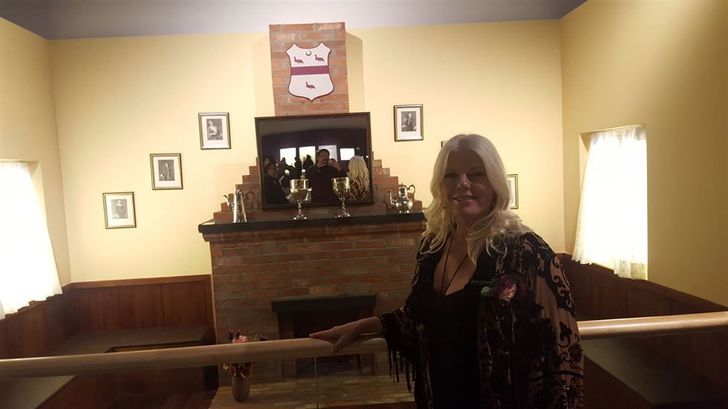
Jennifer Linley Taylor, granddaughter of Albert and Mary Taylor, stands in front of a mockup of the fireplace of Dilkusha. / Courtesy of Robert Neff
When the villagers discovered the Taylors were going to build a house near their sacred tree and spring, they protested. Carts carrying building supplies were knocked over and an angry crowd gathered. Japanese police came and dispersed the crowd but not before a mudang (shaman) cursed them.
Mary dramatically described the incident in her book, “Chain of Amber”:
“'The Spirit of the Place will be revenged. You will wither. Many evils will befall your family and your house will be consumed by fire!' [The shaman] shrieked hysterically in her cracked voice, her snake-like fingers making cabalistic signs.”
And then she was gone and the house was built ― “constructed of stone and brick, with a tiled roof, and stood isolated from neighbours.”
The Taylors moved there in 1924 and were soon joined by Mary's sister, Una. The shaman's curse seemed forgotten until the following year when Una was having breakfast at a small table under the tree. She heard a loud crack, looked up and saw a huge branch falling toward her. Her lightning reflexes saved her from being crushed.
Sickness soon followed the broken branch incident. Una was stricken first with scarlet fever and then malaria and it was decided to send her back to the U.S. to recover. Soon afterwards, Albert was robbed of his health by “some mysterious disease” and the Taylors returned to the U.S.
In July 1926, while they were in the U.S., lightning set the house afire and completely gutted it. But the Taylors were not ready to give up.
By the late summer of 1930 the house was rebuilt. Albert had purchased a small five-level pagoda and placed it under the tree.
“Perhaps,” Mary told Albert, “it will dispel the curse the [shaman] put on us when we first built here. And, now that the spirits have seen their words come true and the house destroyed by fire, they will find it in their hearts to forgive us.”
Albert, always practical, dismissed her superstition and instead laid the blame upon himself for not having installed a lightning rod.
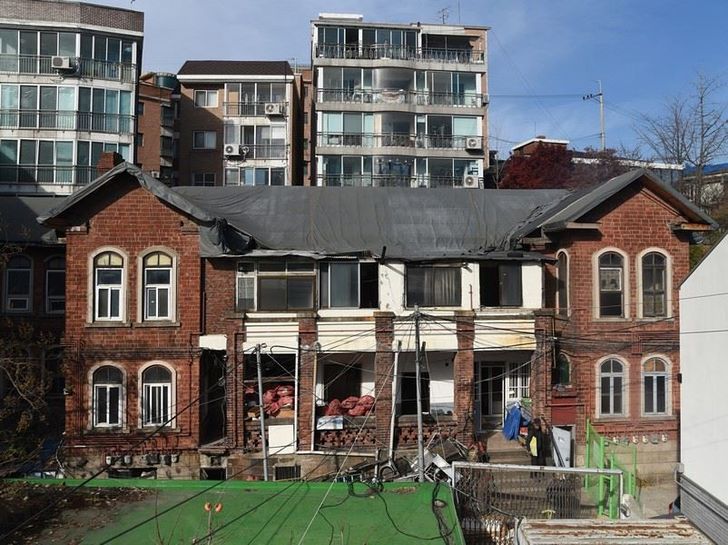
Workers clean out Dilkusha in western Seoul on Nov. 23. / Korea Times photo by Jon Dunbar
The Taylors lived in Dilkusha up until they were forced out of the country by the politics of World War II. Mary returned to Korea in September 1948 with the ashes of her beloved ― he had died suddenly of a heart attack while making preparations to return ― and buried him at Yanghwajin Foreigners' Cemetery. She returned to the U.S. where she kept the memories of Dilkusha and Korea alive in her writings.
At the opening of exhibit, Jennifer Linley Taylor, the granddaughter, confided that she could feel her grandmother's presence all around her.
The exhibit closes March 10, and then the collection will be moved into Dilkusha, which is being restored as a museum. As for the ginkgo, it still stands defiant and proud ― a guardian of the past.
Robert Neff is a historian and columnist for The Korea Times. He can be reached at robertneff103@gmail.com