Gaon to take Korean fine dining to new level

Kim Byeong-jin is the chief chef at the three-Michelin-starred restaurant Gaon. / Courtesy of Gaon
By Kim Ji-soo
The tangy whiff of soy sauce travels up one’s nose as soon as one enters Gaon, the Korean restaurant in Dosandae-ro, Seoul, that earned three Michelin stars on Nov. 7.
“Soy sauce, salt, including malt salt from Hwayo, and soybean paste are what we use at Gaon,” said Gaon’s chief chef, Kim Byeong-jin, 40. Twenty-four Korean restaurants in Seoul received Michelin stars for the first time, with two — Gaon and La Yeon at Hotel Shilla— earning three stars. Gaon is a part of Kwangjuyo Group, which produces the pottery dishes Gaon uses and Hwayo liquor, and owns Bicena, a restaurant that earned one Michelin star.
Gaon’s Michelin stars gave Kim and his team motivation and a renewed sense of responsibility.
At Gaon, which means the “center” in Korean, Kim wants to continue showcasing Korean fine dining. The restaurant, which has five dining areas, is already fully booked through late January.
“At Gaon, I focused on illustrating the flow of what a king would eat in a day, with strong-soft accentuations in between,” Kim said. One of the two menus, “onnal,”features nine dishes, starting from the so-called “five tastes of nature” appetizers, chestnut porridge, cold crab meat salad, steamed abalone, fish from Jeju Island, chestnut honey with eight Oriental herbs, a beef dish, rice with mushrooms, as well as a variety of desserts. With the onnal course priced at 180,000 won, Kim wants to present the power of the ingredients.
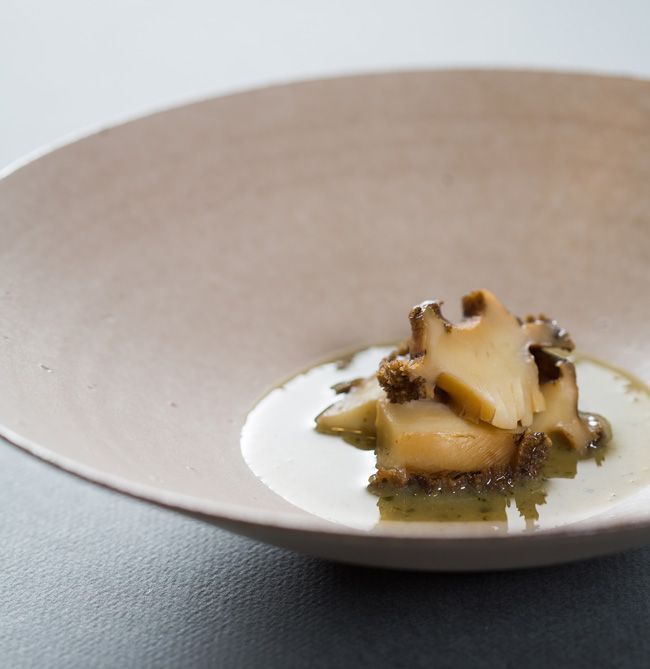
The steamed abalone
The other course is the Gaon (priced at 250,000 won), which features more elaborate dishes, including, once again, the five tastes of nature appetizers, cold shrimp vegetable salad, steamed abalone with pine mushrooms, steamed crab, a sea cucumber dish, jelly made with eight Oriental herbs and others, a beef dish, bibimbap with crab soy sauce and laver, as well as a variety of desserts. The menu changes by the season. Of the restaurant’s relatively high prices, Kim said it means that Korean food is on the way to diversity.
“Essentially, what we want to do is show that we remain committed to showing what we think is the essence of Korean fine dining, which is remaining true to good ingredients and having a certain flow,” Kim said.
Kim spends a lot of time buying ingredients at the Garak and Noryangjin markets in Seoul; he also visits other large markets if more ingredients are needed for the day.
“So for us, the day usually starts at 8 a.m. when the ingredients start arriving, and then we process them throughout the day, until we begin the dinner service at 5:30 p.m.,” Kim said. The restaurant is open until 11 p.m.
Kim said the ingredients are key to ensuring that he can present the customers with Korean food that is natural and healthy, and essentially makes the diner happy. To that end, Kim works with his sous chef Jeon Gwang-sik and four other staff members. Every ingredient is processed by the staff; for instance, the chestnuts are hand cut and the rice is polished right there at the restaurant.
The food at Gaon also reflects Kim’s background. Kim, who hails from Chuncheon, Gangwon Province, explains that the restaurant’s mild sauces or condiments and the kimchi made without salted fish may well reflect the Gangwon region’s geographic or natural features.
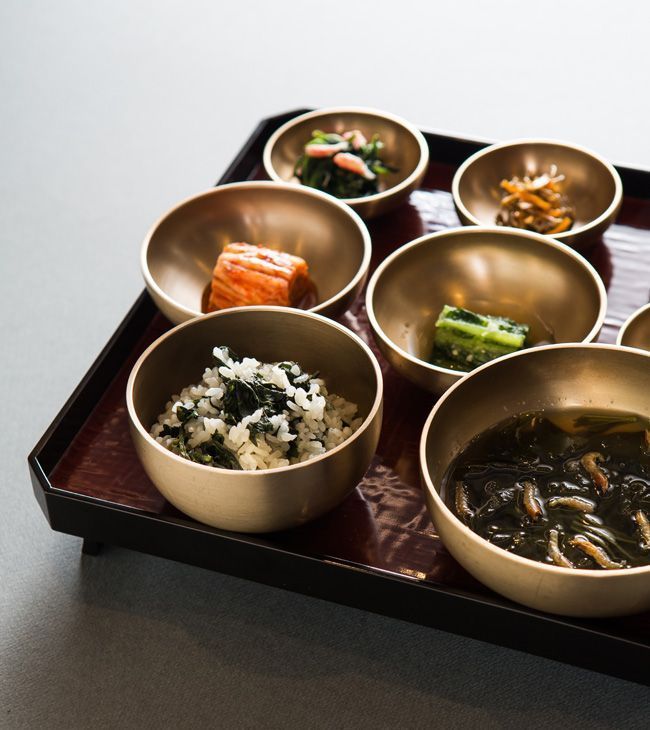
The rice dish with its side dishes
Kim studied traditional Korean cuisine at Hallym Polytechnic University in Chuncheon in Gangwon Province and has been cooking for nearly 20 years, spending the past 13 years with Gaon. Gaon, which opened in 2005 and closed after several years, reopened in January 2015.
Coming up with new menus every season also puts a lot of pressure on Kim. At the time of the interview, he was in the midst of coming up with a new winter menu; he experimented with anglerfish but in the end decided not to use it.
"You know, you can always create a good dish once you have dealt with an ingredient you like or feel confident with,” he said.
With crab, which is one of his favorite ingredients, he experiments in various ways. “It can have different tastes; it can be either sweet or bitter, depending on what ingredients you use with it,” he said. Naturally, he has insisted on including the crab in both the onnal and Gaon menus. Another of Kim’s favorite Gaon dishes is the steamed abalone. “The abalone is intriguing in that it can be used even with the fishy-smelling ingredients, because the abalone itself grows by consuming other ingredients, such as seaweed,” Kim said.
As Koreans are just starting to become aware of Michelin-starred restaurants, Kim asks customers to make bookings. “For Gaon, you don’t have to reserve a certain meal, but you do have to reserve (a place in advance) and call a day ahead if you have to cancel, because all our ingredients arrive only the day before,” Kim said.
He also wants customers to enjoy and be happy with the food, and to leave their feedback with his team at Gaon. Asked if he wanted to work on his own, Kim said: “I just have so much more to learn.”
A certain sense of moderation is visible when he talks about his ingredients and dishes. For instance, when he cooks, he tries not to be too greedy or ambitious. Likewise for the condiments, he uses only salts, soy sauce and fermented bean paste.
His dishes are almost restrained, like a car that could go at 100 percent of its maximum speed but stops at about 80 percent of the speed. I asked him why this is so.
“Despite all the processes that go into it, Korean food is simple in its taste and aesthetic and can be presented simply in pottery dishes,” he said.
His best dish so far? “My mother’s tofu soup with bits of salted shrimp, a touch of red chili pepper and drops of perilla oil,” he said.