Experts discuss maintaining peace in East Asian waters amid growing sea dispute

Society of Ieodo Research President Koh Choong-suk, front row third from left, poses with participants of the 7th Ieodo International Seminar, including scholars from Korea, Taiwan and Japan, during the event at a hotel on Jeju Island, June 15. Korea Times photo by Choi Won-suk
Jeju-based think tank leads academic discourse over maritime disputes in East Asia
By Lee Hae-rin
JEJU ISLAND ― Global experts on international law and sea disputes gathered last week on Korea's southern resort island of Jeju once again, to discuss how to resolve ongoing maritime territorial conflicts in the East Asian region.
During the seventh edition of the Ieodo International Seminar that took place on June 15, experts said tensions have been growing in the East Asian seas due to China's efforts to expand hegemonic power as part of its unrelenting quest to gain supremacy and analyzed related international legal cases of maritime disputes.
Under the theme “Unsettled Issues in the Law of the Sea,” the annual event ― held for the first time in four years due to the COVID-19 pandemic ― brought scholars from Korea, Taiwan and Japan together to share their knowledge on maritime issues in East Asia.
“Disputes and conflicts surrounding maritime sovereignty among East Asian countries persist without resolution,” Koh Choong-suk, president of the Society of Ieodo Research, said in an opening address.
“I hope this seminar will make a significant contribution to maintaining peace in the seas of East Asia and resolving the current and historical challenges that oppose the peace of the sea.”
The Society of Ieodo Research, a Jeju-based think tank founded in 2007 to engage in academic research, education and promotion of Ieodo, hosted the event jointly with The Korea Times. The event was sponsored by the Ministry of Oceans and Fisheries.
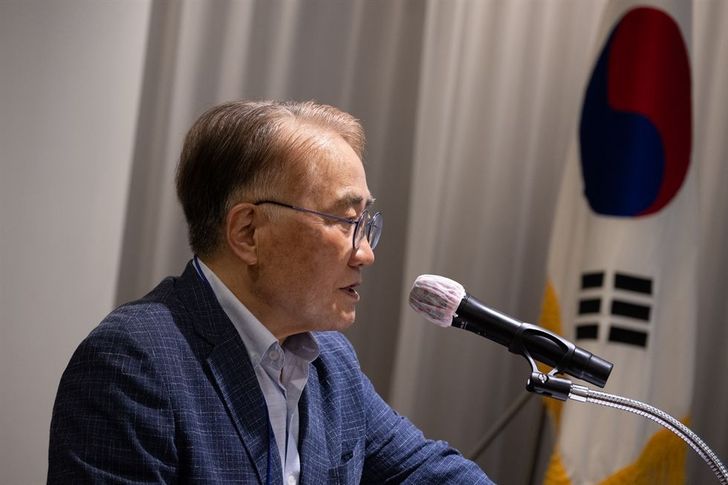
Society of Ieodo Research President Koh Choong-suk speaks during the 7th Ieodo International Seminar, hosted jointly by the Jeju-based think tank and The Korea Times on Jeju Island, June 15. Korea Times photo by Choi Won-suk
Ieodo, Korea's southernmost submerged reef under dispute
Ieodo, internationally known as Socotra Rock, is a submerged rock 149 kilometers southwest of Marado, the country's southernmost island that Jeju islanders once believed to be the home of the spirits of dead fishermen. The reef, which falls in the overlap of the Korean and Chinese Exclusive Economic Zones (EEZs) appears only when waves hit over 10 meters high.
Ieodo was formerly recognized to be in international waters until 1996, when the United Nations Convention of the Law of the Sea (UNCLOS), an international law ratified 168 by U.N. member states in 1982 stipulating that submerged rocks can't be claimed by any country as territory, extended the maximum reach of EEZs to 370 kilometers, serving as the prelude for the international territory dispute.
Given that Ieodo is 287 kilometers east of China's Sheshan Dao, the Chinese government raised a territorial dispute with the Korean government in 1996 as it started insisting on its jurisdiction of the reef, a case similar to Beijing's other territorial disputes in the East China Sea with Japan and South China Sea with the Philippines and Vietnam.
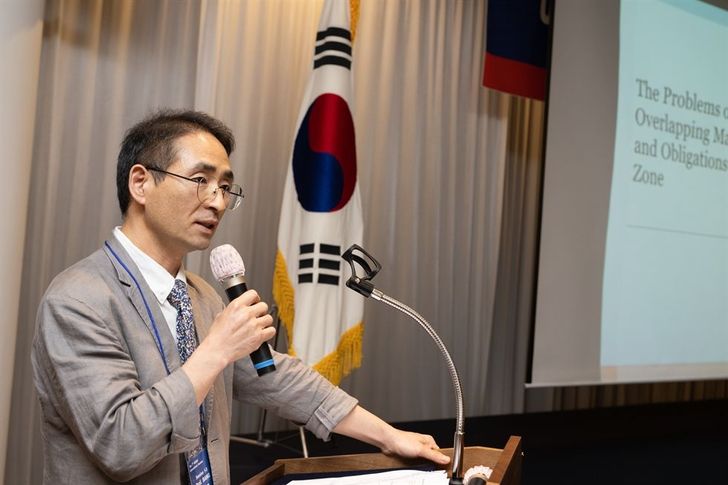
Bang Ho-sam, a professor at Chonnam National University, speaks during the 7th Ieodo International Seminar on Jeju Island, June 15. Korea Times photo by Choi Won-suk
Since 1996, Seoul and Beijing have made no progress in negotiations on drawing the line for the economic zone even after more than 20 rounds of talks.
Korea has been arguing based on the “median line” principle, which means that maritime boundaries should conform to a median line equidistant from the shore of concerned countries and argued that the rocks are located on its continental shelf, closers to the Korean Peninsula than to neighboring China and Japan.
However, China claims that Ieodo, which it calls Suyan, falls under its jurisdiction as the seabed topography extends from China's mainland.
In 2006, the two governments reached an agreement on the issue of the jurisdiction over the sea area. Since Ieodo is not an island but an underwater reef, the dispute's focus moved to which country has claim to the sea. From then on, Korea sought logical and legal basis to prove that Ieodo is within a Korean maritime zone.
Problems and prospects on overlapping maritime claims
Experts said the UNCLOS, aimed at setting order in the international maritime disputes, is ambiguous and not detailed enough to prescribe conflicts where two countries claim sovereign rights over overlapping maritime zones.
Thus, it is difficult for the concerned countries to clearly decide what kind of activities to conduct in conflicted areas.
“In overlapping zones, states concerned should act based on mutual understanding and cooperation,” said Bang Ho-sang, a professor at Chonnam National University.
“It is anticipated that there will be no drastic changes to the existing legal regime in the West Sea and East Sea. … However, it is desirable for states concerned to clearly discuss permissible and impermissible acts regarding marine activities other than fisheries in overlapping zones and issue a declaration on the code of conduct in accordance with the spirit of mutual cooperation in overlapping zones.”
The legal cases between Guyana and Suriname in 2007 and Ghana and Cote d'Ivoire in 2017 show that “certain activities such as seismic exploration can also occur in an undelimited maritime area” if it does not cause permanent physical changes to the marine environment, he explained.
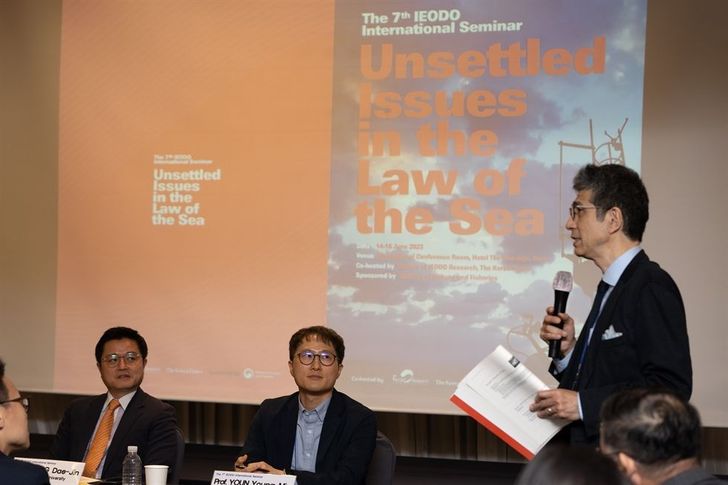
Waseda University professor Taisaku Ikeshima speaks during a panel discussion of the 7th Ieodo International Seminar on Jeju Island, June 15. Korea Times photo by Choi Won-suk
Citing the two international court cases that Bang mentioned along with a more recent one between Somalia and Kenya in 2021, Park Young-kil of the Korea Maritime Institute claimed that the UNCLOS is not clear enough to settle differing economic interests of concerned countries.
Also, viewing that it will be difficult to bring the Ieodo case to the international court and challenge China's assertive activities, Park suggested that Korea should find alternative measures based on the principle of reciprocity.
Chi-ting Tsai, a professor at the National Taiwan University, presented how Taiwan is also engaged in maritime disputes with China that cannot yet be solved with international law and discussed legal framework surrounding the prohibited and restricted waters in the Taiwan Strait.
Wen-cheng Lin from the National Sun Yat-sen University in Taiwan discussed China's maritime gray-zone operations against Taiwan and called for democratic nations to work together in strengthening maritime security.
Also, based on such discussions on East Asian maritime disputes, the international community should form a perspective on sustainable fishery and environmental issues, such as the rising sea level caused by climate changes affecting maritime resources and jurisdictions, according to professors Taisaku Ikeshima and Makoto Seta, both from Waseda University in Japan.
The keynote speech was given by Keimyung University professor Lee Ji-yong and panel discussion and presentations were moderated in English and Korean by Inha Law School professor Kim Hyun-soo. Other participants of the discussion included Jeju Law School professor Choi Jee-hyun, Wonju Halla University professor Jung Dae-jin, Lee Sang-hyun from Daejeon University, Kunsan National University professor Youn Young-min, and Society of Ieodo Research researcher Kang Eun-jeong.