Opposition party, civic groups up in arms over Japan's imminent Fukushima wastewater discharge

Activists stage a protest in front of the Japanese Embassy in Seoul, Tuesday, urging the Japanese government to revoke its decision to start releasing treated wastewater from the Fukushima nuclear power plant into the Pacific Ocean, Thursday. Yonhap
Yoon administration says it sees 'no scientific, technical problems' in release plan
By Ko Dong-hwan
Korea's main opposition party and civic groups have pledged to hold an all-out protest against Japan's announcement, Tuesday, to release treated wastewater from the Fukushima Daiichi Nuclear Power Plant into the Pacific Ocean starting Thursday.
The Democratic Party of Korea (DPK) denounced Japan's decision by staging rallies at the National Assembly and in front of the Japanese Embassy in Seoul to condemn the decision.
“Japan made the vicious decision to discharge contaminated water into the ocean, which belongs to all humans, without scientific proof, understanding from neighboring countries or agreement by the Japanese people,” DPK Chairman Rep. Lee Jae-myung said.
The party said in another statement, “The war criminal nation, after threatening the world in the past war, has once again emerged as a global troublemaker by deciding to release the radioactive water into the ocean.”
The DPK's response came after Japanese Prime Minister Fumio Kishida held a Cabinet meeting and announced the discharge will be carried out on the set day if there are no complications caused by the weather or ocean conditions. While Tokyo Electric Power Company Holdings (TEPCO), the operator of the power plant, plans to discharge the water for the next 30 years through a newly-built underground pipeline, the Japanese government and the International Atomic Energy Agency (IAEA) said they will monitor the process on-site. The nuclear watchdog opened a field office in Japan in July.
The DPK said the Japanese government wants to dump the water into the ocean so that it can save costs instead of having to store it on land.
“All countries that are connected to Japan via ocean now must face the unimaginable risks caused by the radioactive water discharge,” the party statement said.
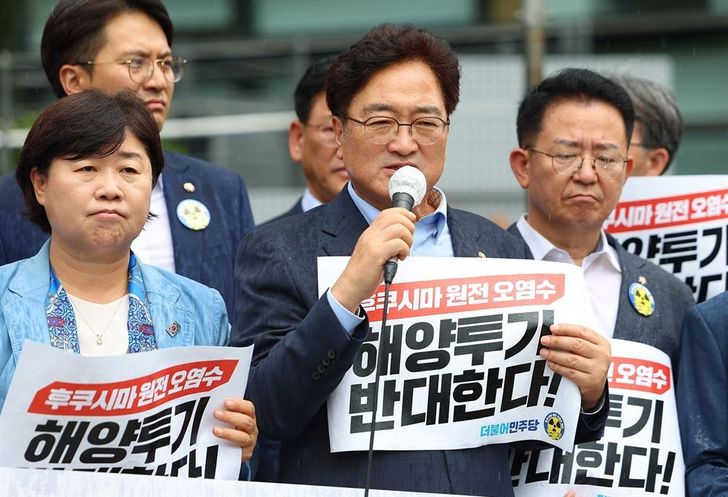
Rep. Woo Won-shik of the main opposition Democratic Party of Korea speaks during a rally in front of the Embassy of Japan in Seoul, Tuesday, protesting the Japanese government's decision to release treated wastewater from the crippled Fukushima nuclear plant into the Pacific Ocean starting Thursday. Yonhap
The DPK's criticism also pointed to the Yoon Suk Yeol administration and the ruling People Power Party (PPP) for not protesting the discharge but instead “abetting the Japanese government.”
“The Yoon administration is encouraging the Japanese government when the release plan is even doubted by local citizens in Japan,” the DPK said.
Civic groups joined the protest.
Greenpeace denounced Japan's decision, saying it can cause “irreversible disaster,” and is “the result of the Japanese government's irresponsibility and the Korean government's disregard.”
“Releasing radioactive materials, produced from the nuclear plant accident, into the ocean is an unprecedented event in Earth's history. It could cause serious danger to the marine ecosystem and human safety,” it said in a statement.
“Japan chose a false solution instead of talking about reality frankly … It should stop the act that infringes on the basic human rights of people in Fukushima, nearby countries and the entire Asia-Pacific region.”
Civic groups and members of the agro-fishery industry on Jeju Island called on Japan to halt its release plan and the Yoon administration to lodge a strong protest.
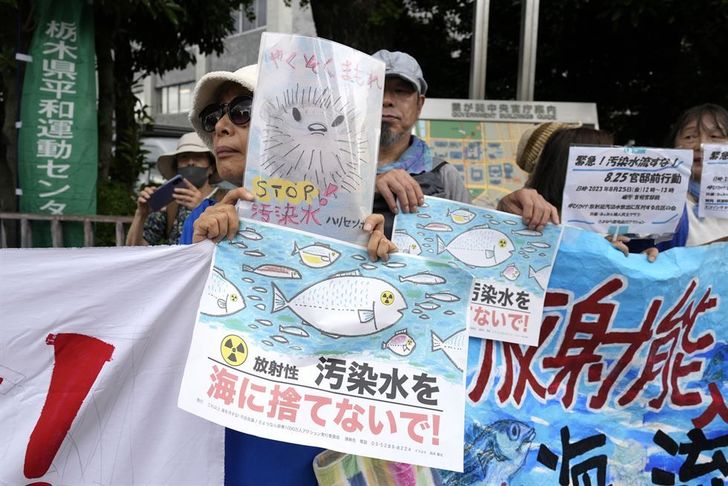
Protesters in Japan hold banners reading "Don't discharge contaminated water into the sea!" during a rally in front of the country's Prime Minister's official residence as Prime Minister Fumio Kishida was holding a ministerial meeting about the release of treated water from the crippled Fukushima nuclear power plant into the sea, in Tokyo, Tuesday. EPA-Yonhap
“Releasing contaminated water into the ocean is an act of terrorism that cannot be understood for any reason,” they said in a statement. “It doesn't comply with international law, goes against environmental justice and damages the sustainability of the human community.”
Upon Japan's announcement, the prime minister's office in Korea said that it saw no problem with the scientific or technical aspects of the discharge plan. The Korean authority added, however, that it does not agree with or support that plan.
“If the Japanese government deviates from the plan even by an inch, the Korean government will deem it a threat to our citizens' safety and request them to stop the discharge immediately,” said Park Ku-yeon, the first deputy chief of the office.
The PPP has also requested the Japanese government to be cautious about the discharge, according to Park.
The IAEA said it will regularly provide the Korean government with up-to-date information about the discharge and facilitate visits by Korean experts to the agency's office in Fukushima.
The agency's director-general Rafael Mariano Grossi said the IAEA and the Korean government have agreed to establish the IAEA-ROK Fukushima Information Mechanism before Thursday to stress the importance of transparency.
Following Japan's announcement, the Chinese government accused Tokyo of “arbitrarily dumping nuclear-contaminated” water into the ocean.
The Hong Kong government also responded to the announcement, with chief executive John Lee instructing his officials to “immediately activate” import curbs on some Japanese food products.
“I express my strong objections,” Lee said on Facebook, Tuesday. He said the discharge plan was “irresponsible” as it disregards safety and environmental concerns.