Korean Theater of Kazakhstan carries legacy of independence fighter

“40 Days of Miracle,” a play jointly produced by the State Republican Academic Korean Theater of Musical Comedy of Kazakhstan and the Che Company of Korea, is staged at the National Assembly Member's Hall in Seoul, Aug. 16. The play portrays the deportation of Koreans from Russia to Kazakhstan in the 1930s. Courtesy of Yang Byung-man
By Kwon Mee-yoo
The Korean Theater of Kazakhstan, the oldest theater troupe of ethnic Koreans, revived the resilient history of Koryoin, or ethnic Koreans in the post-Soviet states, as well as the life of General Hong Beom-do, a commander-in-chief of the Korean Independence Army in the 1920s in their latest work “40 Days of Miracle.”
As part of a tour in Korea to commemorate the second anniversary of the return of General Hong's remains and the 90th anniversary of the theater, the troupe staged “40 Days of Miracle.” This play traces the deportation of Koreans from Russia to Kazakhstan, with performances at the National Assembly Member's Hall in Seoul, Aug. 16, and Daejeon Seogu Cultural Center, Aug. 18.
"This play relates to the history of Koreans in Kazakhstan and the theater itself. It also has ties to General Hong Beom-do, who was known to have worked as a janitor at the theater in his later days," Kim Yelena, director of the Korean Theater, told The Korea Times during an interview at a rehearsal room in Seoul, Aug. 15.
Officially known as the State Republican Academic Korean Theater of Musical Comedy, it is the oldest theater troupe of ethnic Koreans. Originally established in 1932 by a group of Korean amateur actors in Vladivostok, Russia; in 1937, the theater was deported to Central Asia, along with the rest of the Korean population of the Russian Far East, under Stalin's ethnic cleansing policies.
It first settled in the Kazakh city of Kyzyl-Orda, then Ushtobe in 1942, and finally found its current home in Almaty in 1968.
The newest production, "40 Days of Miracle," premiered in Almaty in June before traveling to Korea.
"We've been developing this production for more than three years. The story centers on the Korean independence movement and includes significant events like the famous Battle of Bongo-dong. It also portrays the arduous journey of Koreans as they were relocated from the Russian Far East to Central Asia by train,” Kim explained.
She emphasized the play's universal appeal in Kazakhstan and shared the poignant audience response during its Almaty run.
"Kazakhstan is home to over 100 ethnic groups and Koreans were not the only ethnicity that was deported here. During the play's run in Almaty, numerous Kazakhs who are not of Korean descent were drawn to the performance, leading to sold-out shows and the need for additional temporary seating. The emotional impact was profound, with many in the audience moved to tears."
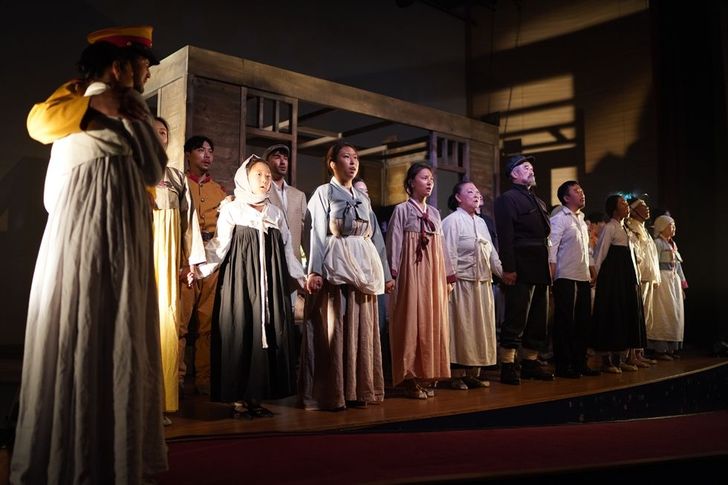
“40 Days of Miracle,” a play jointly produced by the State Republican Academic Korean Theater of Musical Comedy of Kazakhstan and the Che Company of Korea, is staged at the National Assembly Member's Hall in Seoul, Aug. 16. The play portrays the deportation of Koreans from Russia to Kazakhstan in the 1930s. Courtesy of Yang Byung-man
Korean director Kang Tea-sik from the Che Company teamed up with the Kazakh theater to produce the play as part of an ongoing partnership and it features a blended cast and staff of both Koreans and Kazakhs.
“We staged this play in Korea to showcase not just the history of Koryoin, but also the shared history that we have with Koreans," she said.
The director also highlighted a train scene portraying the grueling journey of Koreans to Central Asia as the most emotional part of the play.
"Even I cry every time I watch this scene. A nation that forgets its past has no future,” Kim said.
"The play also explores how the indigenous Kazakhs welcomed those who were deported to Central Asia, reflecting their broad-mindedness."
Besides the artistic contributions, the Korean Theater serves as a cultural bridge between Korea and Kazakhstan. They tour Korea regularly with a mixed Kazakh and Korean repertoire.
"In the past, we mostly presented Kazakh plays to introduce Kazakhstan's traditions and culture to Korea. Now, we try to do more collaborations."
Kim regards visits to Korea as a precious opportunity for the troupe to connect with their roots.
"When we visit Korea, the members visit museums and watch traditional Korean music performances to know more about their heritage," she said.
The troupe's upcoming project, "Tengri Tagh," also developed in collaboration with Kang, will delve into the legend of Korea's founder Dangun, exploring the beginning of Korea through the relationship between the bear and tiger tribes and how Dangun edified them.
Slated for a November premiere in Almaty, it will celebrate the 30th anniversary of diplomatic relations between Korea and Kazakhstan, and feature Korean, Koryoin and Kazakh actors.