Camp David summit expected to strengthen united front against N. Korea

President Yoon Suk Yeol talks with U.S. President Joe Biden and Japanese Prime Minister Fumio Kishida during their meeting on the sidelines of the Group of Seven summit in Hiroshima, Japan, May 21. Joint Press Corps
By Nam Hyun-woo
The trilateral summit between South Korea, the United States and Japan scheduled for Friday (local time) at the U.S. presidential retreat of Camp David is anticipated to be an inflection point where the three countries can set up a united front against North Korea's increasing missile and nuclear threats.
President Yoon Suk Yeol has alluded to the fact that the three countries are committed to the strongest-ever level of trilateral security cooperation, by opening up the possibility of expanding the concept of extended deterrence between Seoul and Tokyo.
Yoon will depart for the U.S. today for the summit, after attending his father's funeral, who died on Tuesday.
In a written interview with Bloomberg published on Wednesday, Yoon said, “The complete denuclearization of North Korea is a clear and consistent goal of the international community, including the Republic of Korea and the United States.”
He also said: “Regarding extended deterrence, we are also open to separate consultations among the Republic of Korea, the United States and Japan.”
After Yoon's summit with U.S. President Joe Biden in April, the two leaders announced the Washington Declaration to upgrade the U.S.' extended deterrence for South Korea against the North's nuclear threats. Since then, the U.S. has deployed its nuclear submarines near the Korean Peninsula, and set up a Nuclear Consultative Group that enhances Seoul's understanding of the U.S.' nuclear planning.
However, Seoul remained cautious about Japan's participation in the platform, with multiple senior national security officials denying Japan's involvement due to the existing bilateral defense arrangements between Seoul and Washington and Tokyo and Washington.
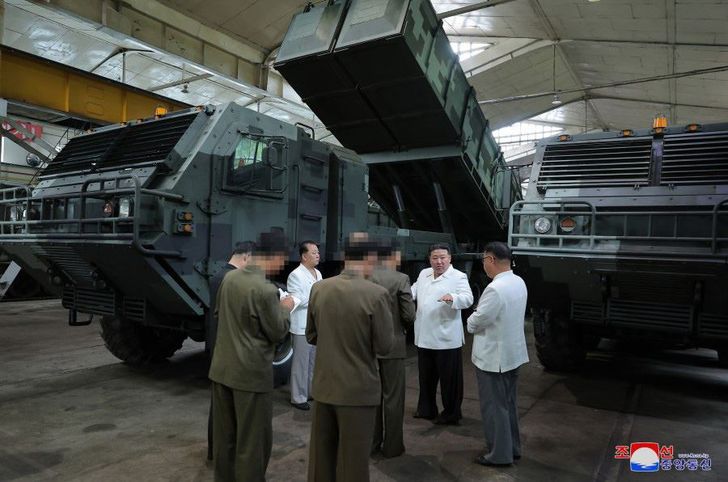
North Korean leader Kim Jong-un inspects a munitions factory at an undisclosed location in North Korea in this photo released by the North's official Korean Central News Agency, Monday. Yonhap
As Yoon acknowledged the possibility of “separate consultations,” it comes as a strong signal that the three countries will set up a united front against the North's threats, and this could take shape via an official announcement at the upcoming summit, which is envisaged as the “Camp David Principles.”
U.S. news website Axios reported that Yoon, Biden and Japanese Prime Minister Fumio Kishida “are preparing to announce the Camp David Principles, a new set of protocols to govern their relationship.”
The principles are expected to contain articles on regular joint military exercises by the three countries, regular meetings of their national security advisers and an early warning system regarding North Korea's missiles.
By stipulating these principles in a written document, the leaders appear to be seeking continued trilateral security cooperation, even if relations between Seoul and Tokyo become aggravated at some point down the line.
“With the summit, the three-country summit could be elevated to a trilateral mechanism comparable to AUKUS (the trilateral security pact between the U.S., the United Kingdom and Australia) or the Quadrilateral Security Dialogue (a strategic dialogue between the U.S., Japan, India and Australia,” said Go Myong-hyun, a senior fellow at the Asan Institute for Policy Studies.
“It will be the three countries' strategic dialogue at ordinary times, meaning their strategic interests are already aligned. The dialogue will also signal the end of an era in which South Korea expresses a certain desire to the U.S. in return for certain incentives.”
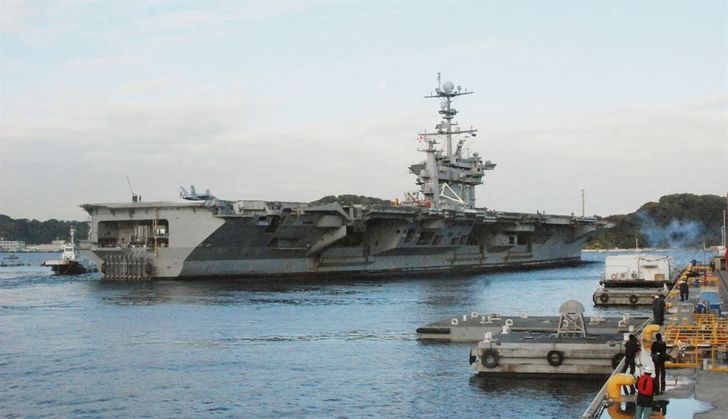
The nuclear-powered USS George Washington leaves Yokosuka U.S. naval base in Japan, Nov. 24, 2010. Reuters-Yonhap
Under this aim, Yoon has been building up his rhetoric on the importance of trilateral security cooperation.
During his National Liberation Day speech Tuesday, Yoon highlighted the importance of the United Nations Command (UNC) in the face of “the forces of communist totalitarianism,” as it stands as one of the practical reasons why the trilateral security cooperation arrangement is important in deterring the North's threats and other global security issues.
“In order to fundamentally block North Korea's nuclear and missile threats, the Republic of Korea, the United States and Japan must closely cooperate on reconnaissance assets and share North Korea's nuclear weapons and missiles data in real time,” Yoon said.
“The seven rear bases provided to the UNC by the government of Japan serve as the greatest deterrent, which keeps the North from invading the South.”
While the UNC headquarters is located in South Korea, Japan provides seven UNC-rear bases, and approximately 50,000 U.S. military personnel are deployed there. In case of an emergency on the peninsula, assets and forces at those bases can be deployed to South Korea and the bases will be managing the flow of U.N. sending states' forces.
On Aug. 10, Yoon had a meeting with UNC Commander Gen. Paul LaCamera at the presidential office, and told him that “the North still views the UNC as the biggest obstacle of its attempt to communize South Korea.”
“The UNC plays a role in immediately and automatically providing the military power of U.N. member states without a separate Security Council resolution,” Yoon said. “This is why North Korea and its followers constantly advocate for the dismantling of the United Nations Command in relation with the end-of-war declaration.”
The end-of-war declaration was pursued during the previous liberal Moon Jae-in administration, as an attempt to bring North Korea back to denuclearization talks, but has been a focus of criticism among conservatives, as it may entail the dismantling of the United Nations Command.